State Key Laboratory of Plateau Ecology and Agriculture of Qinghai University, Key Laboratory of Spring Rapeseed Genetic Improvement, Spring Rapeseed Research and Development Center of Qinghai Province, Qinghai Academy of Agricultural and Forestry Sciences, Qinghai University, Xining, 810016, Qinghai, China.
BMC Plant Biol. 2020 Nov 9;20(1):511. doi: 10.1186/s12870-020-02710-y.
Chlorophyll is the most important factor enabling plants to absorb, transfer and transform light energy and plays an important role in yield formation. Brassica napus is one of the most important oil crops. Breeding Brassica napus for high light efficiency by improving photosynthetic efficiency has considerable social and economic value. In Brassica napus, there have been studies of the initial location of chlorophyll in seed embryos and pericarps, but there are few reports on the fine mapping of chlorophyll QTLs. We constructed near-isogenic lines (NIL), fine-mapped a chlorophyll locus, and evaluated the effect of this dominant locus on agronomic traits.
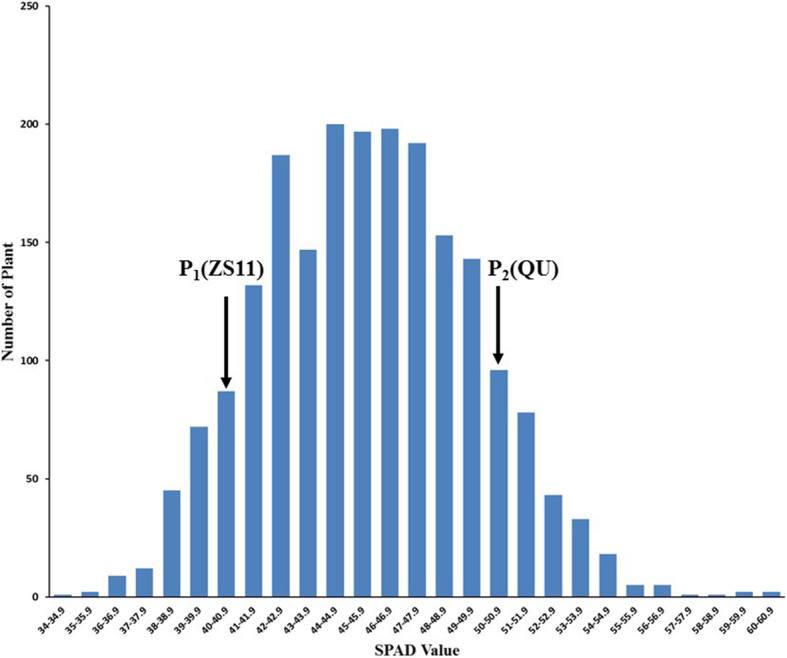
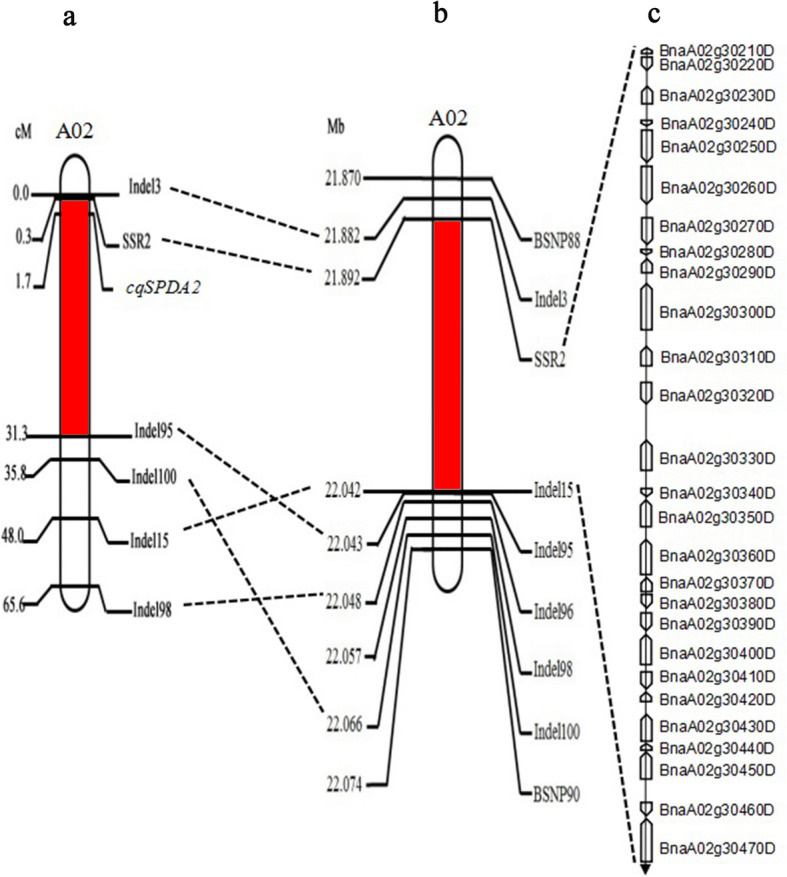
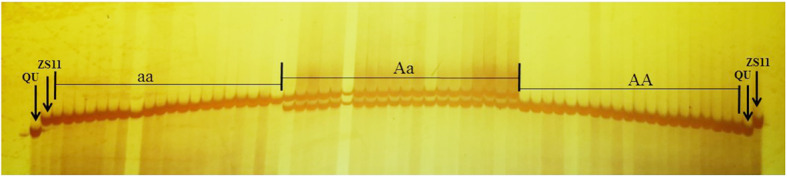
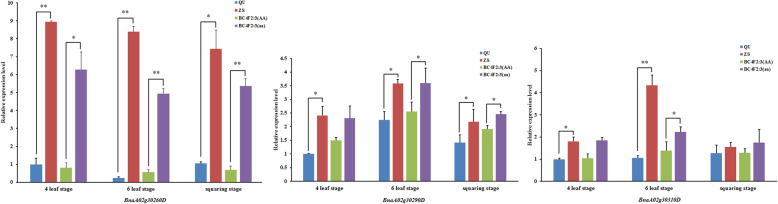
The cqSPDA2 locus was mapped to an interval of 21.87-22.91 Mb on the chromosome A02 of Brassica napus using doubled haploid (DH) lines. To fine-map cqSPDA2, we built NIL and designed Indel primers covering the mapping interval. The 469 individuals in the BCF population were analyzed using these indel primers. Among these indel primers, 15 could narrow the mapping interval to 188 kb between Indel3 and Indel15. Next, 16 indel primers and 19 SSR primers were designed within the new narrower mapping interval, and 5 of the primer-amplified fragments were found to be polymorphic and tightly linked to the cqSPDA2 locus in the BCF population. The mapping interval was narrowed to 152 kb on A02 between SSR2 and Indel15. By gene expression analysis, we found three annotated genes in the mapping interval, including BnaA02g30260D, BnaA02g30290D and BnaA02g30310D, which may be responsible for chlorophyll synthesis.
The locus cqSPDA2, a dominant QTL for chlorophyll content in Brassica napus, was fine-mapped to a 21.89-22.04 Mb interval on A02 Three annotated genes (BnaA02g30260D, BnaA02g30290D and BnaA02g30310D) that may be responsible for chlorophyll synthesis were found.
叶绿素是植物吸收、传递和转化光能最重要的因素,对产量形成起着重要作用。油菜是最重要的油料作物之一。通过提高光合作用效率来培育高光效油菜具有重要的社会和经济价值。在油菜中,已经有研究报道了叶绿素在种子胚和种皮中的初始位置,但关于叶绿素 QTL 的精细图谱的报道较少。我们构建了近等基因系(NIL),精细定位了一个叶绿素基因座,并评估了这个显性基因座对农艺性状的影响。
利用双单倍体(DH)系,将 cqSPDA2 基因座定位到油菜 A02 染色体的 21.87-22.91 Mb 区间。为了精细定位 cqSPDA2,我们构建了 NIL,并设计了覆盖该定位区间的 Indel 引物。利用这些 Indel 引物对 BCF 群体中的 469 个个体进行了分析。在这些 Indel 引物中,有 15 个引物可以将定位区间缩小到 Indel3 和 Indel15 之间的 188 kb。接下来,在新的更窄的定位区间内设计了 16 个 Indel 引物和 19 个 SSR 引物,在 BCF 群体中发现 5 个引物扩增片段与 cqSPDA2 基因座紧密连锁并表现出多态性。定位区间进一步缩小到 A02 上 SSR2 和 Indel15 之间的 152 kb。通过基因表达分析,我们在定位区间内发现了三个注释基因,包括 BnaA02g30260D、BnaA02g30290D 和 BnaA02g30310D,它们可能与叶绿素合成有关。
油菜中叶绿素含量的主效 QTL 位点 cqSPDA2 被精细定位到 A02 上的 21.89-22.04 Mb 区间。发现了三个可能与叶绿素合成有关的注释基因(BnaA02g30260D、BnaA02g30290D 和 BnaA02g30310D)。