Department of Biosystems Science and Engineering, ETH Zurich, Zürich, Switzerland.
Centre for Integrative Neuroplasticity (CINPLA), University of Oslo, Oslo, Norway.
Elife. 2020 Nov 10;9:e61834. doi: 10.7554/eLife.61834.
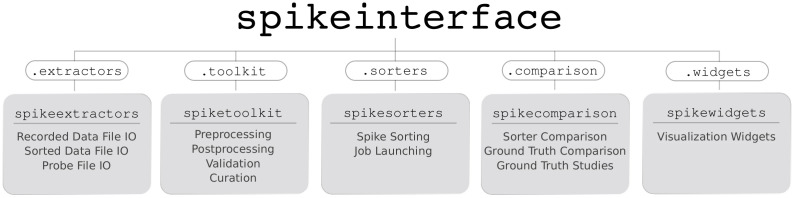
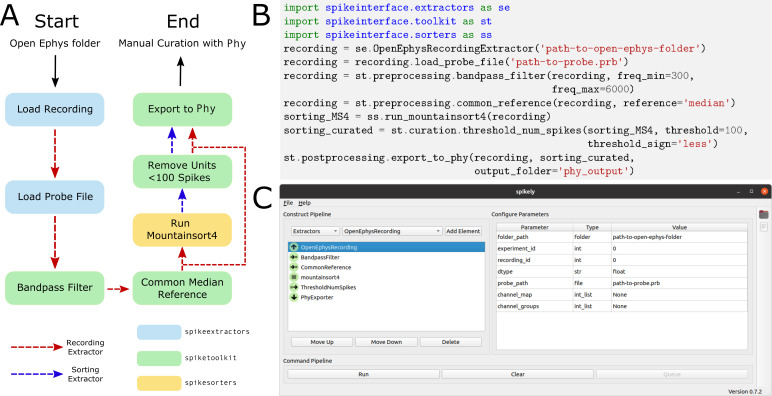
Much development has been directed toward improving the performance and automation of spike sorting. This continuous development, while essential, has contributed to an over-saturation of new, incompatible tools that hinders rigorous benchmarking and complicates reproducible analysis. To address these limitations, we developed SpikeInterface, a Python framework designed to unify preexisting spike sorting technologies into a single codebase and to facilitate straightforward comparison and adoption of different approaches. With a few lines of code, researchers can reproducibly run, compare, and benchmark most modern spike sorting algorithms; pre-process, post-process, and visualize extracellular datasets; validate, curate, and export sorting outputs; and more. In this paper, we provide an overview of SpikeInterface and, with applications to real and simulated datasets, demonstrate how it can be utilized to reduce the burden of manual curation and to more comprehensively benchmark automated spike sorters.
许多研究致力于提高 Spike 排序的性能和自动化水平。这种持续的发展虽然是必要的,但也导致了新的、不兼容的工具过度饱和,从而阻碍了严格的基准测试和复杂的可重复分析。为了解决这些限制,我们开发了 SpikeInterface,这是一个 Python 框架,旨在将现有的 Spike 排序技术统一到一个代码库中,并方便不同方法的直接比较和采用。通过几行代码,研究人员可以重复运行、比较和基准测试大多数现代 Spike 排序算法;预处理、后处理和可视化细胞外数据集;验证、整理和导出排序输出;等等。在本文中,我们概述了 SpikeInterface,并通过对真实和模拟数据集的应用,展示了如何利用它来减轻手动整理的负担,并更全面地基准测试自动化 Spike 排序器。