Omelyanchik Alexander, Levada Kateryna, Pshenichnikov Stanislav, Abdolrahim Maryam, Baricic Miran, Kapitunova Anastasiya, Galieva Alima, Sukhikh Stanislav, Astakhova Lidiia, Antipov Sergey, Fabiano Bruno, Peddis Davide, Rodionova Valeria
Institute of Physics, Mathematics and Information Technology, Immanuel Kant Baltic Federal University, 236041 Kaliningrad, Russia.
Institute of Structure of Matter-CNR, 00016, Monterotondo Stazione, 00015 Rome, Italy.
Materials (Basel). 2020 Nov 6;13(21):5014. doi: 10.3390/ma13215014.
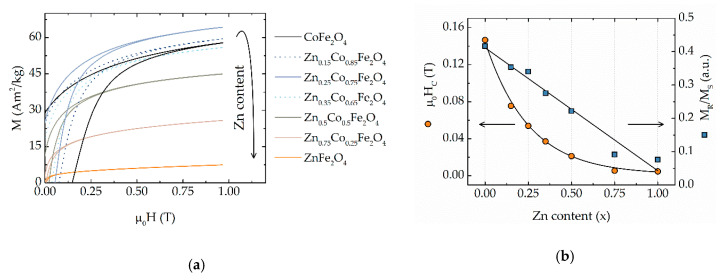
Spinel ferrite magnetic nanoparticles have attracted considerable attention because of their high and flexible magnetic properties and biocompatibility. In this work, a set of magnetic nanoparticles of cobalt ferrite doped with zinc was synthesized via the eco-friendly sol-gel auto-combustion method. Obtained particles displayed a room-temperature ferromagnetic behavior with tuned by chemical composition values of saturation magnetization and coercivity. The maximal values of saturation magnetization ~74 Am/kg were found in cobalt ferrite nanoparticles with a 15-35% molar fraction of cobalt replaced by zinc ions. At the same time, the coercivity exhibited a gradually diminishing trend from ~140 to ~5 mT whereas the concentration of zinc was increased from 0 to 100%. Consequently, nanoparticles produced by the proposed method possess highly adjustable magnetic properties to satisfy the requirement of a wide range of possible applications. Further prepared nanoparticles were tested with bacterial culture to display the influence of chemical composition and magnetic structure on nanoparticles-bacterial cell interaction.
尖晶石铁氧体磁性纳米粒子因其高且灵活的磁性和生物相容性而备受关注。在这项工作中,通过环保的溶胶 - 凝胶自燃烧法合成了一组掺杂锌的钴铁氧体磁性纳米粒子。所获得的粒子表现出室温铁磁行为,其饱和磁化强度和矫顽力可通过化学成分值进行调节。在钴被锌离子取代摩尔分数为15 - 35%的钴铁氧体纳米粒子中发现了饱和磁化强度的最大值74 Am/kg。同时,随着锌浓度从0增加到100%,矫顽力呈现出从140到~5 mT逐渐减小的趋势。因此,通过该方法制备的纳米粒子具有高度可调节的磁性,以满足广泛可能应用的需求。进一步对制备的纳米粒子进行细菌培养测试,以展示化学成分和磁性结构对纳米粒子 - 细菌细胞相互作用的影响。