Department of Chromosome Biology, Max Perutz Laboratories, University of Vienna, A-1030 Vienna, Austria.
Department of Chromosome Biology, Max Perutz Laboratories, University of Vienna, A-1030 Vienna, Austria
J Cell Sci. 2020 Nov 30;133(22):jcs253724. doi: 10.1242/jcs.253724.
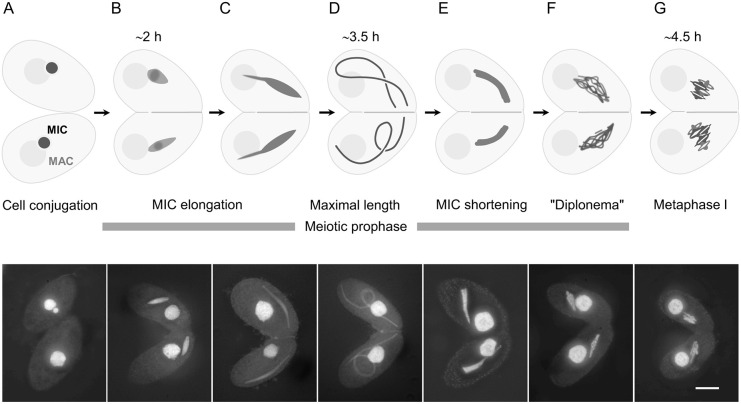
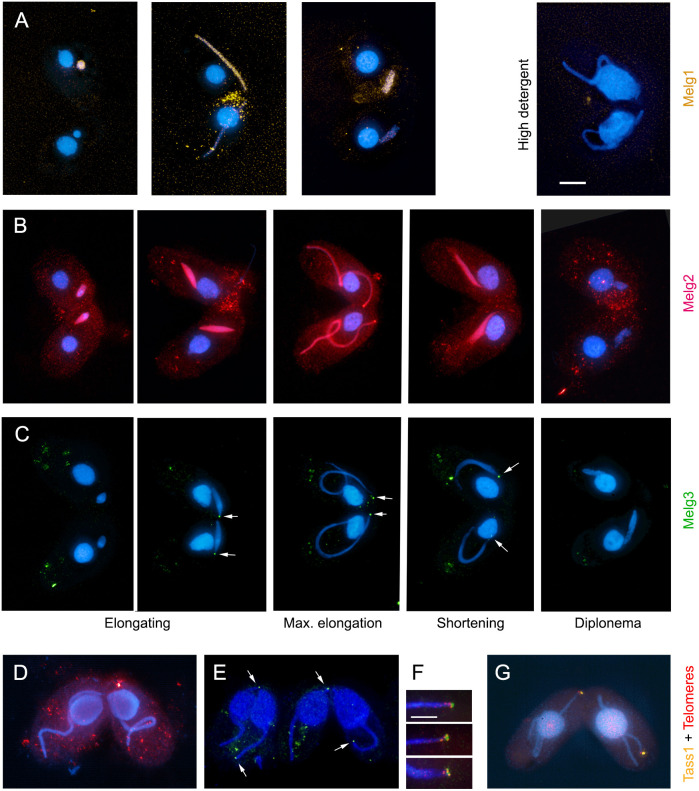
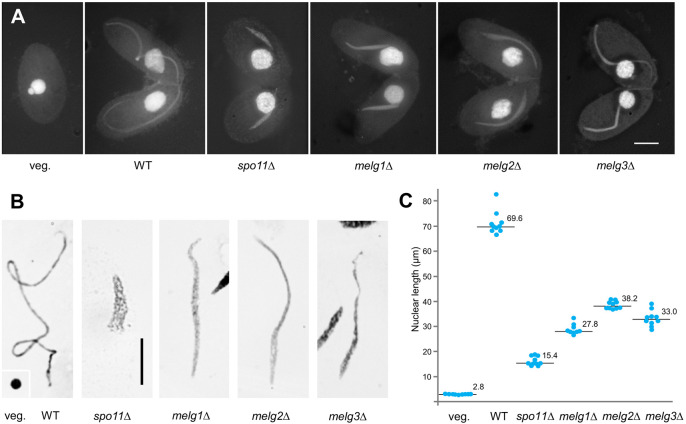
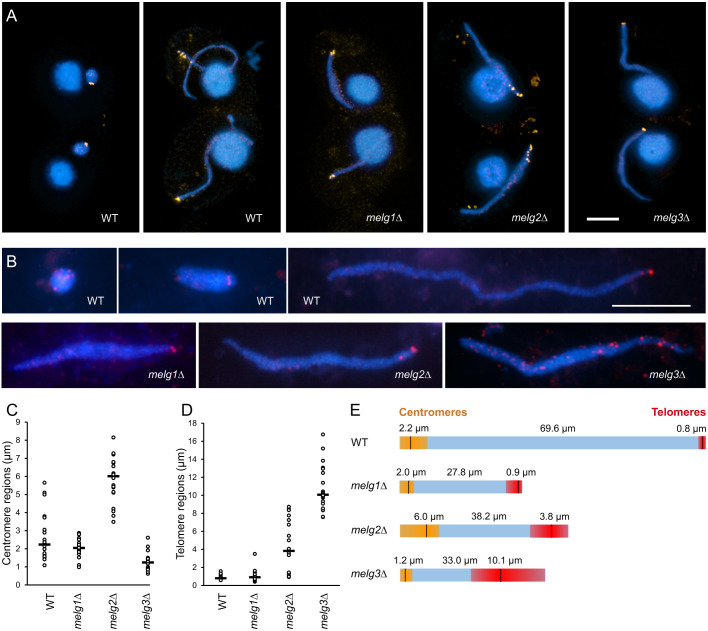
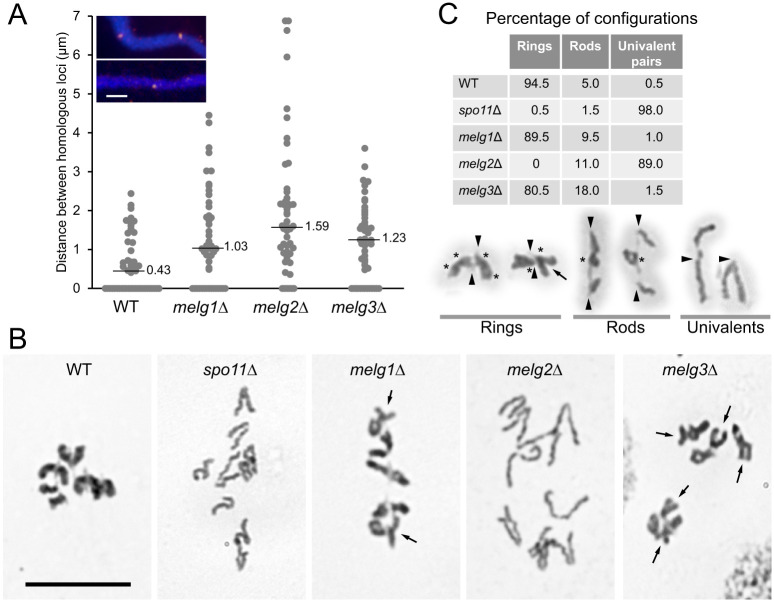
In most eukaryotes, the meiotic chromosomal bouquet (comprising clustered chromosome ends) provides an ordered chromosome arrangement that facilitates pairing and recombination between homologous chromosomes. In the protist , the meiotic prophase nucleus stretches enormously, and chromosomes assume a bouquet-like arrangement in which telomeres and centromeres are attached to opposite poles of the nucleus. We have identified and characterized three meiosis-specific genes [meiotic nuclear elongation 1-3 ()] that control nuclear elongation, and centromere and telomere clustering. The Melg proteins interact with cytoskeletal and telomere-associated proteins, and probably repurpose them for reorganizing the meiotic prophase nucleus. A lack of sequence similarity between the proteins responsible for telomere clustering and bouquet proteins of other organisms suggests that the bouquet is analogous, rather than homologous, to the conserved eukaryotic bouquet. We also report that centromere clustering is more important than telomere clustering for homologous pairing. Therefore, we speculate that centromere clustering may have been the primordial mechanism for chromosome pairing in early eukaryotes.
在大多数真核生物中,减数分裂染色体花束(由聚集的染色体末端组成)提供了一种有序的染色体排列方式,有助于同源染色体之间的配对和重组。在原生动物中,减数分裂前期细胞核会极大地拉伸,染色体呈现出类似于花束的排列方式,端粒和着丝粒附着在细胞核的相对极上。我们已经鉴定和表征了三个减数分裂特异性基因[减数分裂核伸长 1-3(MEI3)],它们控制核伸长以及着丝粒和端粒的聚集。Melg 蛋白与细胞骨架和端粒相关蛋白相互作用,可能将它们重新用于重组减数分裂前期核。负责端粒聚集的蛋白和其他生物的花束蛋白之间缺乏序列相似性表明, 花束类似于而非同源于保守的真核花束。我们还报告说,着丝粒聚类对于同源配对比端粒聚类更为重要。因此,我们推测着丝粒聚类可能是早期真核生物染色体配对的原始机制。