Department of Psychiatry, Faculty of Health, University of California San Diego, La Jolla, CA, 92093-0603, USA.
Temerty Centre for Therapeutic Brain Intervention, Centre for Addiction and Mental Health, Toronto, ON, M5T1R8, Canada.
Transl Psychiatry. 2020 Nov 10;10(1):392. doi: 10.1038/s41398-020-01042-7.
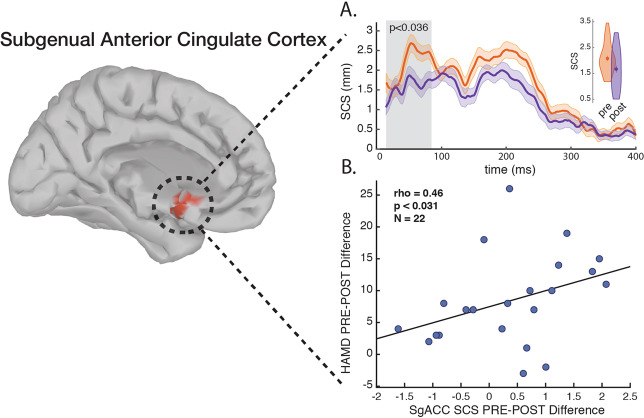
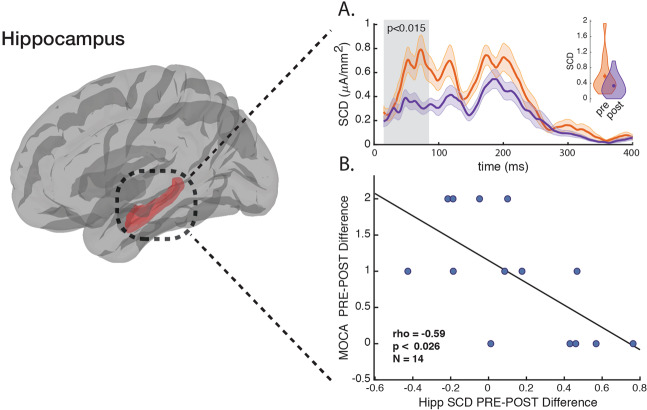
Aberrant connectivity between the dorsolateral prefrontal cortex (DLPFC) and the subgenual cingulate cortex (SGC) has been linked to the pathophysiology of depression. Indirect evidence also links hippocampal activation to the cognitive side effects of seizure treatments. Magnetic seizure therapy (MST) is a novel treatment for patients with treatment resistant depression (TRD). Here we combine transcranial magnetic stimulation with electroencephalography (TMS-EEG) to evaluate the effects of MST on connectivity and activation between the DLPFC, the SGC and hippocampus (Hipp) in patients with TRD. The TMS-EEG was collected from 31 TRD patients prior to and after an MST treatment trial. Through TMS-EEG methodology we evaluated significant current scattering (SCS) as an index of effective connectivity between the SGC and left DLPFC. Significant current density (SCD) was used to assess activity at the level of the Hipp. The SCS between the SGC and DLPFC was reduced after the course of MST (p < 0.036). The DLPFC-SGC effective connectivity reduction correlated with the changes in Hamilton depression score pre-to-post treatment (R = 0.46; p < 0.031). The SCD localized to the Hipp was reduced after the course of MST (p < 0.015), and the SCD change was correlated with montreal cognitive assessment (MOCA) scores pre-post the course of MST (R = -0.59; p < 0.026). Our findings suggest that MST treatment is associated with SGC-DLPFC connectivity reduction and that changes to cognition are associated with Hipp activation reduction. These findings demonstrate two distinct processes which drive efficacy and side effects separately, and might eventually aid in delineating physiological TRD targets in clinical settings.
背外侧前额叶皮层(DLPFC)与扣带回下侧(SGC)之间的异常连接与抑郁症的病理生理学有关。间接证据还将海马体的激活与癫痫治疗的认知副作用联系起来。磁惊厥治疗(MST)是一种治疗耐药性抑郁症(TRD)患者的新方法。在这里,我们结合经颅磁刺激和脑电图(TMS-EEG)来评估 MST 对 TRD 患者 DLPFC、SGC 和海马体(Hipp)之间连接和激活的影响。在 MST 治疗试验之前和之后,从 31 名 TRD 患者中收集了 TMS-EEG。通过 TMS-EEG 方法,我们评估了显著电流散射(SCS)作为 SGC 和左 DLPFC 之间有效连接的指标。使用显著电流密度(SCD)来评估 Hipp 水平的活动。MST 疗程后 SGC 和 DLPFC 之间的 SCS 减少(p<0.036)。DLPFC-SGC 有效连接的减少与治疗前后汉密尔顿抑郁评分的变化相关(R=0.46;p<0.031)。MST 疗程后,海马体的 SCD 减少(p<0.015),SCD 变化与蒙特利尔认知评估(MOCA)评分相关(R=-0.59;p<0.026)。我们的研究结果表明,MST 治疗与 SGC-DLPFC 连接减少有关,而认知变化与 Hipp 激活减少有关。这些发现表明,两种不同的过程分别驱动疗效和副作用,最终可能有助于在临床环境中描绘生理 TRD 靶点。