Institute of Hospital Management, West China Hospital, Sichuan University, 37 Guo Xue Alley, Chengdu, 610040, Sichuan, China.
West China Biomedical Big Data Center, West China Hospital, Sichuan University, 37 Guo Xue Alley, Chengdu, 610040, Sichuan, China.
BMC Health Serv Res. 2020 Nov 11;20(1):1033. doi: 10.1186/s12913-020-05872-5.
This study aimed to obtain health utility parameters among Chinese breast cancer patients in different disease states for subsequent health economics model. In addition, we aimed to explore the feasibility of establishing a breast cancer health utility mapping model in China.
Multiple patient-reported health attributes were assessed, including quality of life, which was measured by the Functional Assessment of Cancer Therapy-Breast (FACT-B) instrument; health utility and self-rated health, which were measured by the EuroQol-5 Dimension-5 Level (EQ-5D-5L) questionnaire. Multivariate regression models, including a linear regression model, an ordinal logistic regression model and a Tobit model, were employed to analyze health differences among 446 breast cancer patients. Subgroup analyses were performed to examine differences in multiple dimensions of health derived from the FACT-B and EQ-5D-5L instruments. A mapping function was used to estimate health utility from quality of life. Rank correlation analyses were employed to examine the correlation between estimated and observed health utility values.
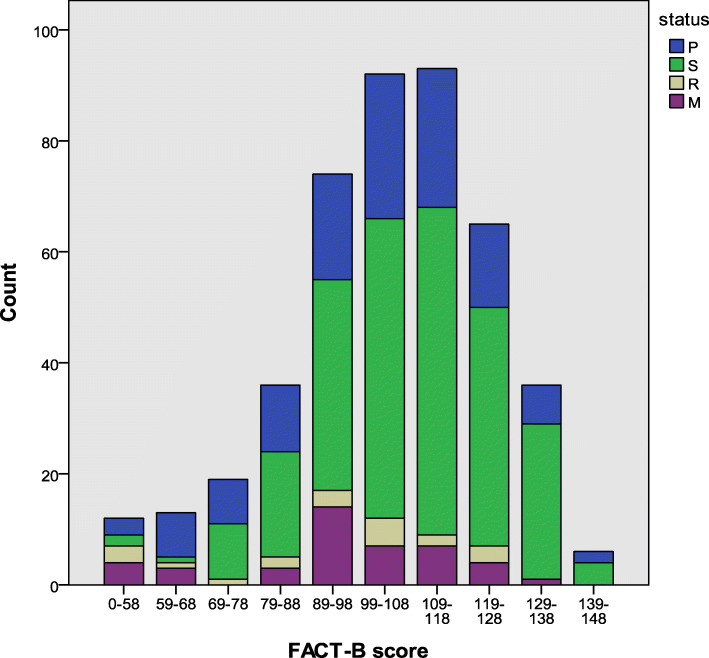
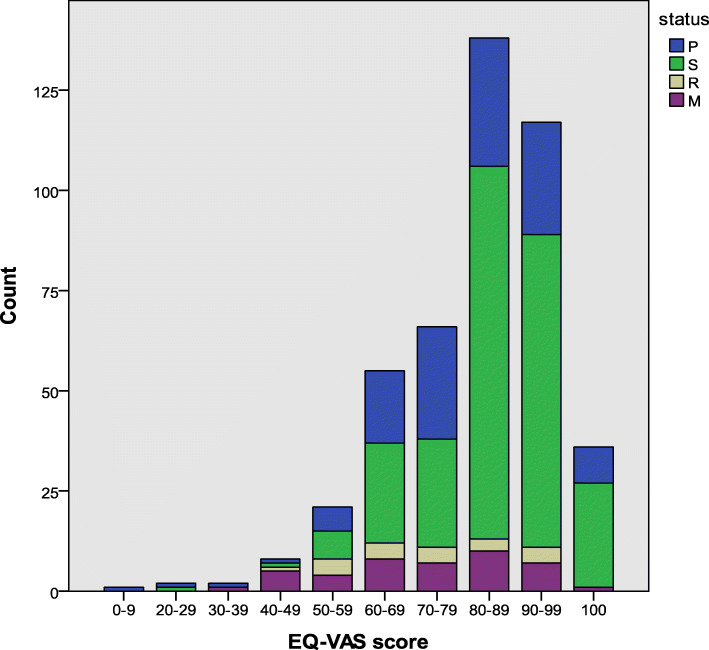
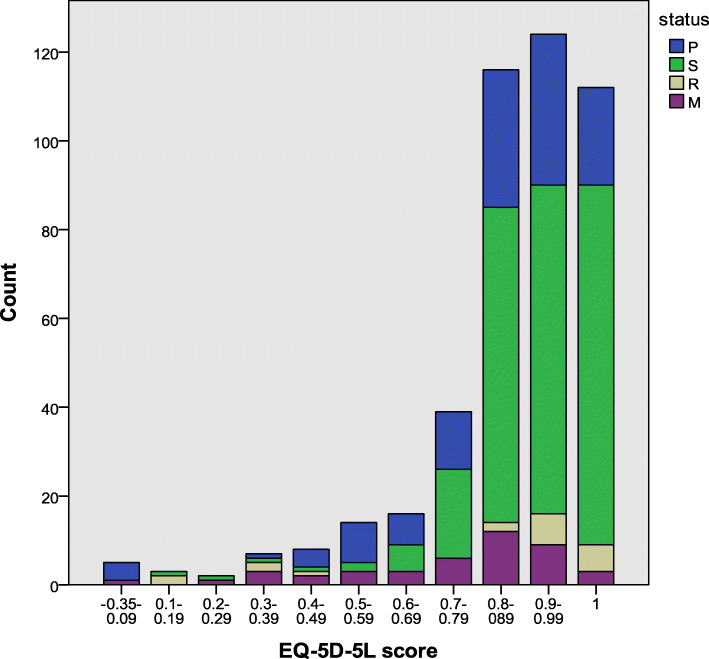
A total of 446 breast cancer patients with different disease states were analyzed. The health utility values of breast cancer patients in the P state (without cancer recurrence and metastasis), R state (with cancer recurrence within a year), S state (with primary and recurrent breast cancer for the second year and above), and M state (metastatic cancer) were 0.81 (SD ± 0.23), 0.90 (SD ± 0.12), 0.78 (SD ± 0.31), and 0.74 (SD ± 0.27), respectively. There were positive correlations between all scores, including every domain of the FACT-B instrument (p < 0.001). Results from multivariate analysis suggested that patients in the R and M states had lower scores for overall quality of life (R, β = - 9.45, p < 0.01; M, β = - 6.72, p < 0.05). Patients in the M state had lower health utility values than patients in the P state (β = - 0.11, p < 0.05). Estimated health utility values, which were derived from quality of life by using a mapping function, were significantly correlated with directly measured health utility values (p < 0.001).
We obtained the health utility and health-related quality of life (HRQoL) scores of Chinese breast cancer patients in different disease states. Mapping health utility values from quality of life using four disease states could be feasible in health economic modelling, but the mapping function may need further revision.
本研究旨在获得不同疾病阶段中国乳腺癌患者的健康效用参数,以便后续进行健康经济学模型研究。此外,我们旨在探索在中国建立乳腺癌健康效用映射模型的可行性。
评估了多种患者报告的健康属性,包括生活质量,采用功能性评估癌症治疗-乳房(FACT-B)量表进行测量;健康效用和自我报告的健康状况,采用欧洲五维健康量表-5 级(EQ-5D-5L)问卷进行测量。采用多元回归模型,包括线性回归模型、有序逻辑回归模型和 Tobit 模型,对 446 名乳腺癌患者的健康差异进行分析。进行了亚组分析,以检查来自 FACT-B 和 EQ-5D-5L 仪器的多个维度的健康差异。使用映射函数来估计生活质量的健康效用。秩相关分析用于检验估计和观察到的健康效用值之间的相关性。
分析了 446 名患有不同疾病阶段的乳腺癌患者。P 状态(无癌症复发和转移)、R 状态(一年内癌症复发)、S 状态(第二年及以上原发性和复发性乳腺癌)和 M 状态(转移性癌症)乳腺癌患者的健康效用值分别为 0.81(SD±0.23)、0.90(SD±0.12)、0.78(SD±0.31)和 0.74(SD±0.27)。所有评分之间均存在正相关,包括 FACT-B 仪器的每个领域(p<0.001)。多变量分析结果表明,R 状态和 M 状态的患者整体生活质量评分较低(R,β=-9.45,p<0.01;M,β=-6.72,p<0.05)。M 状态的患者健康效用值低于 P 状态的患者(β=-0.11,p<0.05)。通过映射函数从生活质量中得出的估计健康效用值与直接测量的健康效用值显著相关(p<0.001)。
我们获得了中国不同疾病阶段乳腺癌患者的健康效用和健康相关生活质量(HRQoL)评分。使用四个疾病状态从生活质量中映射健康效用值在健康经济学建模中可能是可行的,但映射函数可能需要进一步修正。