Family Medicine Specialty Training Program, Lesotho-Boston Health Alliance, Leribe, Lesotho; and, Department of Family Medicine, School of Medicine, Boston University, Boston, United States of America; and, Center for Health System Design and Implementation, Institute for Health System Innovation and Policy, Boston University, Boston.
Afr J Prim Health Care Fam Med. 2020 Oct 19;12(1):e1-e17. doi: 10.4102/phcfm.v12i1.2387.
Strengthening primary care research capacity is a priority globally. Family medicine training programmes in sub-Saharan Africa represent an important opportunity to build primary care research; however, they are often limited by insufficient research training and mentorship. Peers can be used to extend research mentorship capacity, but have not been evaluated in this context.
The aim of this study was to evaluate one family medicine training programme's research capacity building efforts through a blended research curriculum and peer mentorship.
Lesotho is a landlocked country within South Africa of approximately two million people. The Family Medicine Specialty Training Programme (FMSTP) is the only accredited postgraduate medical education programme in Lesotho.
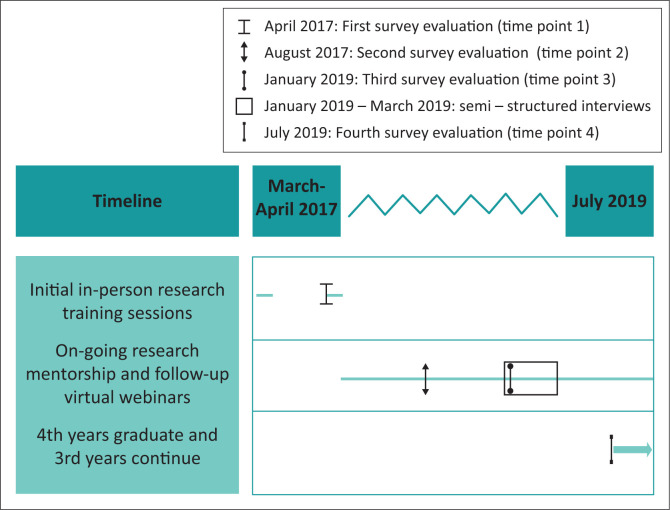
This two-year mixed-methods evaluation used: (1) Likert-scale surveys measuring trainee research confidence, (2) written evaluations by trainees, peers, programme faculty and administrators and (3) in-depth, semi-structured interviews. Survey data were analysed using Friedman and sign tests. Interview and written data were analysed thematically via a mixed inductive-deductive approach using Cooke's framework.
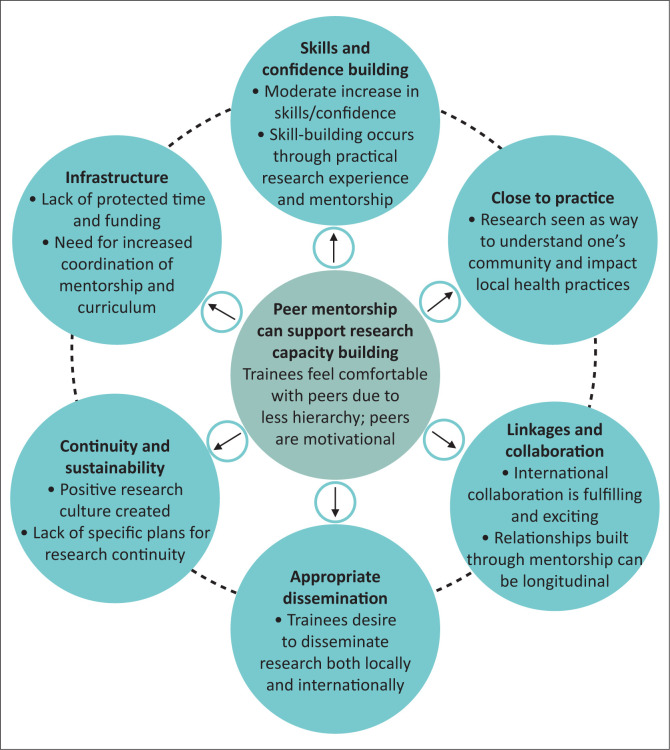
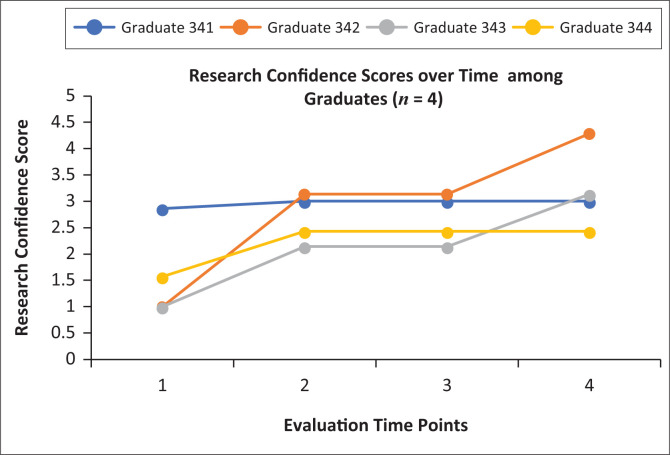
Family Medicine Specialty Training Programme trainees (n = 8) experienced moderate increases in research confidence that were statistically significant. Skill-building occurred primarily via experiential learning. Research was grounded in trainees' clinical practice and locally relevant. A positive research culture was created, promising for sustainability. We identified infrastructure gaps, including funding and protected time. Peer research mentorship supported trainees' motivation and provided a safe space for questions.
The FMSTP research curriculum and peer mentorship programme were successful in positively impacting a number of Cooke's research capacity domains. This evaluation identified improvements that are now being implemented.
加强基层医疗研究能力是全球的优先事项。撒哈拉以南非洲的家庭医学培训计划代表了建立基层医疗研究的重要机会;然而,它们通常受到研究培训和指导不足的限制。同行可以用来扩大研究指导能力,但尚未在这种情况下进行评估。
本研究旨在通过混合研究课程和同行指导来评估一个家庭医学培训计划在建立研究能力方面的努力。
莱索托是南非一个内陆国家,人口约为 200 万。家庭医学专科培训计划(FMSTP)是莱索托唯一认可的研究生医学教育计划。
这项为期两年的混合方法评估使用了:(1)衡量学员研究信心的李克特量表调查,(2)学员、同行、项目教师和管理人员的书面评估,以及(3)深入的半结构化访谈。使用 Friedman 和符号检验分析调查数据。使用 Cooke 的框架通过混合归纳演绎方法对访谈和书面数据进行主题分析。
家庭医学专科培训计划的学员(n=8)经历了研究信心的适度增加,这在统计学上是显著的。技能培养主要通过体验式学习进行。研究基于学员的临床实践和当地相关情况。创建了积极的研究文化,具有可持续性的潜力。我们确定了基础设施差距,包括资金和受保护的时间。同行研究指导支持了学员的积极性,并为提问提供了一个安全的空间。
FMSTP 研究课程和同行指导计划成功地对库克的多个研究能力领域产生了积极影响。本评估确定了正在实施的改进措施。