Department of Special Education and Multiple Abilities, The University of Alabama, Tuscaloosa, AL 35405, USA.
Department of Social and Organizational Psychology, ISCTE-University Institute of Lisbon, Avenida das Forças Armadas, 1649-026 Lisbon, Portugal.
Int J Environ Res Public Health. 2020 Nov 10;17(22):8308. doi: 10.3390/ijerph17228308.
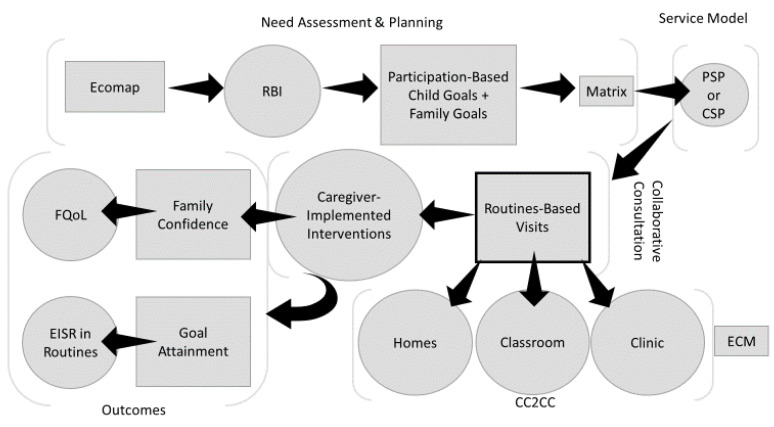
Professionals from 10 countries are implementing practices from the Routines-Based Model, which has three main components: needs assessment and intervention planning, a consultative approach, and a method for running classrooms. Its hallmark practices are the Routines-Based Interview, support-based visits with families, and a focus on child engagement. Implementers were interested in actual practices for putting philosophy and theory into action in their systems and cultures. We describe implementation challenges and successes and conclude that (a) models have to be adaptable, (b) some principles and practices are indeed universal, (c) we can shape excellent practices for international use, and (d) leadership is vital.
来自 10 个国家的专业人士正在实施基于常规的模式实践,该模式有三个主要组成部分:需求评估和干预计划、咨询方法以及班级管理方法。其标志性实践包括基于常规的访谈、与家庭的支持性访问,以及关注儿童参与。实施者对将哲学和理论付诸实践的实际做法在其系统和文化中的应用感兴趣。我们描述了实施过程中的挑战和成功,并得出以下结论:(a)模式必须具有适应性;(b)一些原则和实践确实具有普遍性;(c)我们可以为国际使用塑造优秀实践;(d)领导力至关重要。