Durham University, UK.
Columbia University Irving Medical Center, United States; New York State Psychiatric Institute, United States; Teachers College Columbia University, United States.
Perception. 2020 Nov;49(11):1235-1251. doi: 10.1177/0301006620963808.
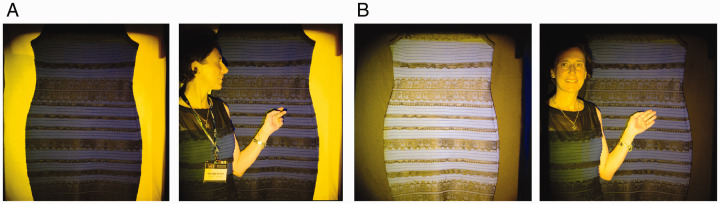
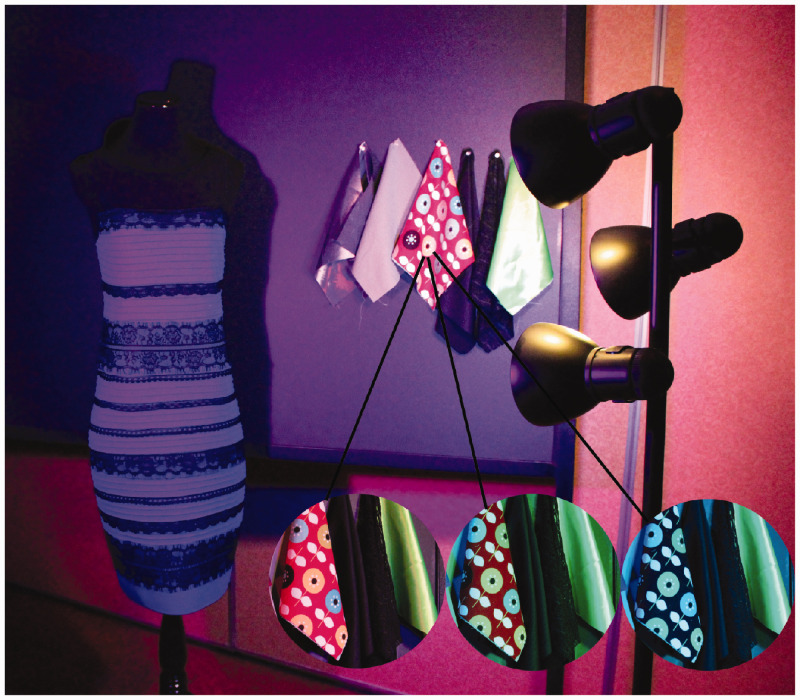
The colors that people see depend not only on the surface properties of objects but also on how these properties interact with light as well as on how light reflected from objects interacts with an individual's visual system. Because individual visual systems vary, the same visual stimulus may elicit different perceptions from different individuals. #thedress phenomenon drove home this point: different individuals viewed the same image and reported it to be widely different colors: blue and black versus white and gold. This phenomenon inspired a collection of demonstrations presented at the Vision Sciences Society 2015 Meeting which showed how spatial and temporal manipulations of light spectra affect people's perceptions of material colors and illustrated the variability in individual color perception. The demonstrations also explored the effects of temporal alterations in metameric lights, including Maxwell's Spot, an entoptic phenomenon. Crucially, the demonstrations established that #thedress phenomenon occurs not only for images of the dress but also for the real dress under real light sources of different spectral composition and spatial configurations.
人们所看到的颜色不仅取决于物体的表面属性,还取决于这些属性与光的相互作用方式,以及物体反射的光与个体视觉系统的相互作用方式。由于个体视觉系统存在差异,相同的视觉刺激可能会引起不同个体的不同感知。“连衣裙现象”就很好地说明了这一点:不同的人观看同一幅图像,却报告说它呈现出截然不同的颜色:蓝色和黑色与白色和金色。这一现象激发了在视觉科学协会 2015 年会议上展示的一系列演示,这些演示展示了光光谱的空间和时间操纵如何影响人们对材料颜色的感知,并说明了个体颜色感知的可变性。这些演示还探索了时变同色异谱光的影响,包括麦克斯韦点,一种内视觉现象。至关重要的是,这些演示表明,“连衣裙现象”不仅出现在连衣裙的图像上,而且出现在不同光谱组成和空间配置的真实光源下的真实连衣裙上。