Bedock Dorothée, Bel Lassen Pierre, Mathian Alexis, Moreau Pauline, Couffignal Julie, Ciangura Cécile, Poitou-Bernert Christine, Jeannin Anne-Caroline, Mosbah Helena, Fadlallah Jehane, Amoura Zahir, Oppert Jean-Michel, Faucher Pauline
Assistance Publique-Hôpitaux de Paris (AP-HP), Nutrition Department, Pitié-Salpêtrière University Hospital, Institute of Cardiometabolism and Nutrition (ICAN), Sorbonne Université, 47-83 Boulevard de l'Hôpital, 75013, Paris, France.
Assistance Publique-Hôpitaux de Paris (AP-HP), Nutrition Department, Pitié-Salpêtrière University Hospital, Institute of Cardiometabolism and Nutrition (ICAN), Sorbonne Université, 47-83 Boulevard de l'Hôpital, 75013, Paris, France; Sorbonne Université, NutriOmics Team, INSERM UMRS U1166, Paris, France.
Clin Nutr ESPEN. 2020 Dec;40:214-219. doi: 10.1016/j.clnesp.2020.09.018. Epub 2020 Sep 18.
BACKGROUND & AIMS: Nutritional knowledge in patients with SARS-Cov2 infection (COVID-19) is limited. Our objectives were: i) to assess malnutrition in hospitalized COVID-19 patients, ii) to investigate the links between malnutrition and disease severity at admission, iii) to study the impact of malnutrition on clinical outcomes such as transfer to an intensive care unit (ICU) or death.
Consecutive patients hospitalized in a medicine ward at a university hospital were included from March 21st to April 24th 2020 (n = 114, 60.5% males, age: 59.9 ± 15.9 years). Nutritional status was defined using Global Leadership Initiative on Malnutrition (GLIM) criteria. Clinical, radiological and biological characteristics of COVID-19 patients were compared according to the presence of malnutrition. Logistic regression was used to assess associations between nutritional parameters and unfavourable outcomes such as transfer to intensive care unit (ICU) or death.
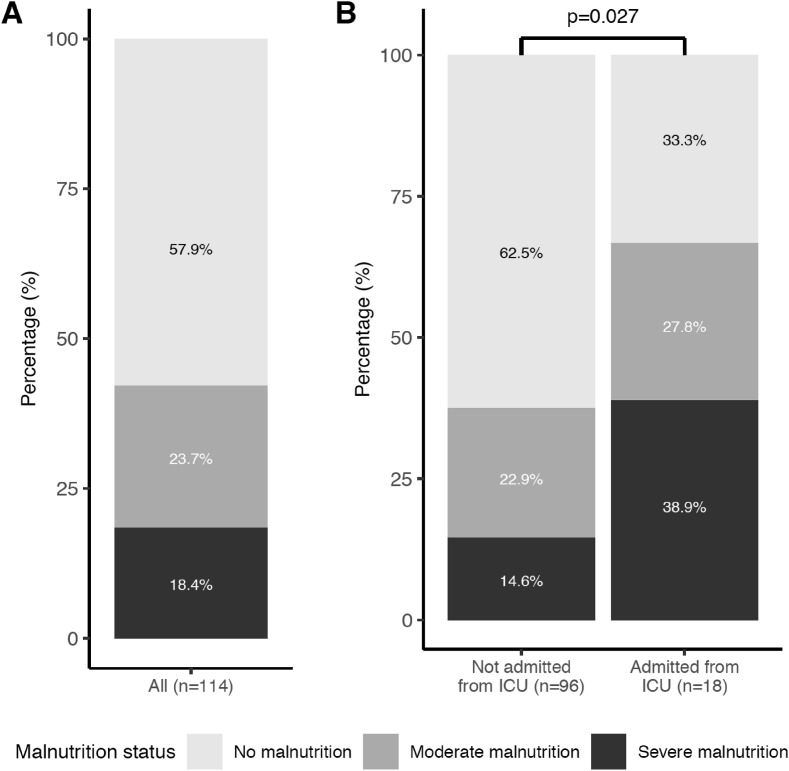
The overall prevalence of malnutrition was 42.1% (moderate: 23.7%, severe: 18.4%). The prevalence of malnutrition reached 66.7% in patients admitted from ICU. No significant association was found between nutritional status and clinical signs of COVID-19. Lower albumin levels were associated with a higher risk of transfer to ICU (for 10 g/l of albumin, OR [95%CI]: 0.31 [0.1; 0.7]; p < 0.01) and this association was independent of age and CRP levels.
COVID-19 in medical units dedicated to non-intensive care is associated with a high prevalence of malnutrition, especially for patients transferred from ICU. These data emphasize the importance of early nutritional screening in these patients to adapt management accordingly.
感染严重急性呼吸综合征冠状病毒2(SARS-CoV-2,即新型冠状病毒肺炎)患者的营养知识有限。我们的目标是:i)评估住院的新型冠状病毒肺炎患者的营养不良情况;ii)调查入院时营养不良与疾病严重程度之间的联系;iii)研究营养不良对诸如转入重症监护病房(ICU)或死亡等临床结局的影响。
纳入2020年3月21日至4月24日在一所大学医院内科病房住院的连续患者(n = 114,男性占60.5%,年龄:59.9 ± 15.9岁)。使用营养不良全球领导倡议(GLIM)标准定义营养状况。根据是否存在营养不良比较新型冠状病毒肺炎患者的临床、放射学和生物学特征。采用逻辑回归评估营养参数与转入重症监护病房(ICU)或死亡等不良结局之间的关联。
营养不良的总体患病率为42.1%(中度:23.7%,重度:18.4%)。从ICU转入的患者中营养不良患病率达66.7%。未发现营养状况与新型冠状病毒肺炎临床体征之间存在显著关联。较低的白蛋白水平与转入ICU的较高风险相关(白蛋白每降低10 g/L,比值比[95%置信区间]:0.31 [0.1;0.7];p < 0.01),且这种关联独立于年龄和C反应蛋白水平。
在非重症监护的医疗单元中,新型冠状病毒肺炎与营养不良的高患病率相关,尤其是对于从ICU转入的患者。这些数据强调了对这些患者进行早期营养筛查以相应调整管理的重要性。