
南非残疾人士的污名化:从歧视到抑郁和低自尊的途径揭示。
Stigma of persons with disabilities in South Africa: Uncovering pathways from discrimination to depression and low self-esteem.
机构信息
Brown School and Institute of Public Health,Washington University in St Louis, 1 Brookings Drive, St Louis, MO, 63130, USA.
Department of Psychology, University of Johannesburg, Johannesburg, South Africa.
出版信息
Soc Sci Med. 2020 Nov;265:113449. doi: 10.1016/j.socscimed.2020.113449. Epub 2020 Oct 21.
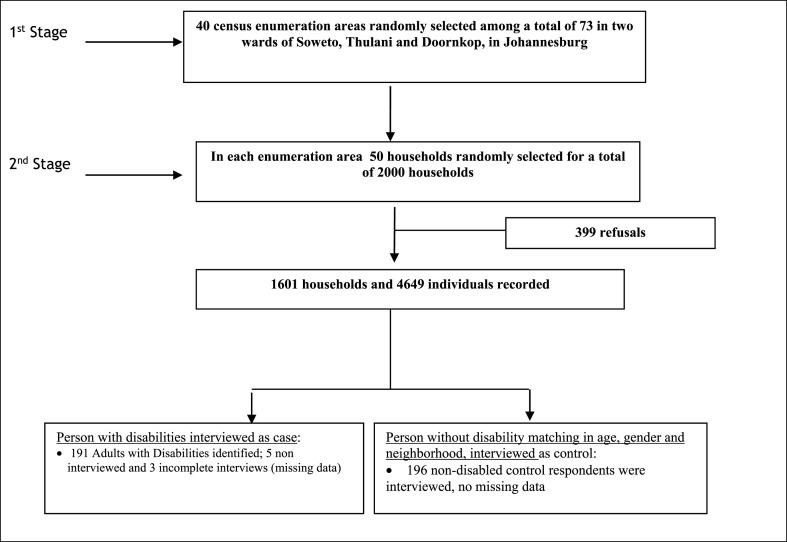
Despite the fact that universal inclusion is a basic principle of the Sustainable Development Goals, the inclusion of persons with disabilities in humanitarian interventions and development policies remains elusive. Persons with disabilities face high risks of poverty, poor nutrition, limited inclusion in labor markets and poor mental health as a result. Stigma is likely to play a negative role in this regard and yet, no study has investigated the impact of stigma on depression and self-esteem of persons with disabilities. To address this gap in the literature, we conducted in June 2017 a random sample disability case control household study in Soweto, a township in Johannesburg, South Africa. Using propensity score analysis and structural equation modeling, we investigated the relationship between disability, stigma, depression and self-esteem controlling for socioeconomic covariates. Our main empirical results showed that stigma significantly mediates the association between disability and higher depression on the one hand and between disability and lower self-esteem on the other. This mediating effect exists even after controlling for age, gender, marital status, education, employment and wealth. We also found strong direct associations between disability and depressive mood, somatic indicators and negative feelings such as unhappiness and low self-esteem. Unemployment aggravates depression and low self-esteem while low education worsens self-esteem only. In addition, depression exacerbates low self-esteem. Both unemployment and low education are more common among persons with disabilities aggravating the disability, depression, poor self-esteem nexus. Similarly, persons with disabilities who are more likely to be depressed are also at higher risk of low self-esteem. These results point to a vicious reinforcing circle of exclusion from society, despair and self-deprecation, which could prove difficult to break. Substantial psycho-social support and anti-stigma policies anchored in local cultural values, engaging persons with disabilities and their communities, are required to break this vicious circle.
尽管普遍包容是可持续发展目标的基本原则,但残疾人士在人道主义干预和发展政策中的包容仍然难以实现。因此,残疾人士面临着较高的贫困、营养不良、劳动力市场参与度有限和心理健康不佳的风险。污名化可能在这方面产生负面影响,但迄今为止,尚无研究调查污名化对残疾人士抑郁和自尊的影响。为了填补这一文献空白,我们于 2017 年 6 月在南非约翰内斯堡的索韦托镇进行了一项残疾病例对照家庭随机抽样研究。我们使用倾向评分分析和结构方程模型,在控制社会经济协变量的情况下,调查了残疾、污名、抑郁和自尊之间的关系。我们的主要实证结果表明,污名在残疾与较高抑郁之间,以及残疾与较低自尊之间,均具有显著的中介效应。即使在控制了年龄、性别、婚姻状况、教育、就业和财富等因素后,这种中介效应仍然存在。我们还发现残疾与抑郁情绪、躯体指标以及不快乐和低自尊等负面情绪之间存在强烈的直接关联。失业加剧了抑郁和低自尊,而低教育则仅恶化了自尊。此外,抑郁会加剧低自尊。失业和低教育在残疾人士中更为普遍,从而加剧了残疾、抑郁和低自尊之间的恶性循环。同样,那些更容易抑郁的残疾人士也面临着低自尊的更高风险。这些结果表明,社会排斥、绝望和自贬的恶性循环可能很难打破。需要基于当地文化价值观,为残疾人士及其社区提供实质性的心理社会支持和反污名化政策,以打破这种恶性循环。



 Zotero 插件