Trauma and Orthopaedics, Imperial College Healthcare NHS Trust, London, UK
Department of Surgery and Cancer, Imperial College London, London, UK.
BMJ Health Care Inform. 2020 Nov;27(3). doi: 10.1136/bmjhci-2020-100233.
Up to half of all musculoskeletal injuries are investigated with plain radiographs. However, high rates of image interpretation error mean that novel solutions such as artificial intelligence (AI) are being explored.
To determine patient confidence in clinician-led radiograph interpretation, the perception of AI-assisted interpretation and management, and to identify factors which might influence these views.
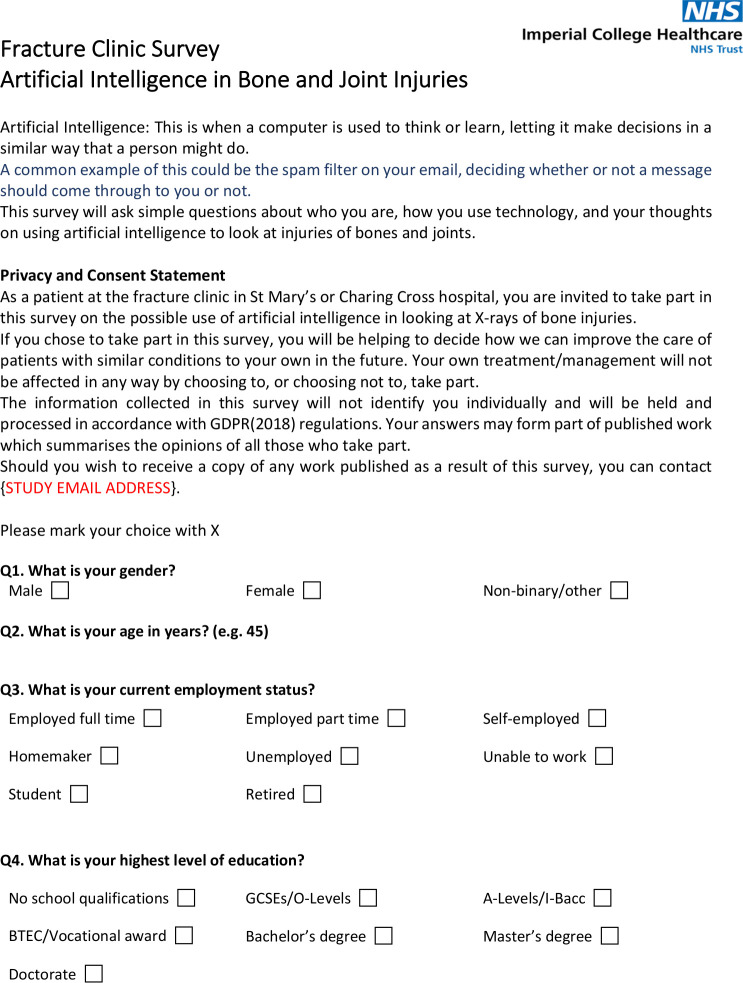
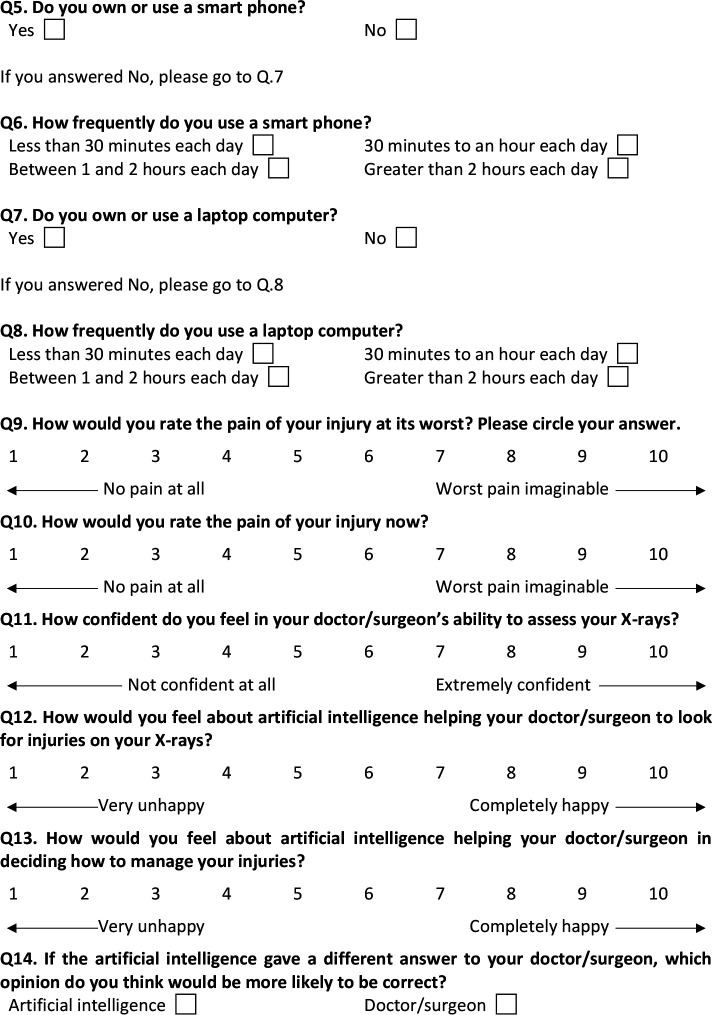
A novel questionnaire was distributed to patients attending fracture clinic in a large inner-city teaching hospital. Categorical and Likert scale questions were used to assess participant demographics, daily electronics use, pain score and perceptions towards AI used to assist in interpretation of their radiographs, and guide management.
216 questionnaires were included (M=126, F=90). Significantly higher confidence in clinician rather than AI-assisted interpretation was observed (clinician=9.20, SD=1.27 vs AI=7.06, SD=2.13), 95.4% reported favouring clinician over AI-performed interpretation in the event of disagreement.Small positive correlations were observed between younger age/educational achievement and confidence in AI-assistance. Students demonstrated similarly increased confidence (8.43, SD 1.80), and were over-represented in the minority who indicated a preference for AI-assessment over their clinicians (50%).
Participant's held the clinician's assessment in the highest regard and expressed a clear preference for it over the hypothetical AI assessment. However, robust confidence scores for the role of AI-assistance in interpreting skeletal imaging suggest patients view the technology favourably.Findings indicate that younger, more educated patients are potentially more comfortable with a role for AI-assistance however further research is needed to overcome the small number of responses on which these observations are based.
多达一半的肌肉骨骼损伤是通过普通 X 光片进行检查的。然而,由于图像解读错误率较高,因此正在探索人工智能(AI)等新解决方案。
确定患者对临床医生主导的 X 光片解读的信心、对 AI 辅助解读和管理的看法,并确定可能影响这些观点的因素。
在一家大型市内教学医院的骨折诊所,向患者分发了一份新的问卷。使用分类和李克特量表问题来评估参与者的人口统计学特征、日常电子设备使用情况、疼痛评分以及对用于协助解读其 X 光片和指导管理的 AI 的看法。
共纳入 216 份问卷(男性 126 份,女性 90 份)。观察到患者对临床医生而非 AI 辅助解读的信心明显更高(临床医生=9.20,SD=1.27 vs AI=7.06,SD=2.13),95.4%的患者报告称,如果出现意见分歧,他们更倾向于临床医生而非 AI 进行解读。年龄较小/教育程度较高与对 AI 辅助的信心之间呈正相关。学生的信心也同样增加(8.43,SD 1.80),并且在那些表示更倾向于 AI 评估而非临床医生评估的少数患者中占比较高(50%)。
患者对临床医生的评估给予了最高的评价,并明确表示更倾向于临床医生的评估而非假设的 AI 评估。然而,对 AI 辅助解读骨骼成像的作用具有较高的置信度评分表明患者对该技术持积极态度。研究结果表明,年龄较小、教育程度较高的患者可能更能接受 AI 辅助的作用,但需要进一步研究来克服这些观察结果所基于的小样本数量的问题。