Postgraduate Program in Nutrition, Federal University of Santa Catarina, Florianopolis, Brazil.
Postgraduate Program in Public Health, Federal University of Maranhão, Maranhão, Brazil.
Nutr J. 2020 Nov 14;19(1):123. doi: 10.1186/s12937-020-00638-5.
Older adults are one of the most susceptible populations to depression, especially those living in low- and middle-income countries. As well, they are also considering a risk group for vitamin D deficiency. Low serum vitamin D has been associated with an increased risk of brain neuropsychiatry disorders. We aimed to investigate the association between serum 25-hydroxycholecalciferol concentrations and depressive symptoms in adults aged 60 years and over from southern Brazil.
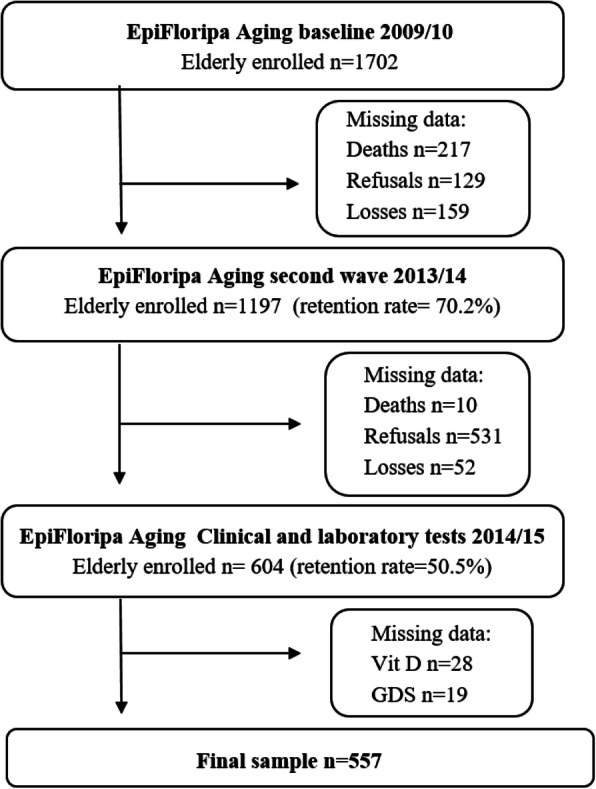
A cross-sectional analysis was performed using data collected during 2013-2014 from the populational-based longitudinal EpiFloripa Aging Study (n = 1197). Serum 25-hydroxycholecalciferol concentrations were analyzed and classified according to the Endocrine Society reference values [sufficiency (≥ 30 ng/mL), insufficiency (21-29 ng/mL), and deficiency (≤ 20 ng/mL)]. Depressive symptoms were evaluated using the Geriatric Depression Scale (15-item GDS). Logistic regression was performed to assess depressive symptoms in each vitamin D category. The analysis was adjusted for sex, age, skin color, family income, leisure-time physical activities, social or religious groups attendance, morbidities, cognitive impairment, and dependence in activities of daily living.
A total of 557 participants with complete data for exposure and outcome were enrolled in the analysis. Most of the sample participants were female (63.1%), age-range 60-69 years (42.2%), white skin color (85.1%), and vitamin D serum level samples were collected in autumn (50.7%). Depressive symptoms were present in 15.8% of the participants, and the prevalence was higher in individuals classified as deficient in vitamin D (23.2, 95% confidence interval [CI] = 15.6;32.9) and insufficiency (17.2, 95%CI = 11.0;25.9). The crude analysis showed that vitamin D deficient participants had 3.08 (CI = 1.53;6.20) times higher odds to present depressive symptoms compared to vitamin D sufficiency. After adjusting, the association was maintained [OR 2.27 (95%CI = 1.05;4.94).
Serum 25-hydroxycholecalciferol deficiency was positively associated with depressive symptoms in older adults from southern Brazil.
老年人是最易患抑郁症的人群之一,尤其是生活在中低收入国家的老年人。此外,他们也是维生素 D 缺乏的高危人群。血清维生素 D 水平较低与大脑神经精神疾病的风险增加有关。我们旨在研究巴西南部 60 岁及以上成年人血清 25-羟胆钙化醇浓度与抑郁症状之间的关系。
使用 2013-2014 年基于人群的纵向 EpiFloripa 衰老研究(n=1197)的数据进行了横断面分析。根据内分泌学会的参考值[充足(≥30ng/mL)、不足(21-29ng/mL)和缺乏(≤20ng/mL)]分析血清 25-羟胆钙化醇浓度并进行分类。使用老年抑郁量表(15 项 GDS)评估抑郁症状。使用逻辑回归评估每个维生素 D 类别中的抑郁症状。分析调整了性别、年龄、肤色、家庭收入、休闲时间体育活动、参加社会或宗教团体、发病情况、认知障碍和日常生活活动的依赖。
共有 557 名暴露和结局数据完整的参与者纳入分析。样本中大多数参与者为女性(63.1%),年龄在 60-69 岁(42.2%),肤色为白色(85.1%),血清维生素 D 水平样本采集于秋季(50.7%)。15.8%的参与者存在抑郁症状,维生素 D 缺乏组的患病率较高(23.2%,95%置信区间[CI]=15.6%;32.9%)和不足组(17.2%,95%CI=11.0%;25.9%)。初步分析显示,与维生素 D 充足者相比,维生素 D 缺乏者出现抑郁症状的可能性高 3.08 倍(CI=1.53;6.20)。调整后,这种关联仍然存在[比值比 2.27(95%CI=1.05;4.94)]。
血清 25-羟胆钙化醇缺乏与巴西南部老年人的抑郁症状呈正相关。