Department of Materials Engineering, Indian Institute of Science, Bangalore, India.
Int J Nanomedicine. 2020 Aug 12;15:5991-6006. doi: 10.2147/IJN.S249717. eCollection 2020.
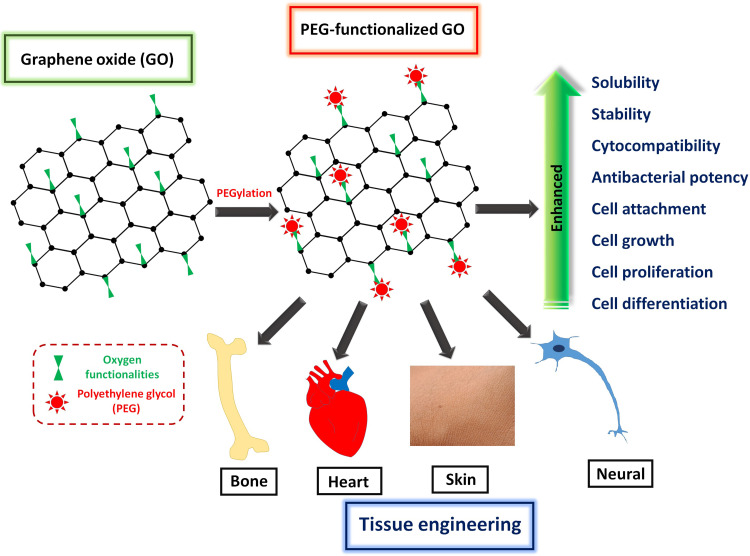
Owing to the unique physical, chemical, mechanical and electrical properties, graphene and its derivatives have been extensively researched for diverse biomedical applications including in tissue engineering since the past decade. Tunable chemical functionalities of graphene oxide (GO), a graphene derivative, allow easy surface functionalization. Functionalization of GO with poly(ethylene glycol) (PEG) (PEG-GO) has received significant attention as it offers superior solubility, stability, and biocompatibility. Besides being an attractive candidate for drug delivery, PEG-GO can aid in the attachment, proliferation, and differentiation of stem cells, thereby augmenting tissue engineering. PEG-GO has shown excellent antibacterial efficacy, which could be an added advantage to minimize implant-associated infections. This review describes the synthesis techniques, properties, and biological potential of PEG-GO towards mammalian and bacterial cells. Studies wherein these nanomaterials have been explored for engineering various tissues are reviewed along with future opportunities in this field.
由于独特的物理、化学、机械和电学性质,石墨烯及其衍生物在过去十年中得到了广泛的研究,应用于包括组织工程在内的各种生物医学领域。氧化石墨烯(GO)是石墨烯的衍生物,其可调的化学官能团使得表面易于功能化。GO 与聚乙二醇(PEG)的功能化(PEG-GO)受到了极大的关注,因为它具有优异的溶解度、稳定性和生物相容性。除了作为一种有吸引力的药物输送载体外,PEG-GO 还可以促进干细胞的附着、增殖和分化,从而增强组织工程。PEG-GO 表现出优异的抗菌效果,这可能是减少植入物相关感染的一个额外优势。本文综述了 PEG-GO 向哺乳动物和细菌细胞的合成技术、性质和生物学潜力。综述了这些纳米材料在各种组织工程中的应用研究,并探讨了该领域的未来机遇。