
吡嗪酰胺单独和与唑类药物联合抗. 的抗真菌作用研究。
and Study of Antifungal Effect of Pyrvinium Pamoate Alone and in Combination With Azoles Against .
机构信息
Department of Dermatology, Jingzhou Central Hospital, The Second Clinical Medical College, Yangtze University, Jingzhou, China.
Department of Dermatology, Zhongshan Hospital Fudan University (Xiamen Branch), Xiamen, China.
出版信息
Front Cell Infect Microbiol. 2020 Oct 23;10:576975. doi: 10.3389/fcimb.2020.576975. eCollection 2020.
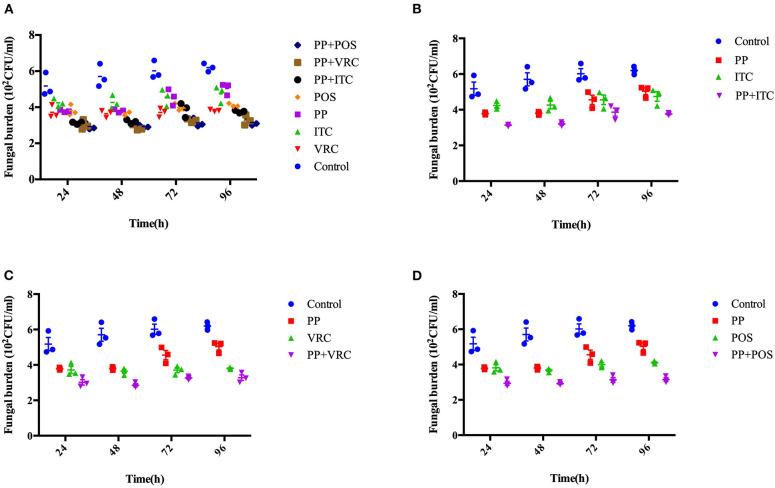
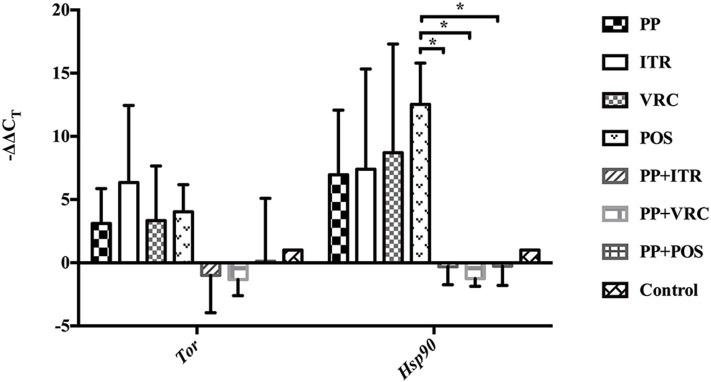
Infections of are often chronic and recalcitrant. Combination therapies with novel compounds and azoles could be an effective solution. Previously, we have demonstrated that pyrvinium pamoate exerted antifungal activity alone and favorable synergy with azoles against planktonic . Herein, the underlying antifungal mode of action were investigated. Pyrvinium alone showed sessile MIC50 (SMIC50) of 8->16 μg/ml against biofilms. However, synergism of PP with itraconazole, voriconazole, and posaconazole were observed against 16 (88.9%), 9 (50%), and 13 (72.2%) strains of biofilms. In accordance with susceptibilities, pyrvinium alone at concentration of 2 μg/ml resulted in significant growth restriction of planktonic . Pyrvinium alone resulted in reduction of biofilm formation. Higher concentration of pyrvinium was associate with more progressive reduction of biofilm mass. The activity of pyrvinium alone and combined with azoles was evaluated using model. Pyrvinium alone significantly improved the survival rate of larvae ( < 0.0001). The combination of pyrvinium and voriconazole or posaconazole acted synergistically ( < 0.05). Fungal burden determination revealed significant reduction of numbers of colony forming unit (CFU) in larvae treated with pyrvinium-itraconazole and pyrvinium-posaconazole compared to itraconazole or posaconazole alone group, respectively. The effect of pyrvinium on apoptosis, expression of and , and drug efflux reversal were evaluated by PI/Annexin V staining, Real-Time Quantitative PCR and Rhodamine 6G assay, respectively. Pyrvinium alone or combined with azoles significantly ( < 0.05) increased late apoptosis or necrosis of cells. Pyrvinium combined with posaconazole significantly decreased the expression of and compared to posaconazole alone group ( < 0.05). Pyrvinium resulted in significant ( < 0.05) decrease of the efflux of Rhodamine 6G. These findings suggested pyrvinium could be a promising synergist with azoles. The underlying mechanisms could be explained by inducing apoptosis/necrosis, inhibition of drug efflux pumps, and signaling pathways related with stress response and growth control.
棘白菌素的感染通常是慢性和难治的。新型化合物与唑类药物的联合治疗可能是一种有效的解决方案。此前,我们已经证明匹伐醌单独具有抗真菌活性,并与唑类药物对浮游生物表现出良好的协同作用。在此,研究了其潜在的抗真菌作用模式。匹伐醌单独对生物膜的固着 MIC50(SMIC50)为 8->16μg/ml。然而,匹伐醌与伊曲康唑、伏立康唑和泊沙康唑的协同作用分别观察到 16(88.9%)、9(50%)和 13(72.2%)株棘白菌素生物膜的抑制。根据药敏试验,匹伐醌单独浓度为 2μg/ml 可显著抑制浮游生物的生长。匹伐醌单独作用可减少生物膜的形成。较高浓度的匹伐醌与生物膜质量的更渐进性降低相关。采用生物膜模型评估了匹伐醌单独和与唑类药物联合的活性。匹伐醌单独使用可显著提高幼虫的存活率(<0.0001)。匹伐醌与伏立康唑或泊沙康唑联合使用具有协同作用(<0.05)。真菌负荷测定显示,与单独使用伊曲康唑或泊沙康唑相比,用匹伐醌-伊曲康唑和匹伐醌-泊沙康唑处理的幼虫中的菌落形成单位(CFU)数量显著减少。通过 PI/Annexin V 染色、实时定量 PCR 和 Rhodamine 6G 测定分别评估了匹伐醌对凋亡、棘白菌素基因和表达的影响,以及药物外排逆转。匹伐醌单独或与唑类药物联合使用均显著(<0.05)增加了真菌细胞的晚期凋亡或坏死。与单独使用泊沙康唑相比,匹伐醌联合泊沙康唑显著降低了 基因和 基因的表达(<0.05)。匹伐醌导致 Rhodamine 6G 的外排显著减少(<0.05)。这些发现表明匹伐醌可能是唑类药物的一种有前途的增效剂。其潜在机制可以通过诱导细胞凋亡/坏死、抑制药物外排泵以及与应激反应和生长控制相关的信号通路来解释。




 Zotero 插件