
通过受定量磁共振成像数据约束的数学模型评估乳腺癌患者的新辅助治疗方案。
Evaluating patient-specific neoadjuvant regimens for breast cancer via a mathematical model constrained by quantitative magnetic resonance imaging data.
机构信息
Oden Institute for Computational Engineering and Sciences, Austin, TX, USA; Livestrong Cancer Institutes, Austin, TX, USA.
Department of Biomedical Engineering, The University of Texas at Austin, Austin, TX, USA.
出版信息
Neoplasia. 2020 Dec;22(12):820-830. doi: 10.1016/j.neo.2020.10.011. Epub 2020 Nov 14.
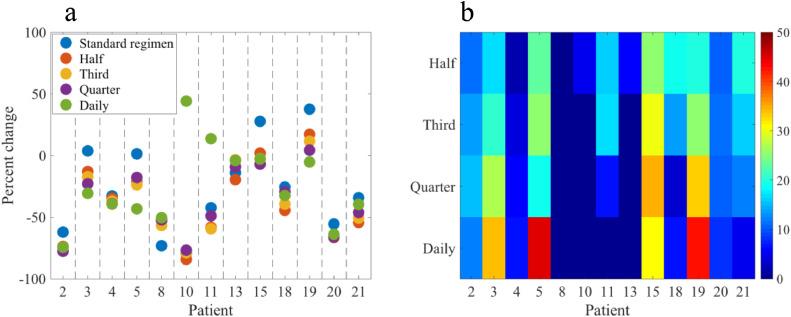
The ability to accurately predict response and then rigorously optimize a therapeutic regimen on a patient-specific basis, would transform oncology. Toward this end, we have developed an experimental-mathematical framework that integrates quantitative magnetic resonance imaging (MRI) data into a biophysical model to predict patient-specific treatment response of locally advanced breast cancer to neoadjuvant therapy. Diffusion-weighted and dynamic contrast-enhanced MRI data is collected prior to therapy, after 1 cycle of therapy, and at the completion of the first therapeutic regimen. The model is initialized and calibrated with the first 2 patient-specific MRI data sets to predict response at the third, which is then compared to patient outcomes (N = 18). The model's predictions for total cellularity, total volume, and the longest axis at the completion of the regimen are significant within expected measurement precision (P< 0.05) and strongly correlated with measured response (P < 0.01). Further, we use the model to investigate, in silico, a range of (practical) alternative treatment plans to achieve the greatest possible tumor control for each individual in a subgroup of patients (N = 13). The model identifies alternative dosing strategies predicted to achieve greater tumor control compared to the standard of care for 12 of 13 patients (P < 0.01). In summary, a predictive, mechanism-based mathematical model has demonstrated the ability to identify alternative treatment regimens that are forecasted to outperform the therapeutic regimens the patients clinically. This has important implications for clinical trial design with the opportunity to alter oncology care in the future.
准确预测反应的能力,然后根据患者的具体情况严格优化治疗方案,将改变肿瘤学领域。为此,我们开发了一种实验数学框架,将定量磁共振成像(MRI)数据整合到生物物理模型中,以预测局部晚期乳腺癌对新辅助治疗的患者特异性治疗反应。在治疗前、治疗 1 个周期后和完成第一个治疗方案后采集扩散加权和动态对比增强 MRI 数据。该模型使用前 2 个患者特定 MRI 数据集进行初始化和校准,以预测第 3 个数据集的反应,然后将其与患者的结果进行比较(N=18)。模型对方案完成时的总细胞数、总体积和最长轴的预测在预期测量精度内具有显著意义(P<0.05),并且与测量的反应高度相关(P<0.01)。此外,我们使用该模型在亚组患者(N=13)中的个体中研究了一系列(实际)替代治疗方案,以实现最大的肿瘤控制。模型确定了替代给药策略,与标准护理相比,可预测对 13 名患者中的 12 名患者实现更大的肿瘤控制(P<0.01)。总之,预测性、基于机制的数学模型已经证明了识别替代治疗方案的能力,这些方案预计将优于患者的临床治疗方案。这对临床试验设计具有重要意义,未来有机会改变肿瘤学治疗方法。


 Zotero 插件