Medical College, Jiangsu Vocational College of Medicine, Yancheng, Jiangsu, China (mainland).
Basic Medical Science, Jiangsu Vocational College of Medicine, Yancheng, Jiangsu, China (mainland).
Med Sci Monit. 2020 Nov 17;26:e926807. doi: 10.12659/MSM.926807.
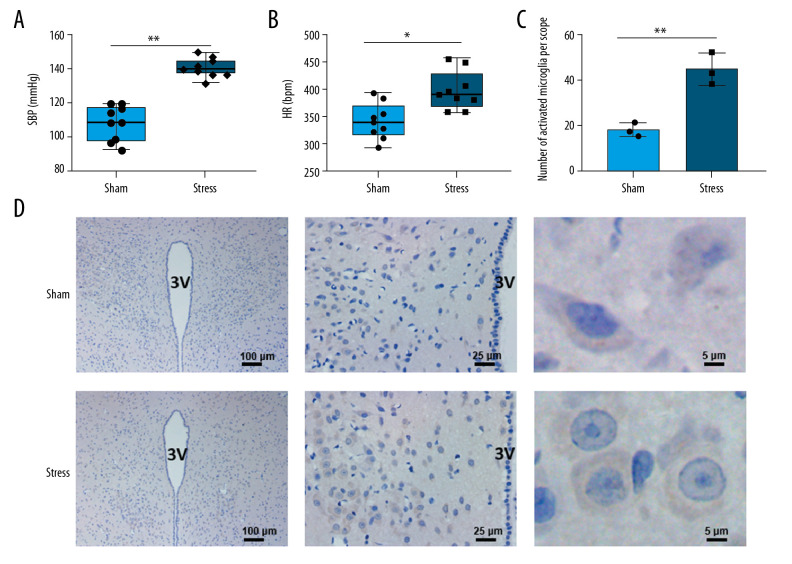
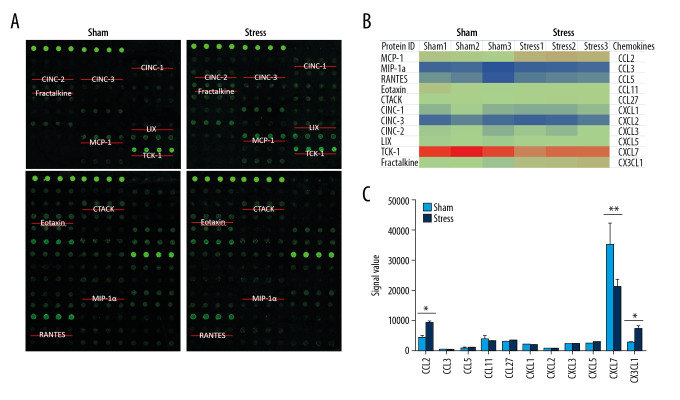
BACKGROUND The neuroinflammation of paraventricular nucleus (PVN) of the hypothalamus has been implicated in the development of hypertension. The promoted invasion of peripheral immune cells into PVN may be attributed to the upregulation of chemokines, then exacerbating neuroinflammation. We studied the expressions of chemokines, activation of microglial cells, and inflammatory mediators in PVN of rats with stress-induced hypertension (SIH). MATERIAL AND METHODS SIH was induced by electrical foot shock combined with noise for 2 h twice a day, at an interval of 4 h for 14 consecutive days. At the end of the 14th day, fresh PVN tissues were collected to measure the expressions of chemokines using the RayBiotech antibody array. RESULTS We are the first to report that the expression of CXCL7 was extremely high in PVN of control rats, and was significantly lower in SIH rats. The expressions of CCL2 and CX3CL1 in PVN of SIH rats significantly exceeded those of control rats. The numbers of CX3CR1 (receptor of CX3CL1)-immunostained cells and oxycocin-42 (OX-42, marker of microglia)-positive cells increased in PVN of the SIH rats. The stress enhanced the protein expressions of proinflammatory cytokines IL-6 and IL-17 and reduced those of anti-inflammatory cytokines TGF-ß and IL-10 in PVN. CONCLUSIONS In PVN of SIH rats, chronic stress induced neuroinflammation characterized by the activated microglia and upregulated proinflammatory cytokines. Expressions of chemokines CXCL7, CX3CL1, and CCL2 were altered. The causal link of chemokines to PVN neuroinflammation and hypertension remain to be determined.
下丘脑室旁核(PVN)的神经炎症与高血压的发展有关。外周免疫细胞向 PVN 的侵袭增加可能归因于趋化因子的上调,进而加剧神经炎症。我们研究了应激诱导高血压(SIH)大鼠 PVN 中趋化因子的表达、小胶质细胞的激活和炎症介质。
通过电脚休克和噪声相结合,每天两次,间隔 4 小时,连续 14 天,每天 2 小时,诱导 SIH。在第 14 天结束时,收集新鲜的 PVN 组织,使用 RayBiotech 抗体阵列测量趋化因子的表达。
我们首次报道,CXCL7 在对照组大鼠的 PVN 中表达极高,而在 SIH 大鼠中则显著降低。CCL2 和 CX3CL1 在 SIH 大鼠 PVN 中的表达明显高于对照组大鼠。CX3CR1(CX3CL1 受体)免疫染色细胞和氧合素-42(OX-42,小胶质细胞标志物)阳性细胞的数量在 SIH 大鼠的 PVN 中增加。应激增强了促炎细胞因子 IL-6 和 IL-17 的蛋白表达,降低了抗炎细胞因子 TGF-β和 IL-10 在 PVN 中的表达。
在 SIH 大鼠的 PVN 中,慢性应激引起以小胶质细胞激活和促炎细胞因子上调为特征的神经炎症。趋化因子 CXCL7、CX3CL1 和 CCL2 的表达发生改变。趋化因子与 PVN 神经炎症和高血压之间的因果关系仍有待确定。