Winkel David J, Wetterauer Christian, Matthias Marc Oliver, Lou Bin, Shi Bibo, Kamen Ali, Comaniciu Dorin, Seifert Hans-Helge, Rentsch Cyrill A, Boll Daniel T
Department of Radiology, University Hospital of Basel, 4051 Basel, Basel-Stadt, Switzerland.
Siemens Healthineers, Medical Imaging Technologies Princeton, Princeton, NJ 08540, USA.
Diagnostics (Basel). 2020 Nov 14;10(11):951. doi: 10.3390/diagnostics10110951.
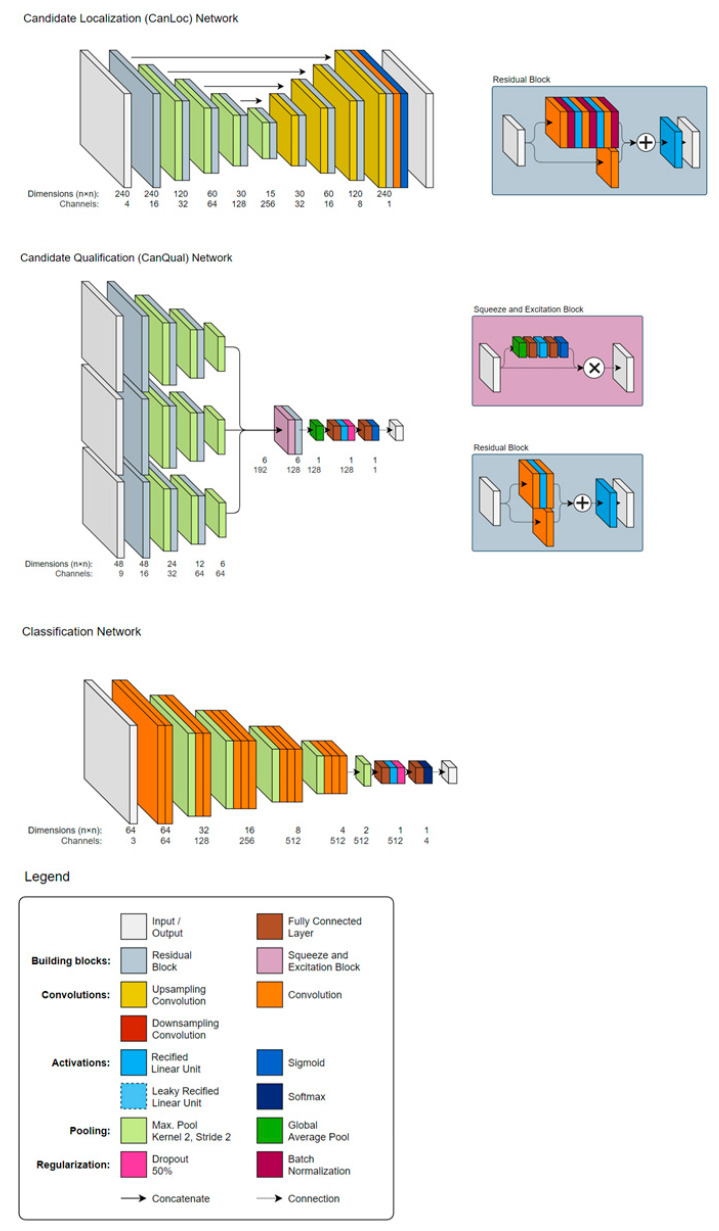
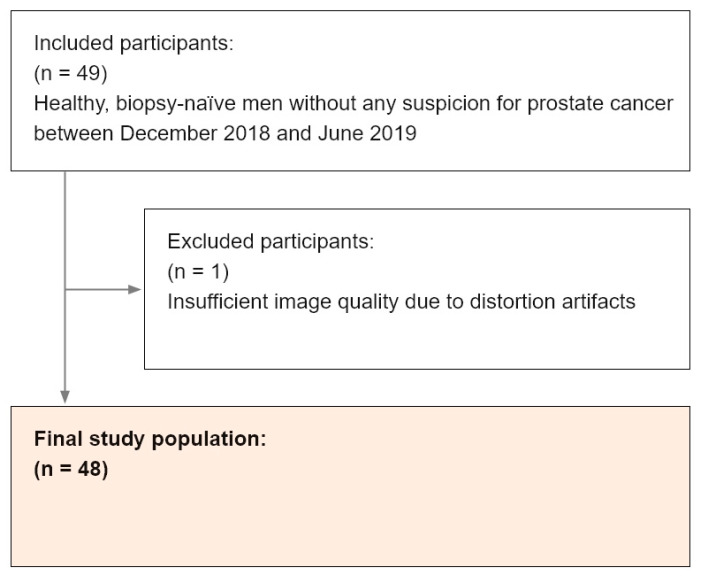
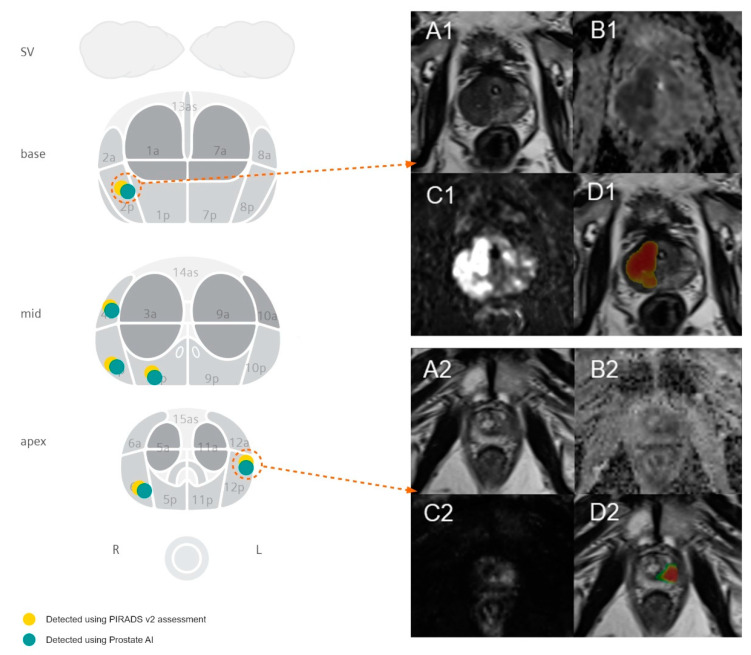
Opportunistic prostate cancer (PCa) screening is a controversial topic. Magnetic resonance imaging (MRI) has proven to detect prostate cancer with a high sensitivity and specificity, leading to the idea to perform an image-guided prostate cancer (PCa) screening; Methods: We evaluated a prospectively enrolled cohort of 49 healthy men participating in a dedicated image-guided PCa screening trial employing a biparametric MRI (bpMRI) protocol consisting of T2-weighted (T2w) and diffusion weighted imaging (DWI) sequences. Datasets were analyzed both by human readers and by a fully automated artificial intelligence (AI) software using deep learning (DL). Agreement between the algorithm and the reports-serving as the ground truth-was compared on a per-case and per-lesion level using metrics of diagnostic accuracy and k statistics; Results: The DL method yielded an 87% sensitivity (33/38) and 50% specificity (5/10) with a k of 0.42. 12/28 (43%) Prostate Imaging Reporting and Data System (PI-RADS) 3, 16/22 (73%) PI-RADS 4, and 5/5 (100%) PI-RADS 5 lesions were detected compared to the ground truth. Targeted biopsy revealed PCa in six participants, all correctly diagnosed by both the human readers and AI.
The results of our study show that in our AI-assisted, image-guided prostate cancer screening the software solution was able to identify highly suspicious lesions and has the potential to effectively guide the targeted-biopsy workflow.
机会性前列腺癌(PCa)筛查是一个有争议的话题。磁共振成像(MRI)已被证明能以高灵敏度和特异性检测前列腺癌,由此产生了进行图像引导的前列腺癌(PCa)筛查的想法。方法:我们评估了一个前瞻性纳入的队列,该队列由49名健康男性组成,他们参与了一项专门的图像引导PCa筛查试验,采用了由T2加权(T2w)和扩散加权成像(DWI)序列组成的双参数MRI(bpMRI)方案。数据集由人工阅片者和使用深度学习(DL)的全自动人工智能(AI)软件进行分析。使用诊断准确性指标和k统计量,在每个病例和每个病灶水平上比较算法与作为金标准的报告之间的一致性。结果:DL方法的灵敏度为87%(33/38),特异性为50%(5/10),k值为0.42。与金标准相比,检测到12/28(43%)的前列腺影像报告和数据系统(PI-RADS)3类、16/22(73%)的PI-RADS 4类和5/5(100%)的PI-RADS 5类病灶。靶向活检在6名参与者中发现了PCa,人工阅片者和AI均正确诊断。
我们的研究结果表明,在我们的AI辅助图像引导前列腺癌筛查中,该软件解决方案能够识别高度可疑的病灶,并有可能有效指导靶向活检工作流程。