Sezer Sümeyye, Piai Vitoria, Kessels Roy P C, Ter Laan Mark
Department of Neurosurgery, Radboud University Medical Center, 6525 GA Nijmegen, The Netherlands.
Department of Medical Psychology, Radboud University Medical Center, 6525 GA Nijmegen, The Netherlands.
J Clin Med. 2020 Nov 13;9(11):3660. doi: 10.3390/jcm9113660.
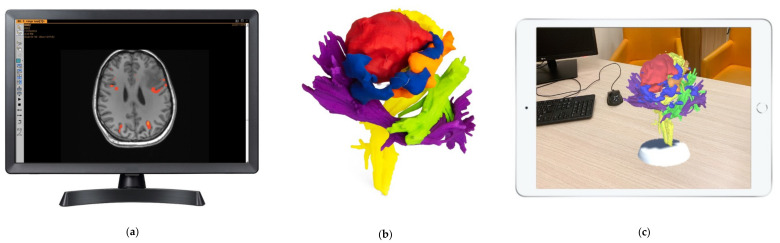
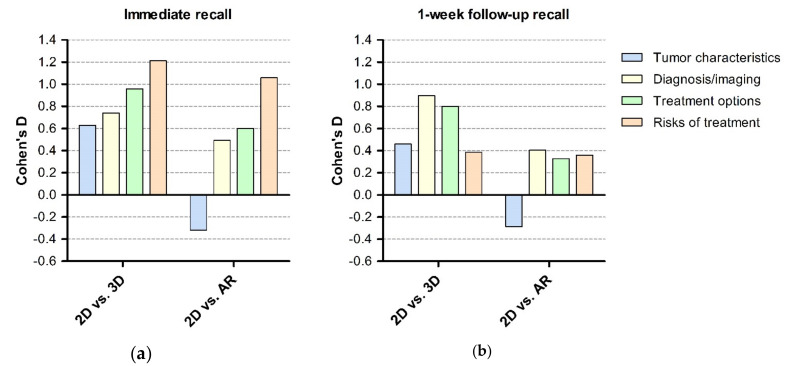
Three-dimensional (3D) technologies are being used for patient education. For glioma, a personalized 3D model can show the patient specific tumor and eloquent areas. We aim to compare the amount of information that is understood and can be recalled after a pre-operative consult using a 3D model (physically printed or in Augmented Reality (AR)) versus two-dimensional (2D) MR images. In this explorative study, healthy individuals were eligible to participate. Sixty-one participants were enrolled and assigned to either the 2D (MRI/fMRI), 3D (physical 3D model) or AR groups. After undergoing a mock pre-operative consultation for low-grade glioma surgery, participants completed two assessments (one week apart) testing information recall using a standardized questionnaire. The 3D group obtained the highest recall scores on both assessments (Cohen's d = 1.76 and Cohen's d = 0.94, respectively, compared to 2D), followed by AR and 2D, respectively. Thus, real-size 3D models appear to improve information recall as compared to MR images in a pre-operative consultation for glioma cases. Future clinical studies should measure the efficacy of using real-size 3D models in actual neurosurgery patients.
三维(3D)技术正被用于患者教育。对于神经胶质瘤,个性化的3D模型可以向患者展示特定的肿瘤和明确的区域。我们旨在比较在术前咨询中使用3D模型(实体打印或增强现实(AR))与二维(2D)磁共振成像(MRI)后,患者理解并能回忆起的信息量。在这项探索性研究中,健康个体有资格参与。61名参与者被招募并分配到2D(MRI/fMRI)、3D(实体3D模型)或AR组。在接受了一次模拟的低级别神经胶质瘤手术术前咨询后,参与者完成了两项评估(相隔一周),使用标准化问卷测试信息回忆情况。3D组在两项评估中均获得了最高的回忆分数(与2D组相比,Cohen's d分别为1.76和0.94),其次是AR组和2D组。因此,在神经胶质瘤病例的术前咨询中,与MRI图像相比,实物大小的3D模型似乎能提高信息回忆能力。未来的临床研究应衡量在实际神经外科手术患者中使用实物大小的3D模型的效果。