Department of Molecular Biology and Microbiology, Graduate School of Biomedical Sciences, Tufts University, School of Medicine, Boston, Massachusetts, USA.
Department of Molecular Biology and Microbiology, Graduate School of Biomedical Sciences, Tufts University, School of Medicine, Boston, Massachusetts, USA
mSphere. 2020 Nov 18;5(6):e00813-20. doi: 10.1128/mSphere.00813-20.
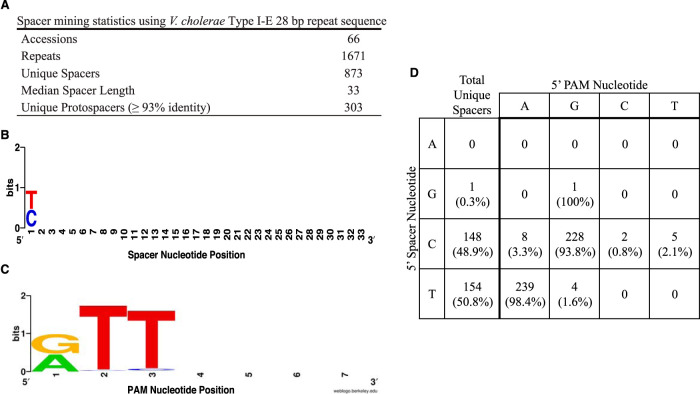
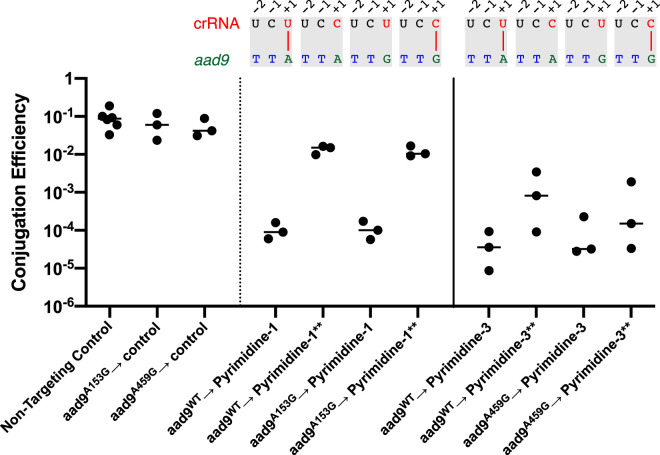
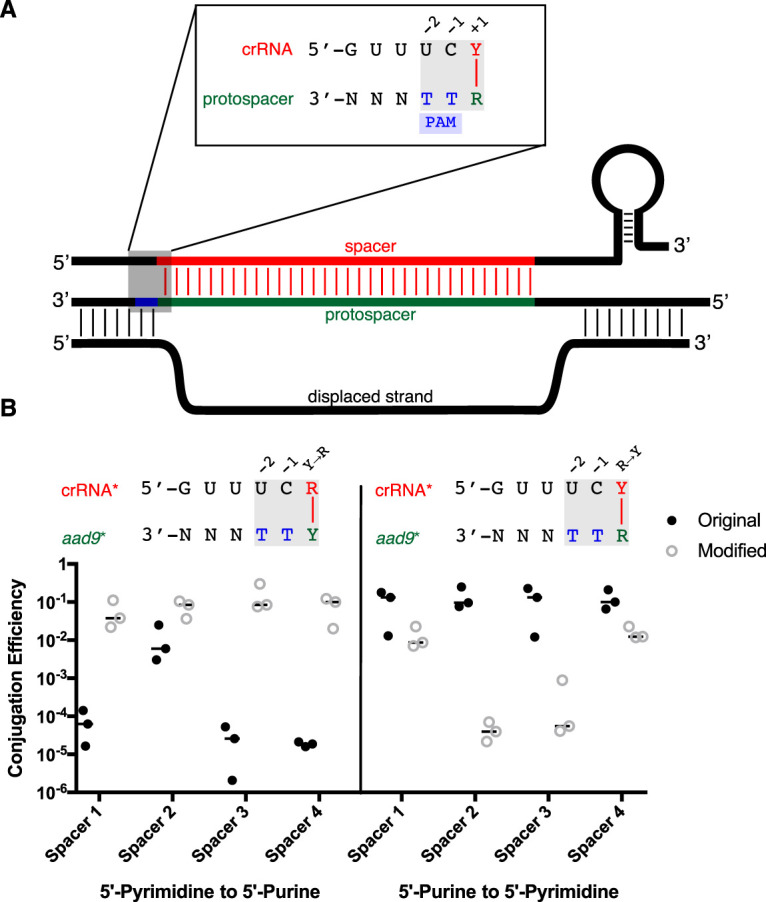
The prokaryotic adaptive immune system CRISPR/Cas serves as a defense against bacteriophage and invasive nucleic acids. A type I-E CRISPR/Cas system has been detected in classical biotype isolates of , the causative agent of the disease cholera. Experimental characterization of this system revealed a functional immune system that operates using a 5'-TT-3' protospacer-adjacent motif (PAM) for interference. However, several designed spacers against the 5'-TT-3' PAM do not interfere as expected, indicating that further investigation of this system is necessary. In this study, we identified additional conserved sequences, including a pyrimidine in the 5' position of the spacer and a purine in the complementary position of the protospacer using 873 unique spacers and 2,267 protospacers mined from CRISPR arrays in deposited sequences of We present bioinformatic evidence that during acquisition the protospacer purine is captured in the prespacer and that a 5'-RTT-3' PAM is necessary for spacer acquisition. Finally, we demonstrate experimentally, by designing and manipulating spacer and cognate PAMs in a plasmid conjugation assay, that a 5'-RTT-3' PAM is necessary for CRISPR interference, and we discover functional consequences for spacer efficacy related to the identity of the 5' spacer pyrimidine. Bacterial CRISPR/Cas systems provide immunity by defending against phage and other invading elements. A thorough comprehension of the molecular mechanisms employed by these diverse systems will improve our understanding of bacteriophage-bacterium interactions and bacterial adaptation to foreign DNA. The type I-E system was previously identified in an extinct classical biotype and was partially characterized for its function. Here, using both bioinformatic and functional assays, we extend that initial study. We have found that the type I-E system still exists in modern strains of Furthermore, we defined additional sequence elements both in the CRISPR array and in target DNA that are required for immunity. CRISPR/Cas systems are now commonly used as precise and powerful genetic engineering tools. Knowledge of the sequences required for CRISPR/Cas immunity is a prerequisite for the effective design and experimental use of these systems. Our results greatly facilitate the effective use of one such system. Furthermore, we provide a publicly available software program that assists in the detection and validation of CRISPR/Cas immunity requirements when such a system exists in a bacterial species.
原核生物适应性免疫系统 CRISPR/Cas 可防御噬菌体和入侵核酸。在霍乱病原体的经典生物型分离物中检测到 I 型-E CRISPR/Cas 系统。该系统的实验特征表明,它是一种使用 5'-TT-3'原间隔邻近基序(PAM)进行干扰的功能免疫系统。然而,针对 5'-TT-3'PAM 的几个设计间隔子并没有按预期进行干扰,这表明需要进一步研究该系统。在这项研究中,我们使用从已发表的序列中 CRISPR 数组中挖掘的 873 个独特间隔子和 2267 个原间隔子,鉴定了其他保守序列,包括间隔子 5'位置的嘧啶和原间隔子互补位置的嘌呤。我们提出了生物信息学证据,表明在获取过程中原间隔子的嘌呤被捕获在前间隔子中,并且 5'-RTT-3'PAM 是间隔子获取所必需的。最后,我们通过在质粒接合测定中设计和操纵间隔子和同源 PAM,实验证明 5'-RTT-3'PAM 是 CRISPR 干扰所必需的,并且我们发现与 5'间隔子嘧啶的身份相关的间隔子功效的功能后果。细菌 CRISPR/Cas 系统通过防御噬菌体和其他入侵元件来提供免疫。深入了解这些不同系统所采用的分子机制将提高我们对噬菌体-细菌相互作用和细菌对异源 DNA 的适应的理解。I 型-E 系统以前在已灭绝的经典生物型中被发现,并对其功能进行了部分特征描述。在这里,我们使用生物信息学和功能测定法扩展了最初的研究。我们发现,I 型-E 系统仍然存在于现代的霍乱菌株中。此外,我们定义了 CRISPR 数组和靶 DNA 中都需要的其他序列元件来实现免疫。CRISPR/Cas 系统现在通常被用作精确而强大的遗传工程工具。了解 CRISPR/Cas 免疫所需的序列是有效设计和实验使用这些系统的前提。我们的研究结果极大地促进了对其中一个系统的有效利用。此外,我们提供了一个公共可用的软件程序,当细菌中存在这样的系统时,该程序可以帮助检测和验证 CRISPR/Cas 免疫要求。