Department of Cardiology, Beni-Suef University, Beni-Suef, Egypt.
Department of Cardiology, Tanta University, Tanta, Egypt.
BMC Cardiovasc Disord. 2020 Nov 19;20(1):489. doi: 10.1186/s12872-020-01784-8.
This work aimed to assess the safety of Ramadan Fasting following the Percutaneous Coronary Intervention.
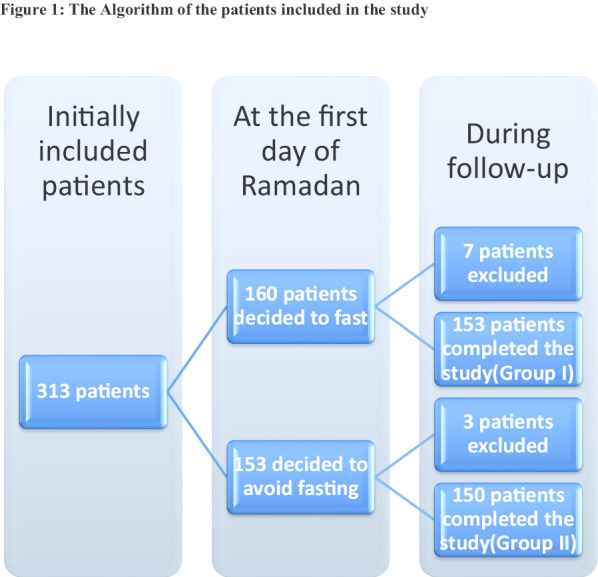
In our two centers' Prospective Cohort Study, We included 303 patients who had successful Percutaneous Coronary Intervention before the first day of Ramadan. We advised the patients that recent Percutaneous Coronary Intervention could be a valid excuse for not fulfilling Ramadan Fasting. However, many patients intended to fast the following Ramadan, and we included them in the fasting Group I. We added the patients who decided not to fast the following Ramadan as a control Group II. We followed all the patients during Ramadan and for 6 months after Ramadan.
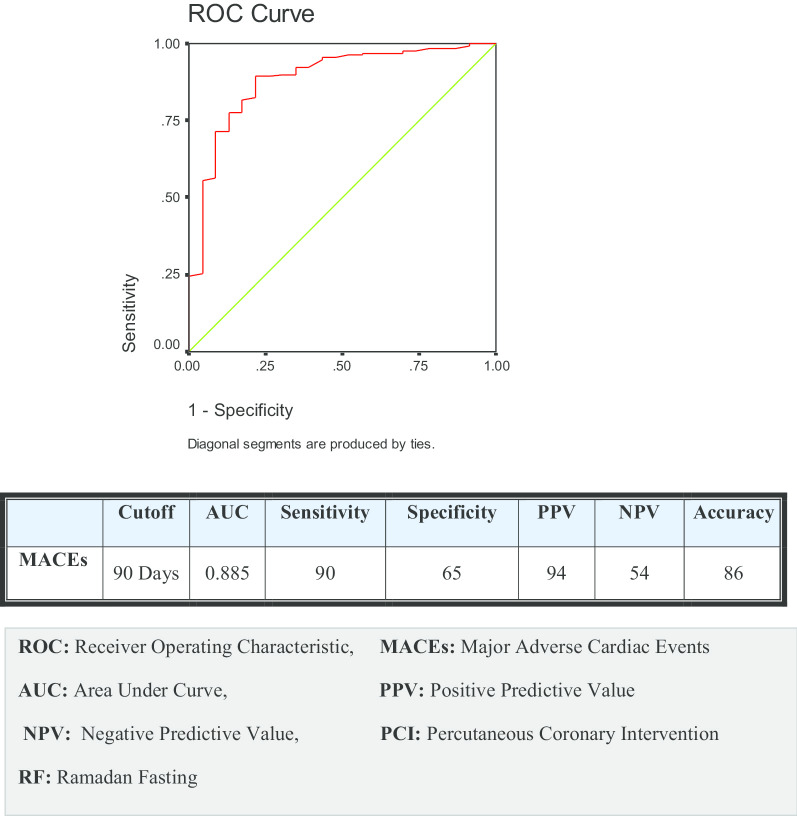
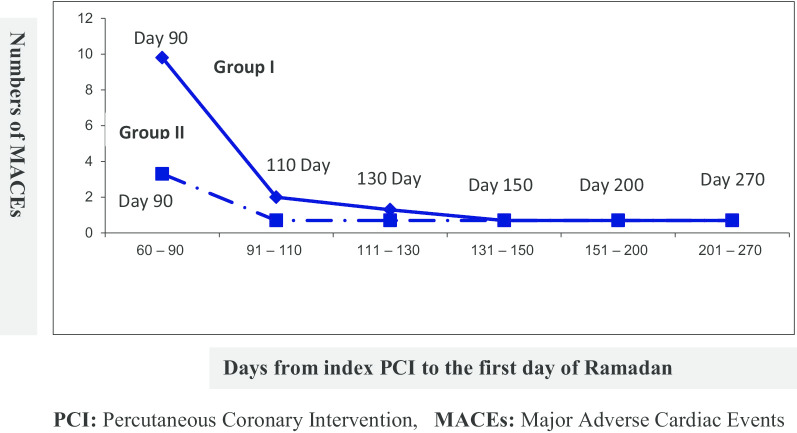
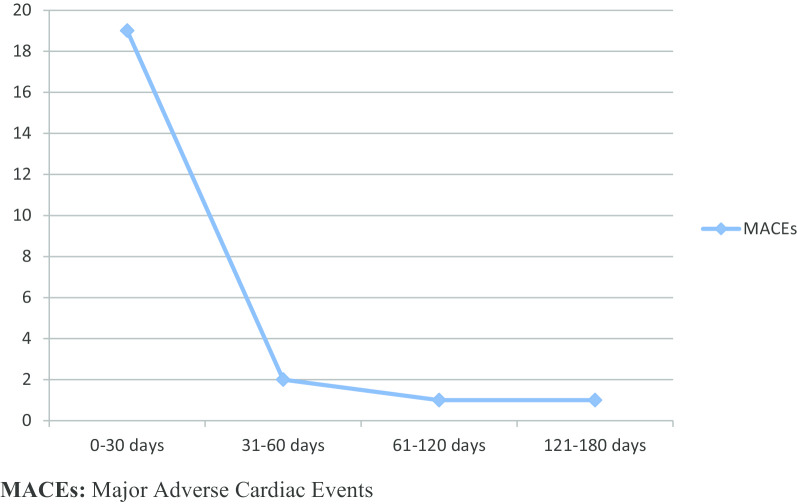
The demographic data of both groups and the complexity of the coronary anatomy showed no statistically significant difference. Group I (n = 153) showed a statistically significant difference in the incidence of Major Adverse Cardiac Events compared to Group II with a P value (0.005). The logistic multivariate regression analysis showed that the duration from index PCI till the start of RF, SYNTAX score > 22, and Complex procedure were independent predictors of Major Adverse Cardiac Events in the fasting Group I with {P = 0.001, OR (2.302), P = 0.026, OR (2.419), and P = 0.032 OR (1.952)}, respectively. Major Adverse Cardiac Events in Group I occurred mainly during Ramadan Fasting, with 19 patients having Major Adverse Cardiac Events during Ramadan and four patients during the remaining of the follow-up period. The Receiver Operating Characteristic curve analysis showed the decline of the incidence of Major Adverse Cardiac Events after 90 days from Percutaneous Coronary Intervention till the start of Ramadan Fasting with Sensitivity and specificity (90% and 65%), respectively.
We suggest that low-risk patients with a normal systolic function who underwent Percutaneous Coronary Intervention may safely fast Ramadan. At the same time, Ramadan Fasting during the first 3 months following the Percutaneous Coronary Intervention may not be safe.
本研究旨在评估经皮冠状动脉介入治疗(PCI)后进行斋月斋戒的安全性。
在我们两个中心的前瞻性队列研究中,我们纳入了 303 名在斋月第一天前成功接受 PCI 的患者。我们建议患者,近期的 PCI 可以作为不遵守斋月斋戒的合理借口。然而,许多患者打算在下一个斋月斋戒,我们将他们纳入斋戒组 I。我们将决定在下一个斋月不斋戒的患者作为对照组 II。我们在斋月期间和斋月结束后 6 个月内对所有患者进行随访。
两组患者的人口统计学数据和冠状动脉解剖结构的复杂性均无统计学差异。与对照组 II 相比,斋戒组 I(n=153)的主要不良心脏事件发生率存在统计学差异,P 值为 0.005。多变量逻辑回归分析显示,从 PCI 到开始斋戒的时间、SYNTAX 评分>22 和复杂操作是斋戒组 I 中主要不良心脏事件的独立预测因素,P 值分别为 0.001(OR 2.302)、0.026(OR 2.419)和 0.032(OR 1.952)。斋戒组 I 的主要不良心脏事件主要发生在斋月斋戒期间,19 名患者在斋月期间发生主要不良心脏事件,4 名患者在随访期间的剩余时间内发生主要不良心脏事件。受试者工作特征曲线分析显示,从 PCI 到开始斋戒的 90 天内,主要不良心脏事件的发生率下降,敏感性和特异性分别为 90%和 65%。
我们建议低危且收缩功能正常的 PCI 术后患者可以安全地进行斋月斋戒。同时,PCI 后 3 个月内进行斋月斋戒可能不安全。