Center for Neural Science, New York University, New York City, New York, USA.
Princeton Neuroscience Institute, Princeton University, Princeton, New Jersey, USA.
PLoS Comput Biol. 2020 Nov 20;16(11):e1008261. doi: 10.1371/journal.pcbi.1008261. eCollection 2020 Nov.
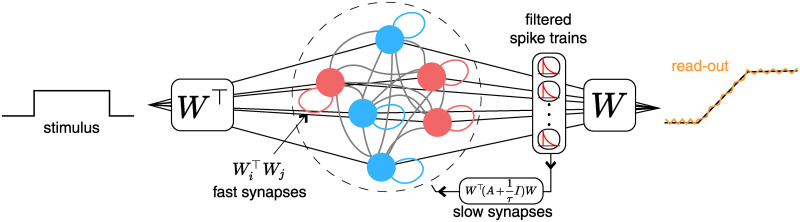
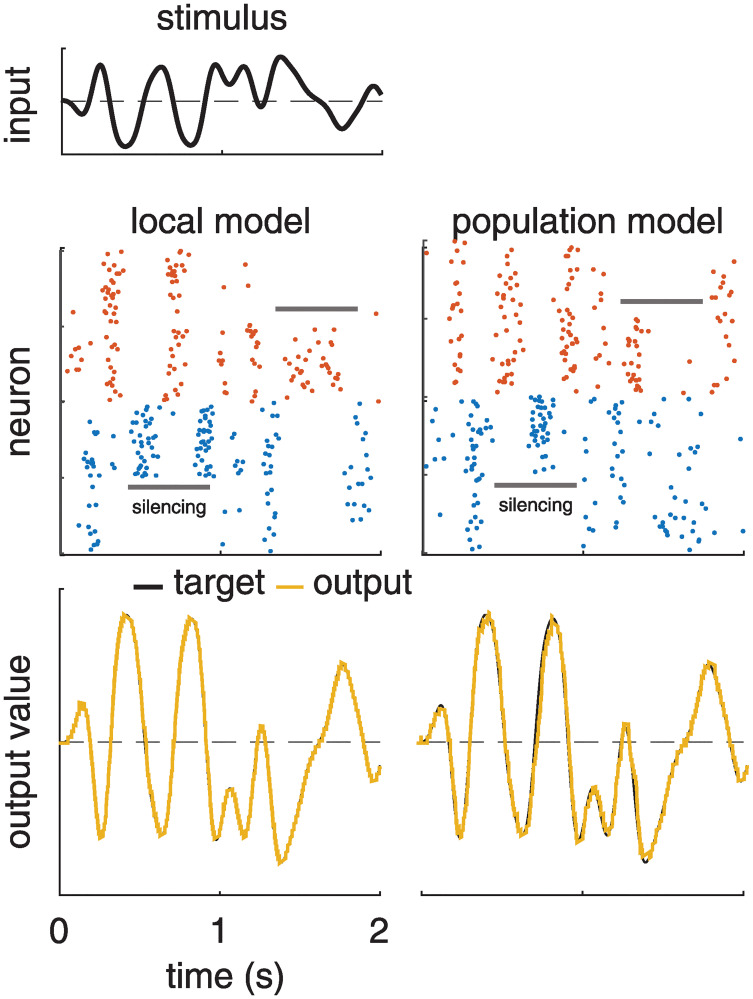
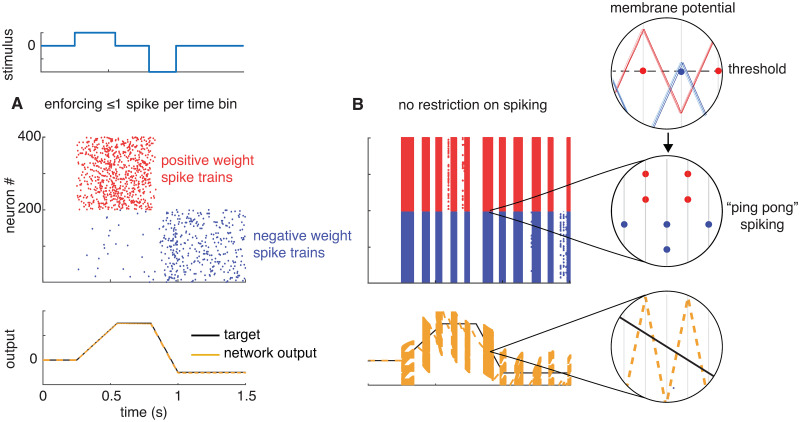
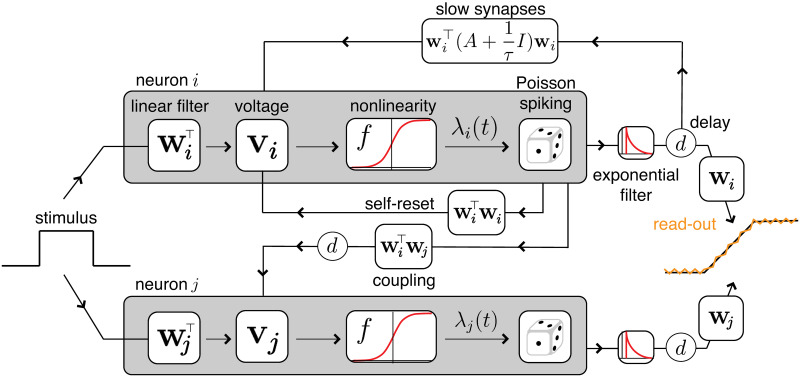
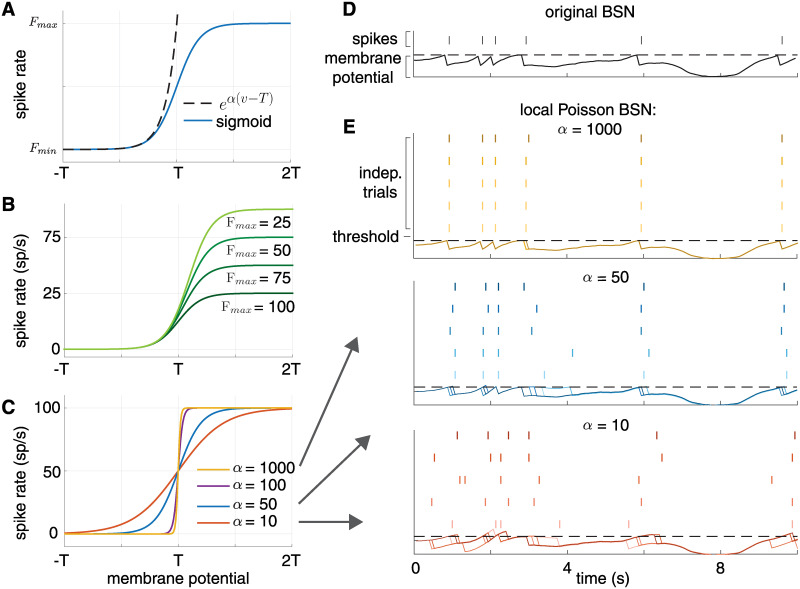
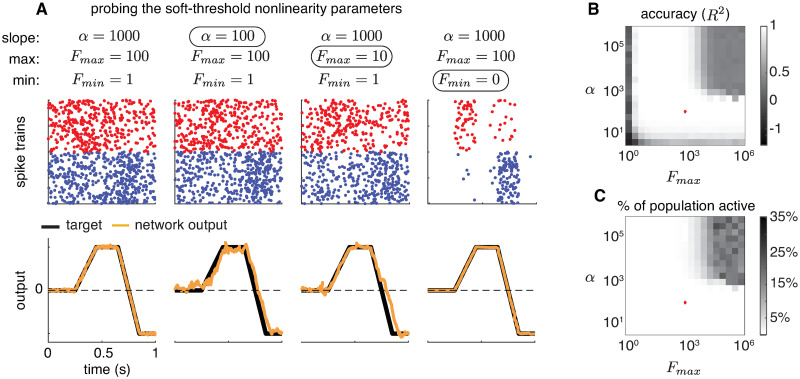
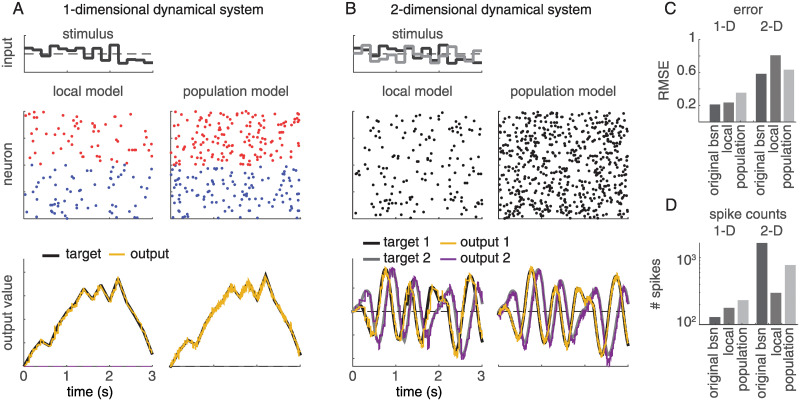
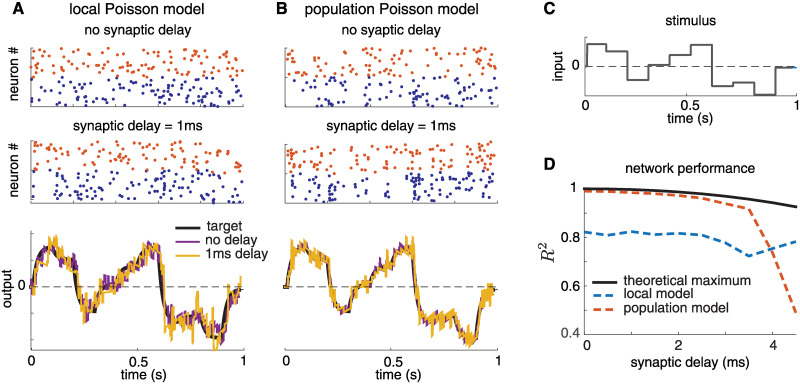
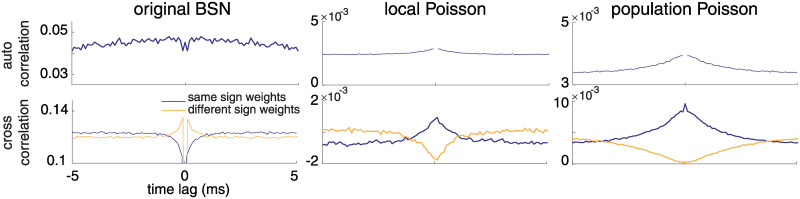
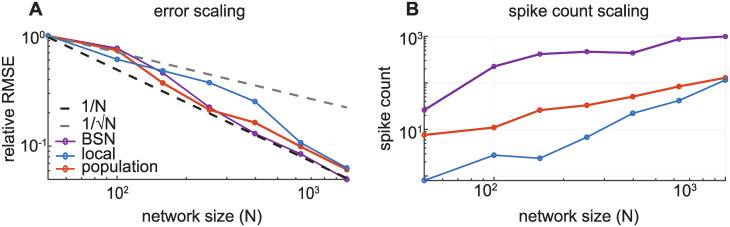
An important problem in computational neuroscience is to understand how networks of spiking neurons can carry out various computations underlying behavior. Balanced spiking networks (BSNs) provide a powerful framework for implementing arbitrary linear dynamical systems in networks of integrate-and-fire neurons. However, the classic BSN model requires near-instantaneous transmission of spikes between neurons, which is biologically implausible. Introducing realistic synaptic delays leads to an pathological regime known as "ping-ponging", in which different populations spike maximally in alternating time bins, causing network output to overshoot the target solution. Here we document this phenomenon and provide a novel solution: we show that a network can have realistic synaptic delays while maintaining accuracy and stability if neurons are endowed with conditionally Poisson firing. Formally, we propose two alternate formulations of Poisson balanced spiking networks: (1) a "local" framework, which replaces the hard integrate-and-fire spiking rule within each neuron by a "soft" threshold function, such that firing probability grows as a smooth nonlinear function of membrane potential; and (2) a "population" framework, which reformulates the BSN objective function in terms of expected spike counts over the entire population. We show that both approaches offer improved robustness, allowing for accurate implementation of network dynamics with realistic synaptic delays between neurons. Both Poisson frameworks preserve the coding accuracy and robustness to neuron loss of the original model and, moreover, produce positive correlations between similarly tuned neurons, a feature of real neural populations that is not found in the deterministic BSN. This work unifies balanced spiking networks with Poisson generalized linear models and suggests several promising avenues for future research.
计算神经科学中的一个重要问题是了解脉冲神经元网络如何执行行为背后的各种计算。 平衡脉冲神经网络 (BSN) 为在积分-点火神经元网络中实现任意线性动力系统提供了强大的框架。 然而,经典的 BSN 模型要求神经元之间的尖峰几乎瞬间传输,这在生物学上是不可信的。 引入现实的突触延迟会导致一种称为“乒乓”的病理状态,其中不同的群体在交替的时间窗中最大程度地爆发,导致网络输出超过目标解。 在这里,我们记录了这一现象并提供了一个新的解决方案:我们表明,如果神经元具有条件泊松点火,则网络可以具有现实的突触延迟,同时保持准确性和稳定性。 正式地,我们提出了泊松平衡脉冲网络的两种替代形式:(1)“局部”框架,该框架用“软”阈值函数替换每个神经元中的硬积分-点火脉冲规则,使得点火概率作为膜电位的平滑非线性函数而增长; (2)“群体”框架,该框架根据整个群体的预期尖峰计数重新制定 BSN 目标函数。 我们表明,这两种方法都提供了改进的鲁棒性,允许在神经元之间具有现实的突触延迟的情况下准确实现网络动态。 泊松框架都保留了原始模型的编码准确性和对神经元丢失的鲁棒性,而且,产生了类似调谐神经元之间的正相关,这是真实神经群体的一个特征,在确定性 BSN 中没有发现。 这项工作将平衡脉冲神经网络与泊松广义线性模型统一起来,并为未来的研究提出了几个有前途的途径。