Department of Structural Biochemistry, Max Planck Institute of Molecular Physiology, Dortmund, Germany.
PLoS Biol. 2020 Nov 20;18(11):e3000925. doi: 10.1371/journal.pbio.3000925. eCollection 2020 Nov.
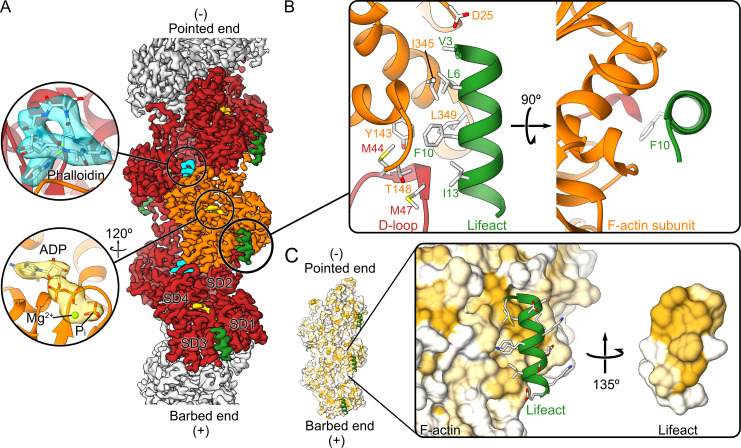
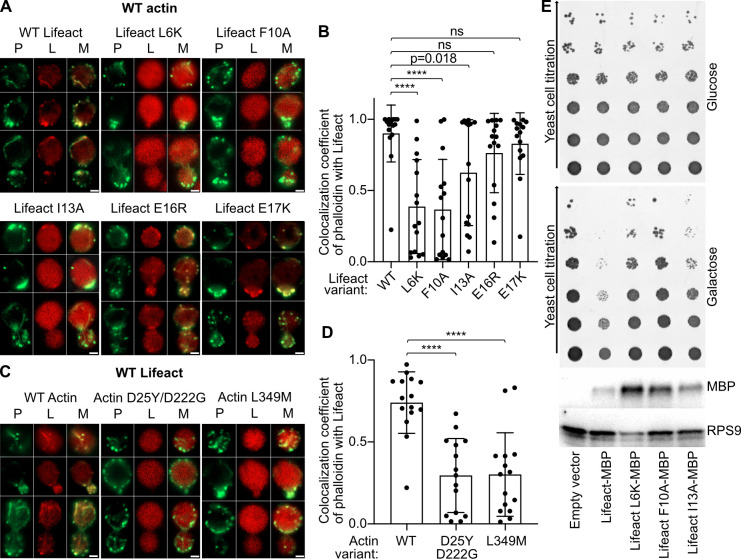
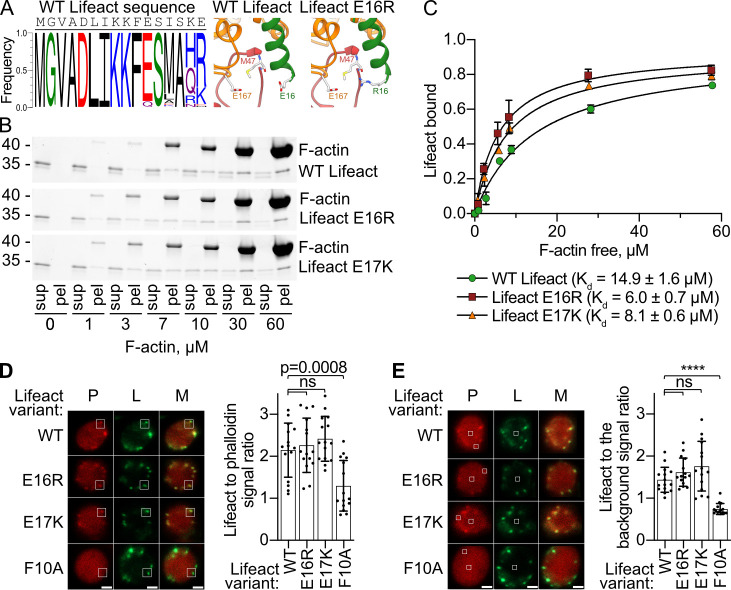
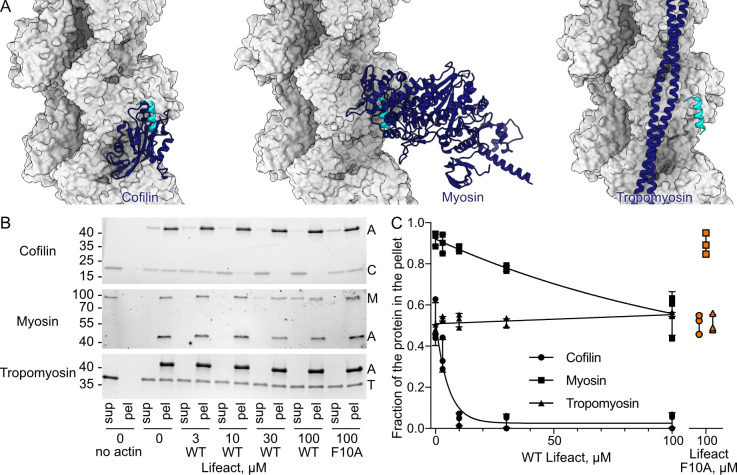
Lifeact is a short actin-binding peptide that is used to visualize filamentous actin (F-actin) structures in live eukaryotic cells using fluorescence microscopy. However, this popular probe has been shown to alter cellular morphology by affecting the structure of the cytoskeleton. The molecular basis for such artefacts is poorly understood. Here, we determined the high-resolution structure of the Lifeact-F-actin complex using electron cryo-microscopy (cryo-EM). The structure reveals that Lifeact interacts with a hydrophobic binding pocket on F-actin and stretches over 2 adjacent actin subunits, stabilizing the DNase I-binding loop (D-loop) of actin in the closed conformation. Interestingly, the hydrophobic binding site is also used by actin-binding proteins, such as cofilin and myosin and actin-binding toxins, such as the hypervariable region of TccC3 (TccC3HVR) from Photorhabdus luminescens and ExoY from Pseudomonas aeruginosa. In vitro binding assays and activity measurements demonstrate that Lifeact indeed competes with these proteins, providing an explanation for the altering effects of Lifeact on cell morphology in vivo. Finally, we demonstrate that the affinity of Lifeact to F-actin can be increased by introducing mutations into the peptide, laying the foundation for designing improved actin probes for live cell imaging.
Lifeact 是一种短的肌动蛋白结合肽,用于通过荧光显微镜观察活真核细胞中的丝状肌动蛋白(F-actin)结构。然而,这种流行的探针已被证明通过影响细胞骨架的结构来改变细胞形态。对于这种人为假象的分子基础了解甚少。在这里,我们使用电子 cryo-显微镜(cryo-EM)确定了 Lifeact-F-actin 复合物的高分辨率结构。该结构表明,Lifeact 与 F-actin 上的疏水结合口袋相互作用,并延伸到 2 个相邻的肌动蛋白亚基上,稳定肌动蛋白的 DNase I 结合环(D-loop)处于封闭构象。有趣的是,疏水结合位点也被肌动蛋白结合蛋白(如丝切蛋白和肌球蛋白)以及肌动蛋白结合毒素(如 Photorhabdus luminescens 的 TccC3 超变区(TccC3HVR)和 Pseudomonas aeruginosa 的 ExoY)使用。体外结合测定和活性测量表明,Lifeact 确实与这些蛋白质竞争,为 Lifeact 在体内改变细胞形态的作用提供了解释。最后,我们证明 Lifeact 对 F-actin 的亲和力可以通过引入肽中的突变来增加,为设计用于活细胞成像的改良肌动蛋白探针奠定了基础。