Centro Oceanográfico de Vigo, Instituto Español de Oceanografía (IEO), 36390 Vigo, Spain.
Centro de Investigacións Mariñas (CIMA), 36620 Vilanova de Arousa, Spain.
Toxins (Basel). 2020 Nov 19;12(11):723. doi: 10.3390/toxins12110723.
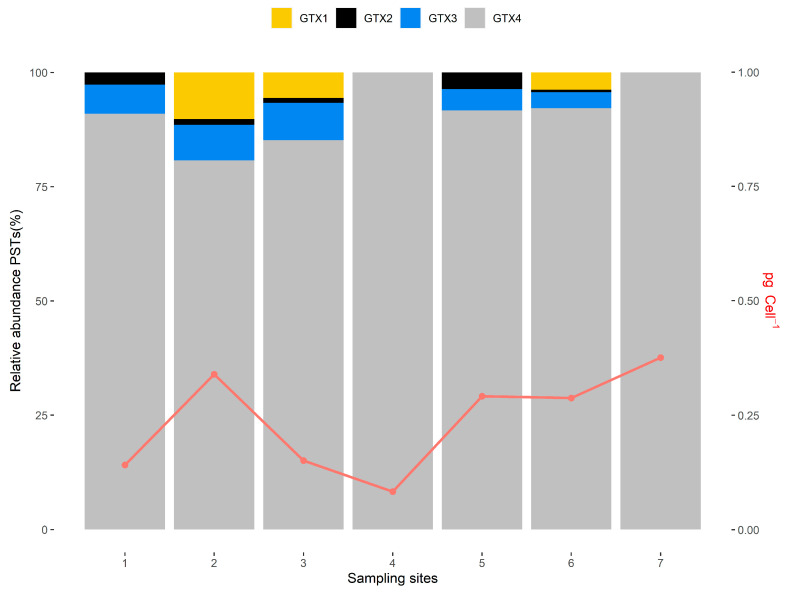
A paralytic shellfish poisoning (PSP) episode developed in summer 2018 in the Rías Baixas (Galicia, NW Spain). The outbreak was associated with an unprecedentedly intense and long-lasting harmful algal bloom (HAB) (~one month) caused by the dinoflagellate . Paralytic shellfish toxins (PSTs) were analyzed in extracts of 45 strains isolated from the bloom by high-performance liquid chromatography with post-column oxidation and fluorescence detection (HPLC-PCOX-FLD). PSTs were also evaluated in tissues from marine fauna (invertebrates and fish) collected during the episode and in dolphin samples. The analysis of 45 strains revealed a toxic profile including GTX1, GTX2, GTX3 and GTX4 toxins. With regard to the marine fauna samples, the highest PSTs levels were quantified in bivalve mollusks, but the toxins were also found in mullets, mackerels, starfish, squids and ascidians. This study reveals the potential accumulation of PSTs in marine invertebrates other than shellfish that could act as vectors in the trophic chain or pose a risk for human consumption. To our knowledge, this is the first time that PSTs are reported in ascidians and starfish from Spain. Moreover, it is the first time that evidence of PSTs in squids is described in Europe.
2018 年夏季,里亚斯拜萨地区(西班牙西北部加利西亚)发生麻痹性贝类毒素(PSP)中毒事件。此次疫情与由夜光藻引起的、前所未有的强烈且持久的有害藻华(HAB)有关,藻华持续了约一个月。通过高效液相色谱-柱后氧化-荧光检测法(HPLC-PCOX-FLD)对从藻华样本中分离出的 45 株藻株提取物中的麻痹性贝类毒素(PSTs)进行了分析。还评估了在此次事件期间采集的海洋动物(无脊椎动物和鱼类)组织以及海豚样本中的 PSTs 含量。对 45 株藻株的分析显示,其毒性谱包括 GTX1、GTX2、GTX3 和 GTX4 毒素。就海洋动物样本而言,贝类以外的双壳类软体动物中 PSTs 含量最高,但在鲻鱼、鲭鱼、海星、鱿鱼和海鞘中也发现了这些毒素。本研究表明 PSTs 可能在贝类以外的海洋无脊椎动物中积累,这些动物可能在食物链中充当载体或对人类食用构成风险。据我们所知,这是西班牙首次在海鞘和海星中报告 PSTs,也是首次在欧洲描述鱿鱼中的 PSTs 证据。