Department of Genetics and Evolution, University of Geneva, 1211 Geneva, Switzerland;
School of Life Sciences, Ecole Polytechnique Fédérale de Lausanne, 1015 Lausanne, Switzerland.
Proc Natl Acad Sci U S A. 2020 Dec 8;117(49):31231-31241. doi: 10.1073/pnas.2015083117. Epub 2020 Nov 23.
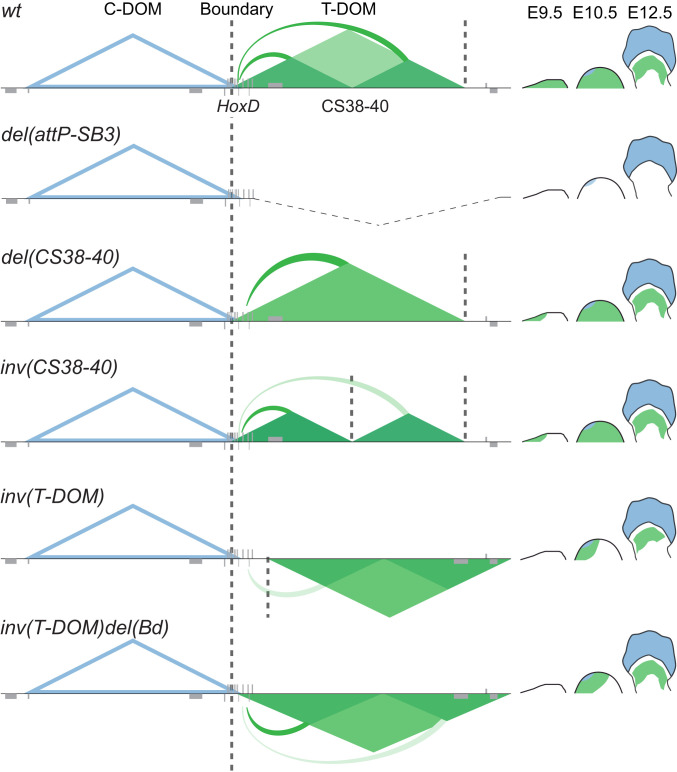
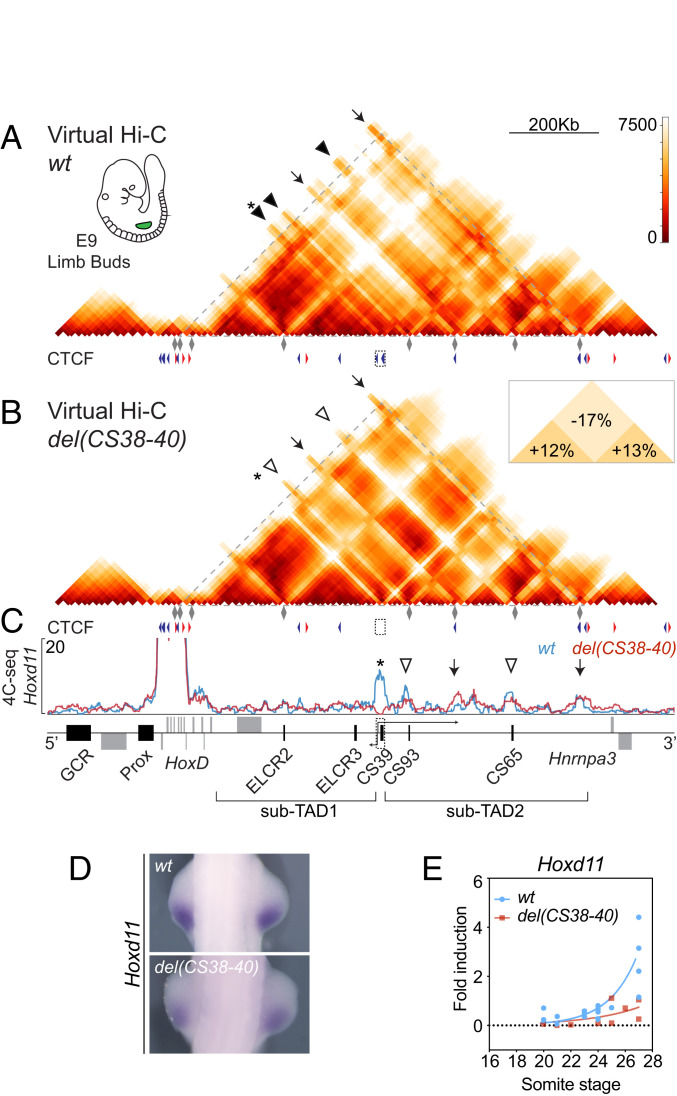
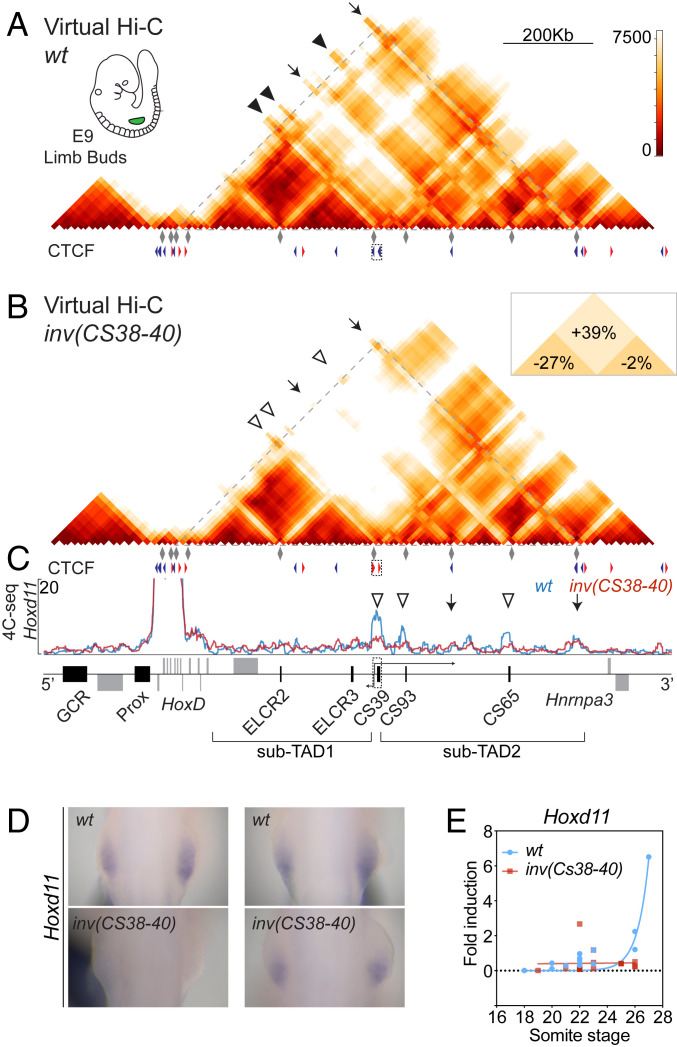
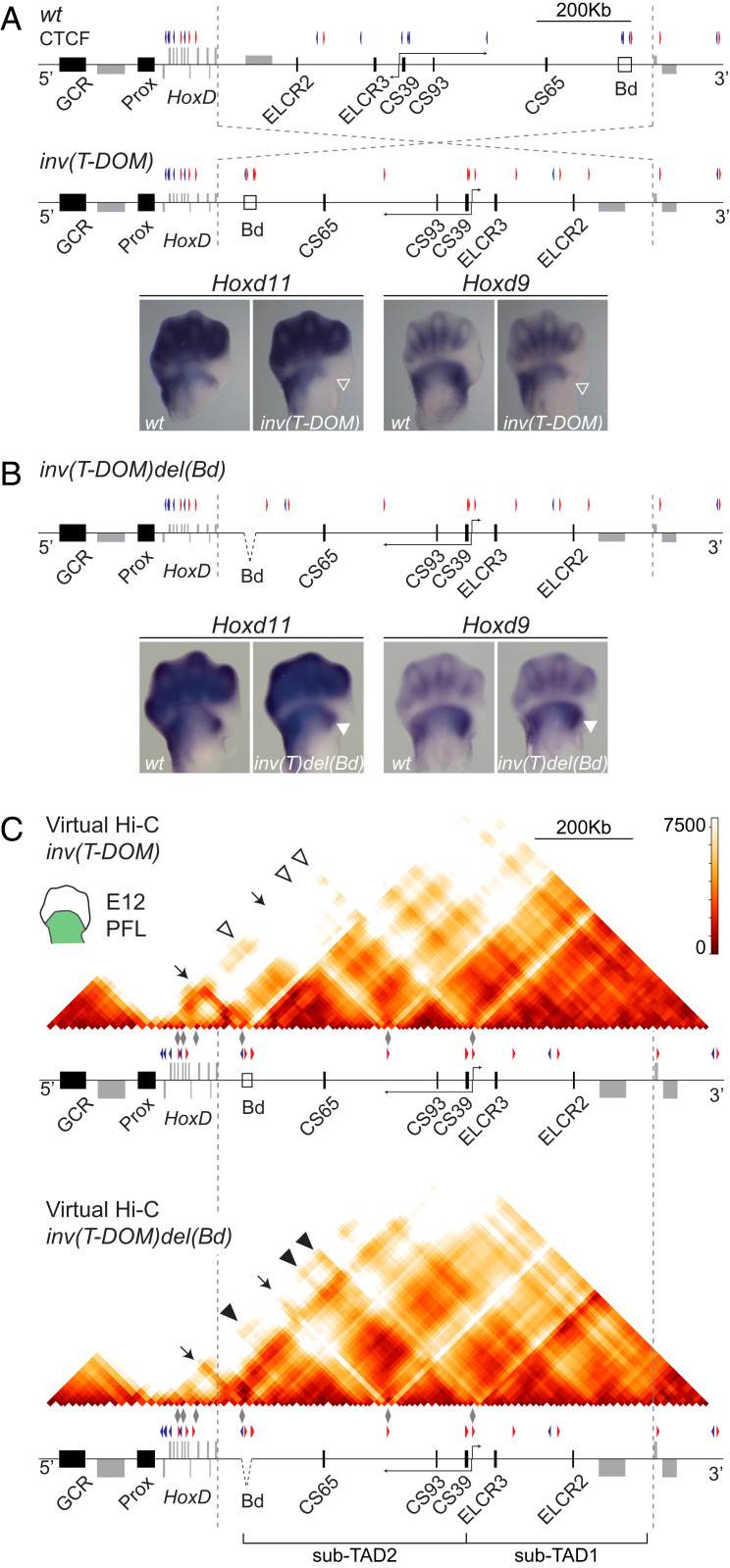
The gene cluster is critical for proper limb formation in tetrapods. In the emerging limb buds, different subgroups of genes respond first to a proximal regulatory signal, then to a distal signal that organizes digits. These two regulations are exclusive from one another and emanate from two distinct topologically associating domains (TADs) flanking , both containing a range of appropriate enhancer sequences. The telomeric TAD (T-DOM) contains several enhancers active in presumptive forearm cells and is divided into two sub-TADs separated by a CTCF-rich boundary, which defines two regulatory submodules. To understand the importance of this particular regulatory topology to control gene transcription in time and space, we either deleted or inverted this sub-TAD boundary, eliminated the CTCF binding sites, or inverted the entire T-DOM to exchange the respective positions of the two sub-TADs. The effects of such perturbations on the transcriptional regulation of genes illustrate the requirement of this regulatory topology for the precise timing of gene activation. However, the spatial distribution of transcripts was eventually resumed, showing that the presence of enhancer sequences, rather than either their exact topology or a particular chromatin architecture, is the key factor. We also show that the affinity of enhancers to find their natural target genes can overcome the presence of both a strong TAD border and an unfavorable orientation of CTCF sites.
基因簇对于四足动物四肢的正常形成至关重要。在新形成的肢芽中,不同亚群的基因首先对近端调控信号作出反应,然后对组织指骨的远端信号作出反应。这两种调控是相互排斥的,源自两个不同的拓扑关联域(TAD),它们侧翼排列,都包含一系列适当的增强子序列。端粒 TAD(T-DOM)包含几个在假定的前臂细胞中活跃的增强子,并分为两个由富含 CTCF 的边界隔开的亚 TAD,该边界定义了两个调节亚模块。为了了解这种特殊的调控拓扑结构对控制基因转录的时间和空间的重要性,我们删除或反转了这个亚 TAD 边界,消除了 CTCF 结合位点,或者反转了整个 T-DOM,以交换两个亚 TAD 的相应位置。这些扰动对基因转录的影响说明了这种调控拓扑结构对于基因激活的精确时间的必要性。然而,转录本的空间分布最终恢复,表明增强子序列的存在,而不是它们的确切拓扑结构或特定的染色质结构,是关键因素。我们还表明,增强子与寻找其自然靶基因的亲和力可以克服强 TAD 边界和 CTCF 位点不利取向的存在。