University of São Paulo, Av. Dr. Arnaldo, 715 Cerqueira César, São Paulo SP 01246-904, Brazil.
Harvard T.H. Chan School of Public Health, Harvard University, 677 Huntington Ave, Boston, MA 02115, USA.
Int J Environ Res Public Health. 2020 Nov 20;17(22):8639. doi: 10.3390/ijerph17228639.
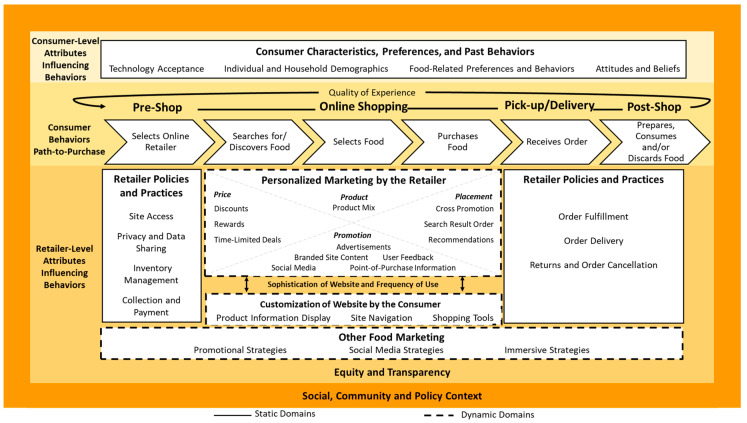
The rapid increase in online shopping and the extension of online food purchase and delivery services to federal nutrition program participants highlight the need for a conceptual framework capturing the influence of online food retail environments on consumer behaviors. This study aims to develop such a conceptual framework. To achieve this, mixed methods were used, including: (1) a literature review and development of an initial framework; (2) key informant interviews; (3) pilot testing and refinement of the draft framework; and (4) a group discussion with experts to establish content validity. The resulting framework captures both consumer- and retailer-level influences across the entire shopping journey, as well as the broader social, community, and policy context. It identifies important factors such as consumer demographic characteristics, preferences, past behaviors, and retailer policies and practices. The framework also emphasizes the dynamic nature of personalized marketing by retailers and customizable website content, and captures equity and transparency in retailer policies and practices. The framework draws from multiple disciplines, providing a foundation for understanding the impact of online food retail on dietary behaviors. It can be utilized to inform public health interventions, retailer practices, and governmental policies for creating healthy and equitable online food retail environments.
在线购物的迅速增长以及将在线食品购买和配送服务扩展到联邦营养计划参与者,突出了需要一个概念框架来捕捉在线食品零售环境对消费者行为的影响。本研究旨在开发这样一个概念框架。为了实现这一目标,采用了混合方法,包括:(1)文献综述和初始框架的制定;(2)关键知情人访谈;(3)草案框架的试点测试和完善;以及(4)与专家进行小组讨论以建立内容有效性。由此产生的框架既捕捉了整个购物过程中消费者和零售商层面的影响,也捕捉了更广泛的社会、社区和政策背景。它确定了一些重要因素,如消费者人口统计学特征、偏好、过去的行为以及零售商的政策和做法。该框架还强调了零售商个性化营销和可定制网站内容的动态性质,并捕捉了零售商政策和做法中的公平性和透明度。该框架借鉴了多个学科,为理解在线食品零售对饮食行为的影响提供了基础。它可以用于为创建健康和公平的在线食品零售环境提供公共卫生干预、零售商实践和政府政策的信息。