Department of Radiology, Severance Hospital, Research Institute of Radiological Science, Yonsei University, College of Medicine, Seoul, South Korea.
Department of Computational Science and Engineering, Yonsei University, Seoul, South Korea.
PLoS One. 2020 Nov 25;15(11):e0242806. doi: 10.1371/journal.pone.0242806. eCollection 2020.
To investigate whether a computer-aided diagnosis (CAD) program developed using the deep learning convolutional neural network (CNN) on neck US images can predict the BRAFV600E mutation in thyroid cancer.
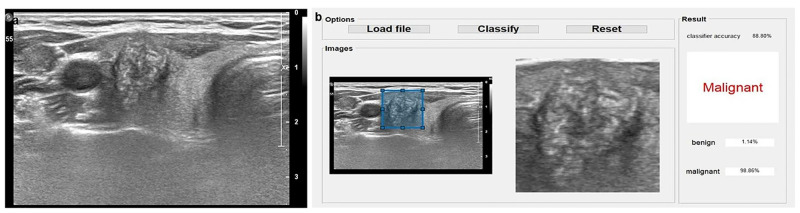
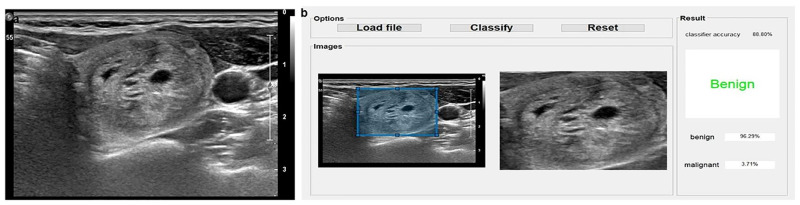
469 thyroid cancers in 469 patients were included in this retrospective study. A CAD program recently developed using the deep CNN provided risks of malignancy (0-100%) as well as binary results (cancer or not). Using the CAD program, we calculated the risk of malignancy based on a US image of each thyroid nodule (CAD value). Univariate and multivariate logistic regression analyses were performed including patient demographics, the American College of Radiology (ACR) Thyroid Imaging, Reporting and Data System (TIRADS) categories and risks of malignancy calculated through CAD to identify independent predictive factors for the BRAFV600E mutation in thyroid cancer. The predictive power of the CAD value and final multivariable model for the BRAFV600E mutation in thyroid cancer were measured using the area under the receiver operating characteristic (ROC) curves.
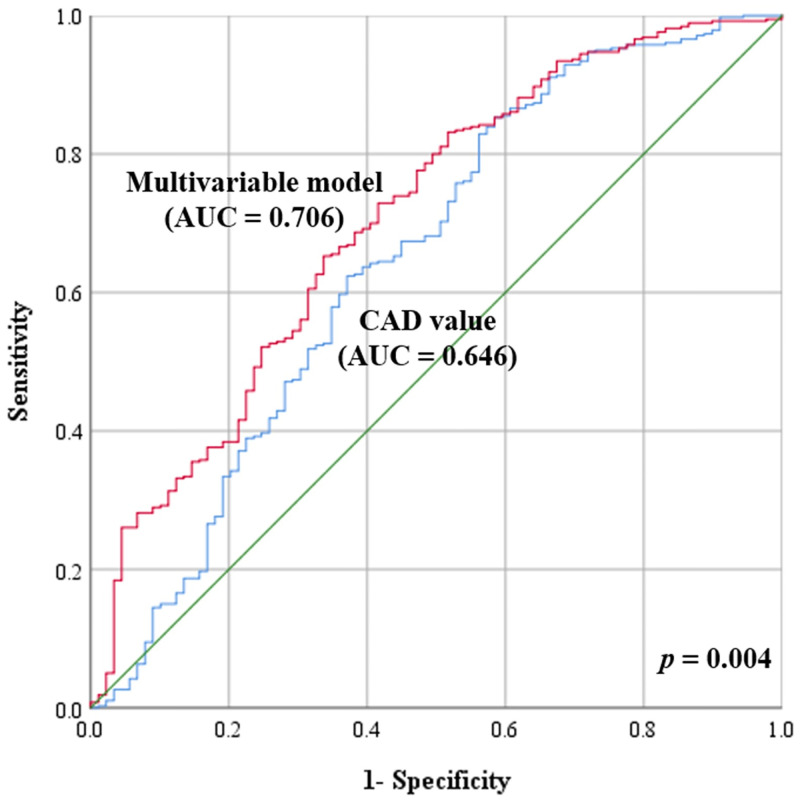
In this study, 380 (81%) patients were positive and 89 (19%) patients were negative for the BRAFV600E mutation. On multivariate analysis, older age (OR = 1.025, p = 0.018), smaller size (OR = 0.963, p = 0.006), and higher CAD value (OR = 1.016, p = 0.004) were significantly associated with the BRAFV600E mutation. The CAD value yielded an AUC of 0.646 (95% CI: 0.576, 0.716) for predicting the BRAFV600E mutation, while the multivariable model yielded an AUC of 0.706 (95% CI: 0.576, 0.716). The multivariable model showed significantly better performance than the CAD value alone (p = 0.004).
Deep learning-based CAD for thyroid US can help us predict the BRAFV600E mutation in thyroid cancer. More multi-center studies with more cases are needed to further validate our study results.
研究基于深度学习卷积神经网络(CNN)的颈部超声计算机辅助诊断(CAD)程序是否可用于预测甲状腺癌的 BRAFV600E 突变。
本回顾性研究纳入了 469 名患者的 469 个甲状腺癌。最近开发的基于深度 CNN 的 CAD 程序提供了恶性肿瘤风险(0-100%)和二分类结果(癌症或非癌症)。我们使用 CAD 程序根据每个甲状腺结节的超声图像计算恶性肿瘤风险(CAD 值)。采用单因素和多因素逻辑回归分析,包括患者的人口统计学资料、美国放射学院(ACR)甲状腺成像报告和数据系统(TIRADS)分类以及通过 CAD 计算的恶性肿瘤风险,以确定甲状腺癌 BRAFV600E 突变的独立预测因素。采用受试者工作特征(ROC)曲线下面积(AUC)评估 CAD 值和最终多变量模型对甲状腺癌 BRAFV600E 突变的预测能力。
本研究中,380 例(81%)患者 BRAFV600E 突变阳性,89 例(19%)患者 BRAFV600E 突变阴性。多因素分析显示,年龄较大(OR=1.025,p=0.018)、结节较小(OR=0.963,p=0.006)和 CAD 值较高(OR=1.016,p=0.004)与 BRAFV600E 突变显著相关。CAD 值预测 BRAFV600E 突变的 AUC 为 0.646(95%CI:0.576,0.716),多变量模型的 AUC 为 0.706(95%CI:0.576,0.716)。多变量模型的表现明显优于 CAD 值(p=0.004)。
基于深度学习的甲状腺超声 CAD 有助于预测甲状腺癌的 BRAFV600E 突变。需要更多多中心、大样本的研究来进一步验证我们的研究结果。