Department of Endocrinology and Metabolism, Guizhou Provincial People's Hospital, Guiyang, 550002, Guizhou, China.
Department of Respiratory and Critical Medicine, Guizhou Provincial People's Hospital, No. 83, Zhongshan East Road, Guiyang, 550002, Guizhou, China.
Respir Res. 2020 Nov 26;21(1):314. doi: 10.1186/s12931-020-01580-0.
Previous studies have focused on the clinical characteristics of hospitalized patients with the novel 2019 coronavirus disease (COVID-19). Limited data are available for convalescent patients. This study aimed to evaluate the clinical characteristics of discharged COVID-19 patients.
In this retrospective study, we extracted data for 134 convalescent patients with COVID-19 in Guizhou Provincial Staff Hospital from February 15 to March 31, 2020. Cases were analyzed on the basis of demographic, clinical, and laboratory data as well as radiological features.
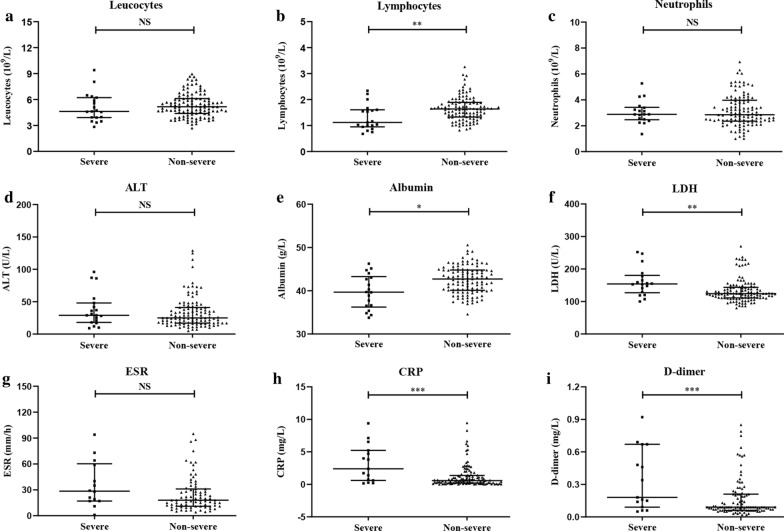
Of 134 convalescent patients with COVID-19, 19 (14.2%) were severe cases, while 115 (85.8%) were non-severe cases. The median patient age was 33 years (IQR, 21.8 to 46.3), and the cohort included 69 men and 65 women. Compared with non-severe cases, severe patients were older and had more chronic comorbidities, especially hypertension, diabetes, and thyroid disease (P < 0.05). Leukopenia was present in 32.1% of the convalescent patients and lymphocytopenia was present in 6.7%, both of which were more common in severe patients. 48 (35.8%) of discharged patients had elevated levels of alanine aminotransferase, which was more common in adults than in children (40.2% vs 13.6%, P = 0.018). A normal chest CT was found in 61 (45.5%) patients during rehabilitation. Severe patients had more ground-glass opacity, bilateral patchy shadowing, and fibrosis. No significant differences were observed in the positive rate of IgG and/or IgM antibodies between severe and non-severe patients.
Leukopenia, lymphopenia, ground-glass opacity, and fibrosis are common in discharged severe COVID-19 patients, and liver injury is common in discharged adult patients. We suggest physicians develop follow-up treatment plans based on the different clinical characteristics of convalescent patients.
先前的研究主要集中在新型 2019 冠状病毒病(COVID-19)住院患者的临床特征上。关于康复期患者的数据有限。本研究旨在评估已出院 COVID-19 患者的临床特征。
在这项回顾性研究中,我们从 2020 年 2 月 15 日至 3 月 31 日提取了贵州省职工医院 134 例 COVID-19 康复患者的数据。根据人口统计学、临床和实验室数据以及影像学特征对病例进行分析。
134 例 COVID-19 康复患者中,19 例(14.2%)为重症病例,115 例(85.8%)为非重症病例。中位患者年龄为 33 岁(IQR,21.8 至 46.3),队列中包括 69 名男性和 65 名女性。与非重症病例相比,重症患者年龄更大,合并慢性疾病更多,尤其是高血压、糖尿病和甲状腺疾病(P<0.05)。白细胞减少症见于 32.1%的康复患者,淋巴细胞减少症见于 6.7%,两者在重症患者中更为常见。48(35.8%)例出院患者的丙氨酸氨基转移酶升高,成人比儿童更常见(40.2%比 13.6%,P=0.018)。61(45.5%)例康复患者的胸部 CT 正常。重症患者更常见磨玻璃影、双侧斑片状阴影和纤维化。重症和非重症患者的 IgG 和/或 IgM 抗体阳性率无显著差异。
白细胞减少症、淋巴细胞减少症、磨玻璃影和纤维化是出院的重症 COVID-19 患者的常见表现,肝损伤在出院的成年患者中常见。我们建议医生根据康复患者的不同临床特征制定后续治疗计划。