Haldipurkar Suhas S, Shetty Vijay, Shah Dhruven, Haldipurkar Tanvi, Kashelkar Priyanka, Khatib Zain, Sankhe Prachi, Mane Aalapi, Mhatre Paresh, Setia Maninder Singh
Laxmi Eye Institute, Panvel, Maharashtra, India.
Ophthalmol Ther. 2021 Mar;10(1):101-113. doi: 10.1007/s40123-020-00321-2. Epub 2020 Nov 27.
The present study compared visual outcomes in eyes with bilateral implantation of two multifocal intraocular lenses (MFIOLs)-the Eyecryl™ ACTV diffractive multifocal IOL (group 1) and AcrySof IQ ReSTOR multifocal IOL (group 2).
This was a prospective, two-group observational longitudinal study of 118 eyes from 59 patients conducted at Laxmi Eye Institute, Panvel, India. We evaluated the patients at 1, 3, and 6 months. We assessed visual acuity, contrast sensitivity, higher-order aberrations, reading speed, defocus curve, stereopsis, quality of life (QOL), and adverse events in these participants.
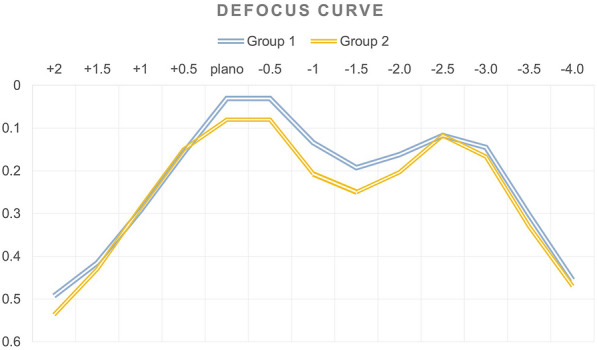
The median (interquartile range) best-corrected distance visual acuity was 0.18 (0, 0.18) in group 1 and 0.18 (0, 0.18) in group 2 at 1, 3, and 6 months; the difference was not statistically significant (p = 0.48). The binocular defocus curve in both groups showed two peaks at 0.0 to -0.5 D and at -2.5 D. The mean (95% confidence interval) critical print size was significantly different between groups 1 and 2 at low illumination (0.918 [0.905, 0.931] vs 1.154 [1.128, 1.180]; p = 0.004). Contrast sensitivity was significantly better in group 1 under mesopic conditions but not under scotopic conditions. Though total QOL did not differ significantly between groups, the psychosocial quality of life was significantly better in group 1. About 23% of patients in group 2 reported unwanted images, compared with 0% in group 1 (p = 0.01).
We found that the Eyecryl and AcrySof groups were comparable for best-corrected visual acuity, photopic contrast sensitivity, defocus curve, reading parameters, stereopsis, and quality of vision. However, the Eyecryl group had better mesopic contrast and a lower proportion of unwanted images. Psychosocial quality of life was significantly better in the Eyecryl group; however, satisfaction was similar between groups. The cost of one of the lenses is less than the other. Thus, individuals with limited resources may opt for the Eyecryl™ ACTV, with similar visual outcomes.
本研究比较了双眼植入两种多焦点人工晶状体(MFIOL)的眼睛的视觉效果,这两种人工晶状体分别是Eyecryl™ ACTV衍射多焦点人工晶状体(第1组)和AcrySof IQ ReSTOR多焦点人工晶状体(第2组)。
这是一项在印度潘韦尔拉克希米眼科研究所对59例患者的118只眼睛进行的前瞻性、两组观察性纵向研究。我们在1个月、3个月和6个月时对患者进行评估。我们评估了这些参与者的视力、对比敏感度、高阶像差、阅读速度、散焦曲线、立体视觉、生活质量(QOL)和不良事件。
在1个月、3个月和6个月时,第1组的最佳矫正远视力中位数(四分位间距)为0.18(0,0.18),第2组为0.18(0,0.18);差异无统计学意义(p = 0.48)。两组的双眼散焦曲线在0.0至 -0.5 D和 -2.5 D处显示两个峰值。在低光照条件下,第1组和第2组的平均(95%置信区间)临界印刷字体大小有显著差异(0.918 [0.905,0.931] 对1.154 [1.128,1.180];p = 0.004)。在中间视觉条件下,第1组的对比敏感度明显更好,但在暗视觉条件下并非如此。虽然两组的总体生活质量没有显著差异,但第1组的心理社会生活质量明显更好。第2组约23%的患者报告有不需要的图像,而第1组为0%(p = 0.01)。
我们发现Eyecryl组和AcrySof组在最佳矫正视力、明视觉对比敏感度、散焦曲线、阅读参数、立体视觉和视觉质量方面具有可比性。然而,Eyecryl组具有更好的中间视觉对比度和更低比例的不需要的图像。Eyecryl组的心理社会生活质量明显更好;然而,两组之间的满意度相似。其中一种晶状体的成本低于另一种。因此,资源有限的个体可能会选择Eyecryl™ ACTV,其视觉效果相似。