Department of Radiology and Biomedical Imaging, University of California, San Francisco, San Francisco, California.
Department of Pharmaceutical Chemistry, University of California, San Francisco, San Francisco, California.
J Nucl Med. 2021 Jul 1;62(7):949-955. doi: 10.2967/jnumed.120.252460. Epub 2020 Nov 27.
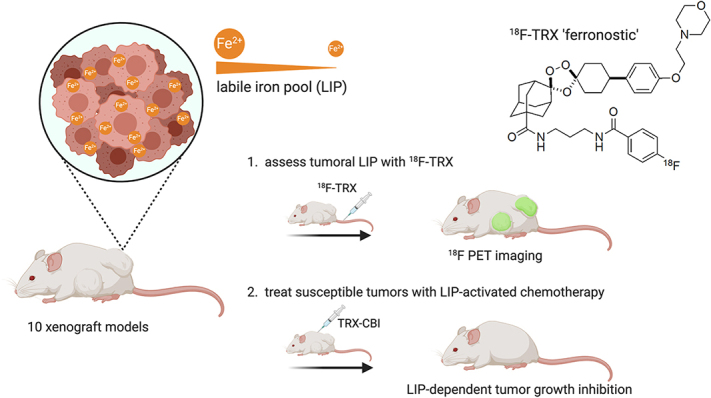
Although cancer has been known for decades to harbor an insatiable appetite for iron, only recently has the chemistry emerged to exploit this altered state therapeutically, by targeting the expanded cytosolic labile iron pool (LIP) of the cancer cell. The state of the art includes therapies that react with the LIP to produce cytotoxic radical species (in some cases also releasing drug payloads) and molecules that exacerbate LIP-induced oxidative stress to trigger ferroptosis. Effectively implementing LIP-targeted therapies in patients will require biomarkers to identify those tumors with the most elevated LIP and thus most likely to succumb to LIP-targeted interventions. Toward this goal, we tested whether tumor uptake of the novel LIP-sensing radiotracer F-TRX aligns with tumor sensitivity to LIP-targeted therapies. F-TRX uptake was assessed in vivo among 10 subcutaneous and orthotopic human xenograft models. Glioma and renal cell carcinoma were prioritized because these tumors have the highest relative expression levels of STEAP3, the oxidoreductase that reduces ferric iron to the ferrous oxidation state, in the Broad Institute Cancer Cell Line Encyclopedia. The antitumor effects of the LIP-activated prodrug TRX-CBI, which releases the DNA alkylator CBI, were compared in mice bearing U251 or PC3 xenografts, tumors with high and intermediate levels of F-TRX uptake, respectively. F-TRX showed a wide range of tumor accumulation. An antitumor assessment study showed that the growth of U251 xenografts, the model with the highest F-TRX uptake, was potently inhibited by TRX-CBI. Moreover, the antitumor effects against U251 were significantly greater than those observed for PC3 tumors, consistent with the relative F-TRX-determined LIP levels in tumors before therapy. Lastly, a dosimetry study showed that the estimated effective human doses for adult male and female mice were comparable to those of other F-based imaging probes. We report the first evidence-to our knowledge-that tumor sensitivity to an LIP-targeted therapy can be predicted with a molecular imaging tool. More generally, these data bring a new dimension to the nuclear theranostic model by showing a requirement for imaging to quantify, in situ, the concentration of a metastable bioanalyte toward predicting tumor drug sensitivity.
尽管几十年来人们已经知道癌症对铁有一种贪得无厌的胃口,但直到最近,化学才出现了一种方法,可以通过靶向癌细胞扩展的细胞质可溶铁池(LIP)来利用这种改变的状态进行治疗。最先进的治疗方法包括与 LIP 反应以产生细胞毒性自由基物质(在某些情况下还释放药物有效载荷)的疗法,以及加剧 LIP 诱导的氧化应激以触发铁死亡的分子。为了在患者中有效实施 LIP 靶向治疗,需要生物标志物来识别那些 LIP 水平最高的肿瘤,因此最有可能对 LIP 靶向干预产生反应。为了实现这一目标,我们测试了新型 LIP 感应放射性示踪剂 F-TRX 的肿瘤摄取是否与 LIP 靶向治疗的肿瘤敏感性一致。在 10 种皮下和原位人异种移植模型中评估了 F-TRX 的体内摄取。优先考虑神经胶质瘤和肾细胞癌,因为这些肿瘤在 Broad 研究所癌症细胞系百科全书中有最高的相对表达水平的 STEAP3,该氧化还原酶将三价铁还原为二价氧化态。在携带 U251 或 PC3 异种移植物的小鼠中比较了 LIP 激活前药 TRX-CBI 的抗肿瘤作用,该前药释放 DNA 烷化剂 CBI,分别具有高和中等水平的 F-TRX 摄取。F-TRX 表现出广泛的肿瘤积累。一项抗肿瘤评估研究表明,具有最高 F-TRX 摄取的模型 U251 异种移植物的生长被 TRX-CBI 强烈抑制。此外,与治疗前肿瘤中相对 F-TRX 确定的 LIP 水平一致,对 U251 的抗肿瘤作用明显大于对 PC3 肿瘤的作用。最后,剂量测定研究表明,雄性和雌性成年小鼠的估计有效人类剂量与其他 F 基成像探针相当。我们报告了第一个证据-据我们所知-表明可以使用分子成像工具预测 LIP 靶向治疗的肿瘤敏感性。更一般地说,这些数据通过显示需要成像来定量、原位测量不稳定生物分析物的浓度来预测肿瘤药物敏感性,为核治疗模型带来了一个新的维度。