Department of Computer Science, Georgia State University, Atlanta, Georgia, United States of America.
Department of Evolutionary and Environmental Biology, University of Haifa, Haifa, Israel.
PLoS Comput Biol. 2020 Nov 30;16(11):e1008454. doi: 10.1371/journal.pcbi.1008454. eCollection 2020 Nov.
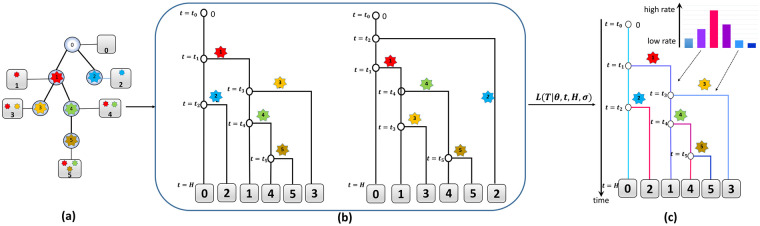
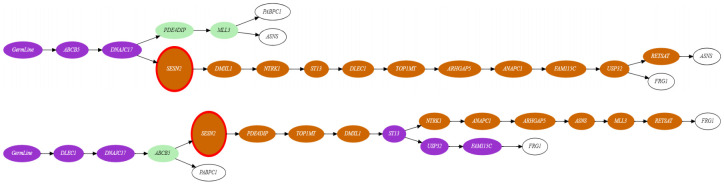
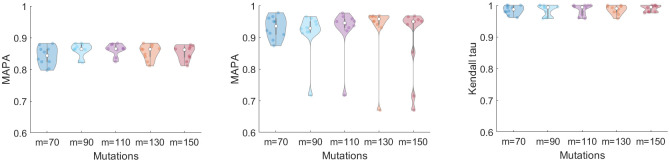
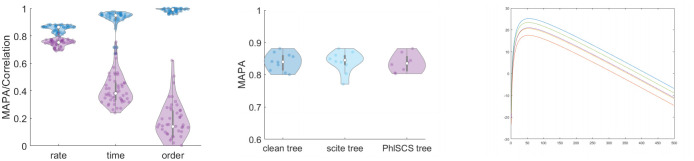
One of the hallmarks of cancer is the extremely high mutability and genetic instability of tumor cells. Inherent heterogeneity of intra-tumor populations manifests itself in high variability of clone instability rates. Analogously to fitness landscapes, the instability rates of clonal populations form their mutability landscapes. Here, we present MULAN (MUtability LANdscape inference), a maximum-likelihood computational framework for inference of mutation rates of individual cancer subclones using single-cell sequencing data. It utilizes the partial information about the orders of mutation events provided by cancer mutation trees and extends it by inferring full evolutionary history and mutability landscape of a tumor. Evaluation of mutation rates on the level of subclones rather than individual genes allows to capture the effects of genomic interactions and epistasis. We estimate the accuracy of our approach and demonstrate that it can be used to study the evolution of genetic instability and infer tumor evolutionary history from experimental data. MULAN is available at https://github.com/compbel/MULAN.
癌症的一个特征是肿瘤细胞极高的突变率和遗传不稳定性。肿瘤内群体固有的异质性表现在克隆不稳定性率的高度可变性上。类似于适应度景观,克隆群体的不稳定性率形成了它们的可变性景观。在这里,我们提出了 MULAN(突变率景观推断),这是一种最大似然计算框架,用于使用单细胞测序数据推断个体癌症亚克隆的突变率。它利用癌症突变树提供的关于突变事件顺序的部分信息,并通过推断肿瘤的完整进化历史和可变性景观来扩展它。在亚克隆而不是单个基因的水平上估计突变率,可以捕捉基因组相互作用和上位性的影响。我们评估了我们方法的准确性,并证明它可以用于研究遗传不稳定性的进化,并从实验数据推断肿瘤的进化历史。MULAN 可在 https://github.com/compbel/MULAN 上获得。