Cuevas-Ferrando Enric, Pérez-Cataluña Alba, Allende Ana, Guix Susana, Randazzo Walter, Sánchez Gloria
Department of Preservation and Food Safety Technologies, Institute of Agrochemistry and Food Technology, IATA-CSIC, Av. Agustín Escardino 7, Paterna 46980, Valencia, Spain.
Research Group on Quality, Safety and Bioactivity of Plant Foods, Department of Food Science and Technology, CEBAS-CSIC, Campus Universitario de Espinardo, 25, 30100 Murcia, Spain.
Sci Total Environ. 2021 Mar 25;762:143101. doi: 10.1016/j.scitotenv.2020.143101. Epub 2020 Oct 16.
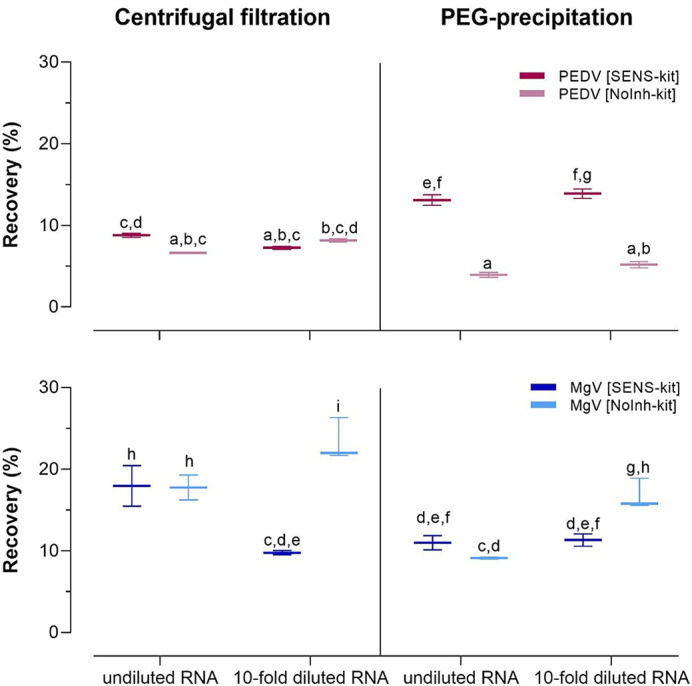
The need for monitoring tools to better control the ongoing coronavirus disease (COVID-19) pandemic is extremely urgent and the contamination of water resources by excreted viral particles poses alarming questions to be answered. As a first step to overcome technical limitations in monitoring SARS-CoV-2 along the water cycle, we assessed the analytical performance of a dead end hollow fiber ultrafiltration coupled to different options for secondary concentrations to concentrate viral particles from large volume of spiked tap water, seawater and surface water together with two quantitative RT-qPCR detection kits. Spiking the porcine epidemic diarrhea virus (PEDV), an enveloped virus surrogate for SARS-CoV-2, together with the mengovirus, we demonstrated that PEG-precipitation and SENS-kit better recovered PEDV (13.10 ± 0.66%) from tap water, while centrifugal filtration resulted the best option to recover mengovirus regardless of the detection kit used. No statistical significant differences were found when comparing high (10,000 ×g) and low (3500 ×g) centrifugation speeds for the secondary PEG- based concentration of spiked seawater, while considerable inhibition was observed for both viruses detected by NoInh-kit assay. Similarly, the co-concentration of PCR inhibitors and viral particles was observed in surface waters detected with either SENS-kit or NoInh-kit and RNA dilution was needed to achieve acceptable recoveries at the expenses of the overall sensitivity of the method. These methodologies represent suitable options to investigate SARS-CoV-2 occurrence in different water resources and allow to conduct on site sampling of large volume of water.
迫切需要监测工具来更好地控制正在蔓延的冠状病毒病(COVID-19)大流行,并且排泄出的病毒颗粒对水资源的污染引发了亟待解答的警示性问题。作为克服在水循环中监测严重急性呼吸综合征冠状病毒2(SARS-CoV-2)的技术限制的第一步,我们评估了死端中空纤维超滤结合不同二级浓缩方法的分析性能,以从大量加标的自来水、海水和地表水中浓缩病毒颗粒,同时使用了两种定量逆转录-实时荧光定量聚合酶链反应(RT-qPCR)检测试剂盒。我们将猪流行性腹泻病毒(PEDV,一种SARS-CoV-2的包膜病毒替代物)与脑心肌炎病毒一起加标,结果表明,聚乙二醇(PEG)沉淀法和SENS试剂盒能更好地从自来水中回收PEDV(13.10±0.66%),而无论使用哪种检测试剂盒,离心过滤都是回收脑心肌炎病毒的最佳方法。在比较用于加标海水基于PEG的二级浓缩的高(10,000×g)和低(3500×g)离心速度时,未发现统计学上的显著差异,而NoInh试剂盒检测的两种病毒均观察到相当程度的抑制作用。同样,在用SENS试剂盒或NoInh试剂盒检测的地表水中观察到了聚合酶链反应(PCR)抑制剂和病毒颗粒的共浓缩现象,并且需要进行RNA稀释以实现可接受的回收率,但这是以牺牲该方法的整体灵敏度为代价的。这些方法是研究不同水资源中SARS-CoV-2存在情况的合适选择,并允许对大量水进行现场采样。