Li Xuan, Feng Ya, Wang Xi-Xi, Truong Daniel, Wu Yun-Cheng
1Department of Neurology, Shanghai General Hospital, Shanghai Jiao Tong University School of Medicine, Shanghai 200080, China.
2The Truong Neurosciences Institute, Orange Coast Memorial Medical Center, Fountain Valley, CA, USA.
Aging Dis. 2020 Dec 1;11(6):1608-1622. doi: 10.14336/AD.2020.0216. eCollection 2020 Dec.
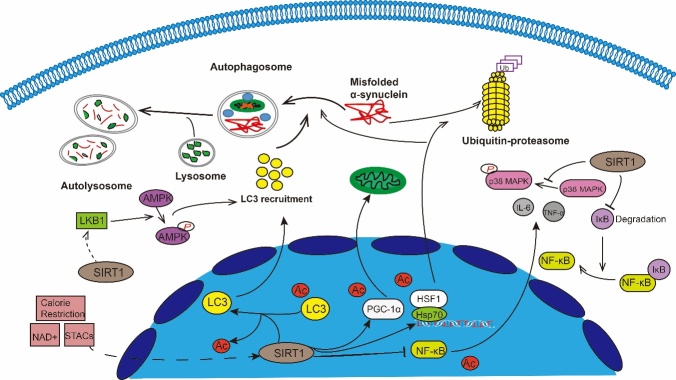
Silence information regulator 1 (SIRT1), a member of the sirtuin family, targets histones and many non-histone proteins and participates in various physiological functions. The enzymatic activity of SIRT1 is decreased in patients with Parkinson's disease (PD), which may reduce their ability to resist neuronal damage caused by various neurotoxins. As far as we know, SIRT1 can induce autophagy by regulating autophagy related proteins such as AMP-activated protein kinase, light chain 3, mammalian target of rapamycin, and forkhead transcription factor 1. Furthermore, SIRT1 can regulate mitochondrial function and inhibit oxidative stress mainly by maintaining peroxisome proliferator-activated receptor-γ coactivator-1α (PGC-1α) in a deacetylated state and thus maintaining a constant level of PGC-1α. Other studies have demonstrated that SIRT1 may play a role in the pathophysiology of PD by regulating neuroinflammation. SIRT1 deacetylases nuclear factor-kappa B and thus reduces its transcriptional activity, inhibits inducible nitric oxide synthase expression, and decreases tumor necrosis factor-alpha and interleukin-6 levels. SIRT1 can also upregulate heat shock protein 70 by deacetylating heat shock factor 1 to increase the degradation of α-synuclein oligomers. Few studies have focused on the relationship between SIRT1 single nucleotide polymorphisms and PD risk, so this topic requires further research. Based on the neuroprotective effects of SIRT1 on PD, many in vitro and in vivo experiments have demonstrated that some SIRT1 activators, notably resveratrol, have potential neuroprotective effects against dopaminergic neuronal damage caused by various neurotoxins. Thus, SIRT1 plays a critical role in PD development and might be a potential target for PD therapy.
沉默信息调节因子1(SIRT1)是沉默调节蛋白家族的成员,作用于组蛋白和许多非组蛋白,并参与多种生理功能。帕金森病(PD)患者中SIRT1的酶活性降低,这可能会降低他们抵抗各种神经毒素引起的神经元损伤的能力。据我们所知,SIRT1可通过调节自噬相关蛋白(如AMP激活的蛋白激酶、轻链3、雷帕霉素靶蛋白和叉头转录因子1)来诱导自噬。此外,SIRT1主要通过维持过氧化物酶体增殖物激活受体γ共激活因子1α(PGC-1α)处于去乙酰化状态,从而维持PGC-1α的恒定水平,来调节线粒体功能并抑制氧化应激。其他研究表明,SIRT1可能通过调节神经炎症在PD的病理生理过程中发挥作用。SIRT1使核因子κB去乙酰化,从而降低其转录活性,并抑制诱导型一氧化氮合酶的表达,同时降低肿瘤坏死因子α和白细胞介素6的水平。SIRT1还可通过使热休克因子1去乙酰化来上调热休克蛋白70,以增加α-突触核蛋白寡聚体的降解。很少有研究关注SIRT1单核苷酸多态性与PD风险之间的关系,因此这个话题需要进一步研究。基于SIRT1对PD的神经保护作用,许多体外和体内实验表明,一些SIRT1激活剂,尤其是白藜芦醇,对各种神经毒素引起的多巴胺能神经元损伤具有潜在的神经保护作用。因此,SIRT1在PD发展中起关键作用,可能是PD治疗的潜在靶点。