College of Nursing, University of South Florida, 12901 Bruce B. Downs Blvd, Tampa, FL, 33612, USA.
College of Nursing, University of Tennessee - Knoxville, 1200 Volunteer Blvd, Knoxville, TN, 37902, USA.
BMC Public Health. 2020 Dec 3;20(1):1853. doi: 10.1186/s12889-020-09924-7.
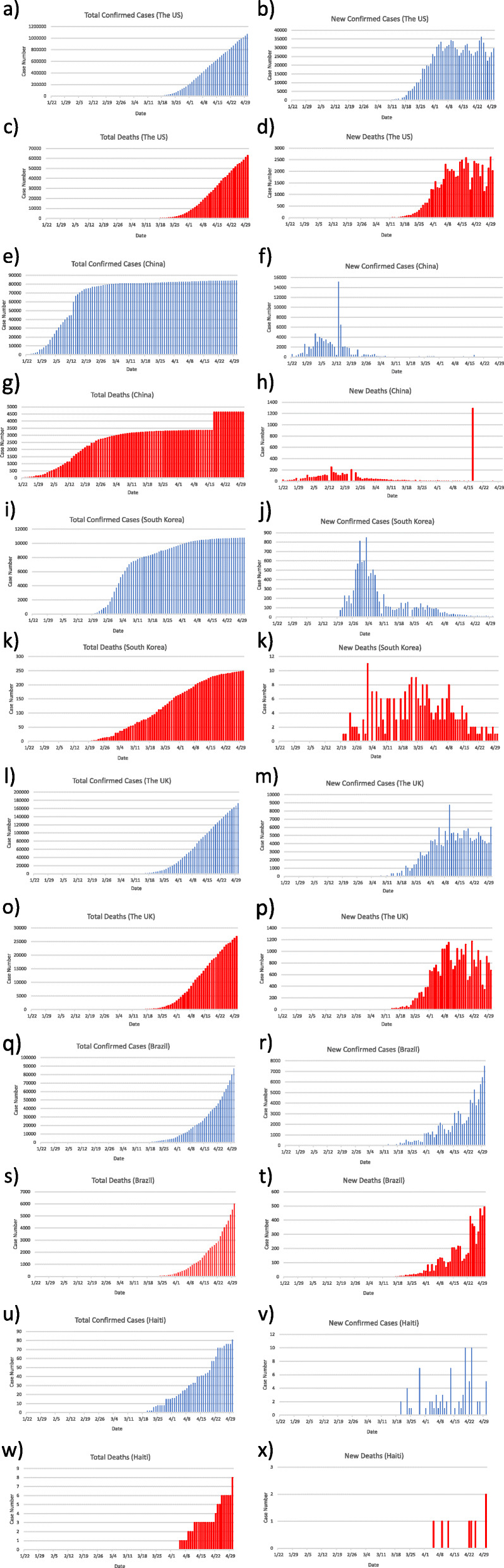
In late January, a worldwide crisis known as COVID-19 was declared a Public Health Emergency of International Concern by the WHO. Within only a few weeks, the outbreak took on pandemic proportions, affecting over 100 countries. It was a significant issue to prevent and control COVID-19 on both national and global scales due to the dramatic increase in confirmed cases worldwide. Government guidelines provide a fundamental resource for communities, as they guide citizens on how to protect themselves against COVID-19, however, they also provide critical guidance for policy makers and healthcare professionals on how to take action to decrease the spread of COVID-19. We aimed to identify the differences and similarities between six different countries' (US, China, South Korea, UK, Brazil and Haiti) government-provided community and healthcare system guidelines, and to explore the relationship between guideline issue dates and the prevalence/incidence of COVID-19 cases.
To make these comparisons, this exploratory qualitative study used document analysis of government guidelines issued to the general public and to healthcare professionals. Documents were purposively sampled (N = 55) and analyzed using content analysis.
The major differences in the evaluation and testing criteria in the guidelines across the six countries centered around the priority of testing for COVID-19 in the general population, which was strongly dependent on each country's healthcare capacity. However, the most similar guidelines pertained to the clinical signs and symptoms of COVID-19, and methods to prevent its contraction.
In the initial stages of the outbreak, certain strategies were universally employed to control the deadly virus's spread, including quarantining the sick, contact tracing, and social distancing. However, each country dealt with differing healthcare capacities, risks, threats, political and socioeconomic challenges, and distinct healthcare systems and infrastructure. Acknowledging these differences highlights the importance of examining the various countries' response to the COVID-19 pandemic with a nuanced view, as each of these factors shaped the government guidelines distributed to each country's communities and healthcare systems.
1 月底,世界卫生组织宣布一种名为 COVID-19 的全球危机为国际关注的突发公共卫生事件。仅几周内,疫情便呈大流行之势,影响了 100 多个国家。由于全球确诊病例数的急剧增加,需要在国家和全球范围内对 COVID-19 进行预防和控制,这是一个重大问题。政府指南为社区提供了一个基本资源,因为它们指导公民如何保护自己免受 COVID-19 的侵害,但它们也为政策制定者和医疗保健专业人员提供了如何采取行动减少 COVID-19 传播的关键指导。我们旨在确定六个不同国家(美国、中国、韩国、英国、巴西和海地)政府提供的社区和医疗系统指南之间的差异和相似之处,并探讨指南发布日期与 COVID-19 病例流行/发病率之间的关系。
为了进行这些比较,这项探索性定性研究使用了对向公众和医疗保健专业人员发布的政府指南的文件分析。文件采用目的抽样(N=55),并使用内容分析进行分析。
六个国家的指南在评估和检测标准方面的主要差异集中在对普通人群进行 COVID-19 检测的优先级上,这强烈取决于每个国家的医疗保健能力。然而,最相似的指南涉及 COVID-19 的临床症状和体征,以及预防其传播的方法。
在疫情的初始阶段,某些策略被普遍用于控制致命病毒的传播,包括隔离病人、接触者追踪和社会隔离。然而,每个国家都面临着不同的医疗保健能力、风险、威胁、政治和社会经济挑战以及不同的医疗保健系统和基础设施。认识到这些差异突显了用细致入微的视角审视各国对 COVID-19 大流行的反应的重要性,因为这些因素塑造了向每个国家的社区和医疗系统分发的政府指南。