Weill Institute for Cell and Molecular Biology, Department of Microbiology, and Cornell Institute of Host-Pathogen Interactions and Disease, Cornell University, Ithaca, New York.
Ann N Y Acad Sci. 2021 Jul;1496(1):35-58. doi: 10.1111/nyas.14541. Epub 2020 Dec 3.
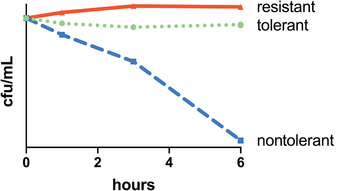
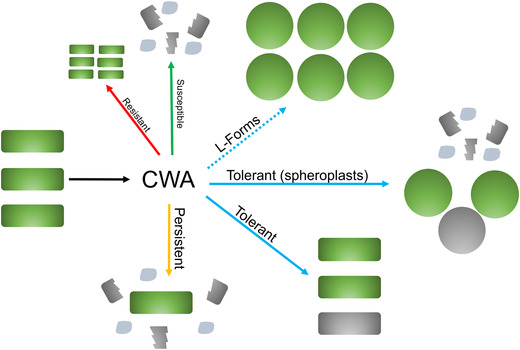
Antibiotic tolerance-the ability of bacteria to survive for an extended time in the presence of bactericidal antibiotics-is an understudied contributor to antibiotic treatment failure. Herein, I review the manifestations, mechanisms, and clinical relevance of tolerance to cell wall-active (CWA) antibiotics, one of the most important groups of antibiotics at the forefront of clinical use. I discuss definitions of tolerance and assays for tolerance detection, comprehensively discuss the mechanism of action of β-lactams and other CWA antibiotics, and then provide an overview of how cells mitigate the potentially lethal effects of CWA antibiotic-induced cell damage to become tolerant. Lastly, I discuss evidence for a role of CWA antibiotic tolerance in clinical antibiotic treatment failure.
抗生素耐药性——细菌在杀菌抗生素存在的情况下能够长时间存活的能力——是导致抗生素治疗失败的一个研究不足的因素。在此,我回顾了细胞壁活性(CWA)抗生素耐药性的表现、机制和临床相关性,CWA 抗生素是临床应用最前沿的最重要的抗生素之一。我讨论了耐药性的定义和耐药性检测的方法,全面讨论了β-内酰胺类和其他 CWA 抗生素的作用机制,然后概述了细胞如何减轻 CWA 抗生素诱导的细胞损伤的潜在致命影响以产生耐药性。最后,我讨论了 CWA 抗生素耐药性在临床抗生素治疗失败中的作用的证据。