Curado Manuel, Escolano Francisco, Lozano Miguel A, Hancock Edwin R
Polytechnic School, Catholic University of Murcia, 30107 Murcia, Spain.
Department of Computer Science and AI, University of Alicante, 03690 Alicante, Spain.
Entropy (Basel). 2020 Apr 19;22(4):465. doi: 10.3390/e22040465.
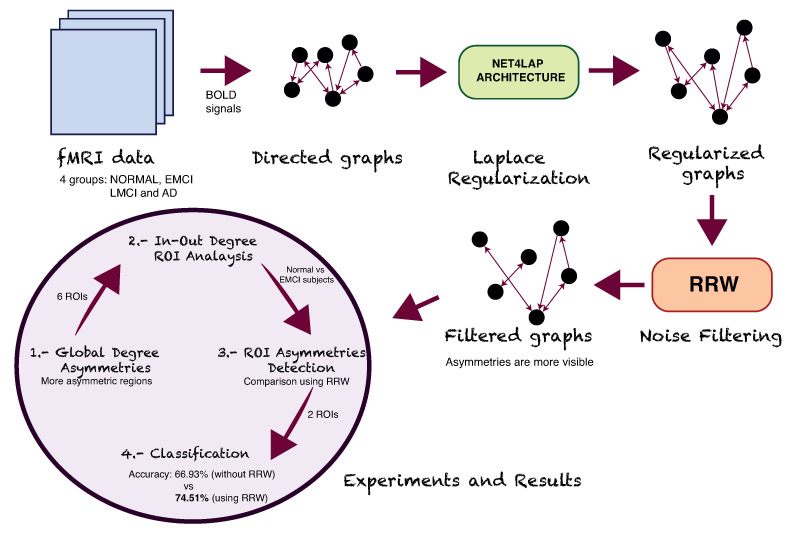
Alzheimer's disease has been extensively studied using undirected graphs to represent the correlations of BOLD signals in different anatomical regions through functional magnetic resonance imaging (fMRI). However, there has been relatively little analysis of this kind of data using directed graphs, which potentially offer the potential to capture asymmetries in the interactions between different anatomical brain regions. The detection of these asymmetries is relevant to detect the disease in an early stage. For this reason, in this paper, we analyze data extracted from fMRI images using the algorithm to infer a directed graph from the available BOLD signals, and then seek to determine asymmetries between the left and right hemispheres of the brain using a directed version of the Return Random Walk (RRW). Experimental evaluation of this method reveals that it leads to the identification of anatomical brain regions known to be implicated in the early development of Alzheimer's disease in clinical studies.
阿尔茨海默病已通过无向图进行了广泛研究,以通过功能磁共振成像(fMRI)来表示不同解剖区域中血氧水平依赖(BOLD)信号的相关性。然而,使用有向图对这类数据的分析相对较少,而有向图可能具有捕捉不同解剖脑区之间相互作用不对称性的潜力。检测这些不对称性与疾病早期检测相关。因此,在本文中,我们使用该算法分析从fMRI图像中提取的数据,以从可用的BOLD信号推断出有向图,然后试图使用有向版本的返回随机游走(RRW)来确定大脑左右半球之间的不对称性。对该方法的实验评估表明,它能够识别临床研究中已知与阿尔茨海默病早期发展有关的解剖脑区。