Milken Institute School of Public Health, George Washington University, 950 New Hampshire Ave NW, Washington, DC, 20052, USA.
Now at: American Lung Association, Springfield, IL, USA.
Environ Health. 2020 Dec 7;19(1):130. doi: 10.1186/s12940-020-00681-z.
Exposure to heat, air pollution, and pollen are associated with health outcomes, including cardiovascular and respiratory disease. Studies assessing the health impacts of climate change have considered increased exposure to these risk factors separately, though they may be increasing simultaneously for some populations and may act synergistically on health. Our objective is to systematically review epidemiological evidence for interactive effects of multiple exposures to heat, air pollution, and pollen on human health.
We systematically searched electronic literature databases (last search, April 29, 2019) for studies reporting quantitative measurements of associations between at least two of the exposures and mortality from any cause and cardiovascular and respiratory morbidity and mortality specifically. Following the Navigation Guide systematic review methodology, we evaluated the risk of bias of individual studies and the overall quality and strength of evidence.
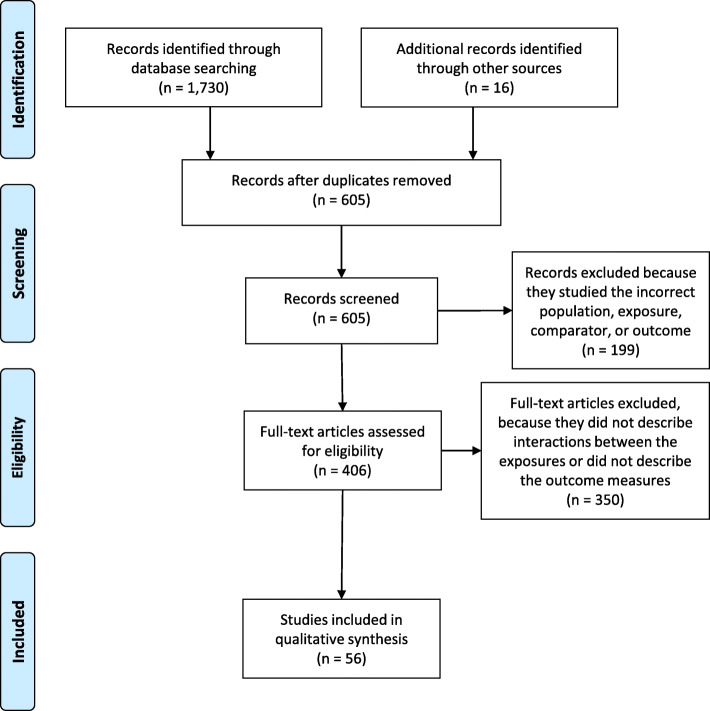
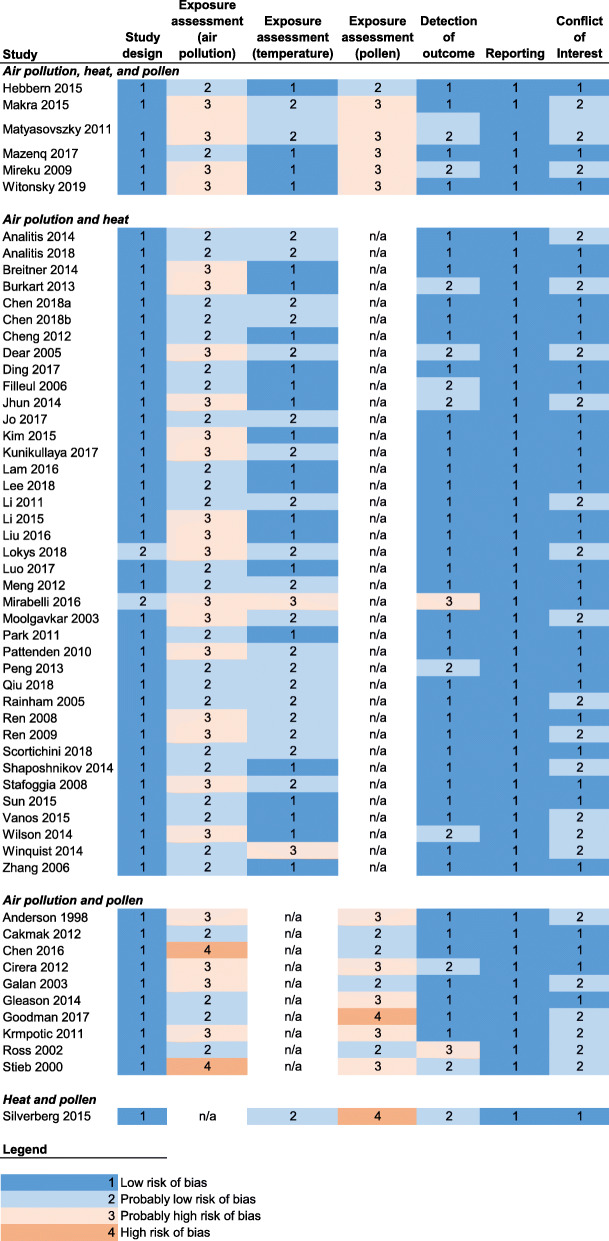
We found 56 studies that met the inclusion criteria. Of these, six measured air pollution, heat, and pollen; 39 measured air pollution and heat; 10 measured air pollution and pollen; and one measured heat and pollen. Nearly all studies were at risk of bias from exposure assessment error. However, consistent exposure-response across studies led us to conclude that there is overall moderate quality and sufficient evidence for synergistic effects of heat and air pollution. We concluded that there is overall low quality and limited evidence for synergistic effects from simultaneous exposure to (1) air pollution, pollen, and heat; and (2) air pollution and pollen. With only one study, we were unable to assess the evidence for synergistic effects of heat and pollen.
If synergistic effects between heat and air pollution are confirmed with additional research, the health impacts from climate change-driven increases in air pollution and heat exposure may be larger than previously estimated in studies that consider these risk factors individually.
暴露于热、空气污染和花粉与健康结果相关,包括心血管和呼吸道疾病。评估气候变化对健康影响的研究分别考虑了这些危险因素暴露的增加,尽管对于某些人群,它们可能同时增加,并且可能对健康产生协同作用。我们的目标是系统地审查有关热、空气污染和花粉多种暴露对人类健康的交互影响的流行病学证据。
我们系统地搜索了电子文献数据库(最后一次搜索,2019 年 4 月 29 日),以寻找报告至少两种暴露与任何原因导致的死亡率以及心血管和呼吸道发病率和死亡率之间定量关联的研究。按照导航指南系统评价方法,我们评估了个体研究的偏倚风险以及证据的总体质量和强度。
我们发现了 56 项符合纳入标准的研究。其中,6 项研究测量了空气污染、热和花粉;39 项研究测量了空气污染和热;10 项研究测量了空气污染和花粉;1 项研究测量了热和花粉。几乎所有研究都存在暴露评估错误的偏倚风险。然而,研究间一致的暴露-反应使我们得出结论,即存在总体中等质量和充分证据表明热和空气污染具有协同作用。我们得出的结论是,同时暴露于(1)空气污染、花粉和热;以及(2)空气污染和花粉具有协同作用的证据总体上质量较低且有限。由于仅有一项研究,我们无法评估热和花粉协同作用的证据。
如果通过进一步研究证实热和空气污染之间存在协同作用,那么气候变化导致的空气污染和热暴露增加对健康的影响可能比单独考虑这些危险因素的研究中估计的更大。