Faculty of Biology, Medicine and Health, University of Manchester, Manchester, UK.
Department of Laboratory Medicine/ANA Futura, Division of Clinical Physiology, Karolinska Institutet, Alfred Nobles Allé 8B, Huddinge, 141 52, Stockholm, Sweden.
Sports Med. 2021 Feb;51(2):199-214. doi: 10.1007/s40279-020-01389-3.
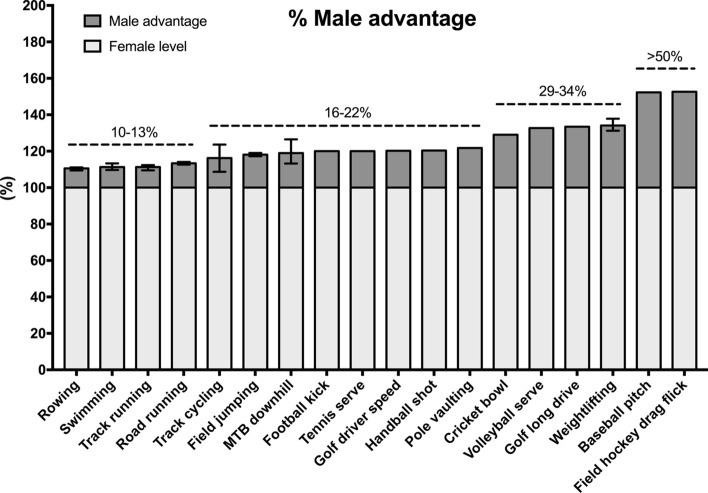
Males enjoy physical performance advantages over females within competitive sport. The sex-based segregation into male and female sporting categories does not account for transgender persons who experience incongruence between their biological sex and their experienced gender identity. Accordingly, the International Olympic Committee (IOC) determined criteria by which a transgender woman may be eligible to compete in the female category, requiring total serum testosterone levels to be suppressed below 10 nmol/L for at least 12 months prior to and during competition. Whether this regulation removes the male performance advantage has not been scrutinized. Here, we review how differences in biological characteristics between biological males and females affect sporting performance and assess whether evidence exists to support the assumption that testosterone suppression in transgender women removes the male performance advantage and thus delivers fair and safe competition. We report that the performance gap between males and females becomes significant at puberty and often amounts to 10-50% depending on sport. The performance gap is more pronounced in sporting activities relying on muscle mass and explosive strength, particularly in the upper body. Longitudinal studies examining the effects of testosterone suppression on muscle mass and strength in transgender women consistently show very modest changes, where the loss of lean body mass, muscle area and strength typically amounts to approximately 5% after 12 months of treatment. Thus, the muscular advantage enjoyed by transgender women is only minimally reduced when testosterone is suppressed. Sports organizations should consider this evidence when reassessing current policies regarding participation of transgender women in the female category of sport.
男性在竞技体育中享有优于女性的身体表现优势。基于性别的男女运动项目分类并没有考虑到跨性别者,他们的生理性别与其所经历的性别认同之间存在不一致。因此,国际奥林匹克委员会(IOC)确定了跨性别女性有资格参加女性组别的标准,要求在比赛前和比赛期间,血清总睾酮水平至少抑制在 10nmol/L 以下 12 个月。这种规定是否消除了男性的表现优势尚未得到仔细审查。在这里,我们回顾了男性和女性之间的生物学特征差异如何影响运动表现,并评估是否有证据支持这样的假设,即抑制跨性别女性的睾酮可以消除男性的表现优势,从而实现公平和安全的竞争。我们报告说,男性和女性之间的表现差距在青春期变得显著,并且根据运动项目的不同,通常达到 10-50%。在依赖肌肉质量和爆发力的运动项目中,这种差距更为明显,特别是在上半身。长期研究检查了抑制睾酮对跨性别女性肌肉质量和力量的影响,一致显示出非常温和的变化,在 12 个月的治疗后,瘦体重、肌肉面积和力量的损失通常约为 5%。因此,当抑制睾酮时,跨性别女性享有的肌肉优势仅略有减少。体育组织在重新评估跨性别女性参加女性组别的现行政策时,应考虑到这一证据。