Chen Ziyuan, Zhang Yuan, Lu Chunyan, Zeng Hao, Schumann Moritz, Cheng Sulin
Department of Physical Education, Exercise, Health and Technology Centre, Shanghai Jiao Tong University, Shanghai, China.
The Key Laboratory of Systems Biomedicine, Ministry of Education, and The Exercise Translational Medicine Centre, Shanghai Center for Systems Biomedicine, Shanghai Jiao Tong University, Shanghai, China.
Front Physiol. 2019 Jul 3;10:843. doi: 10.3389/fphys.2019.00843. eCollection 2019.
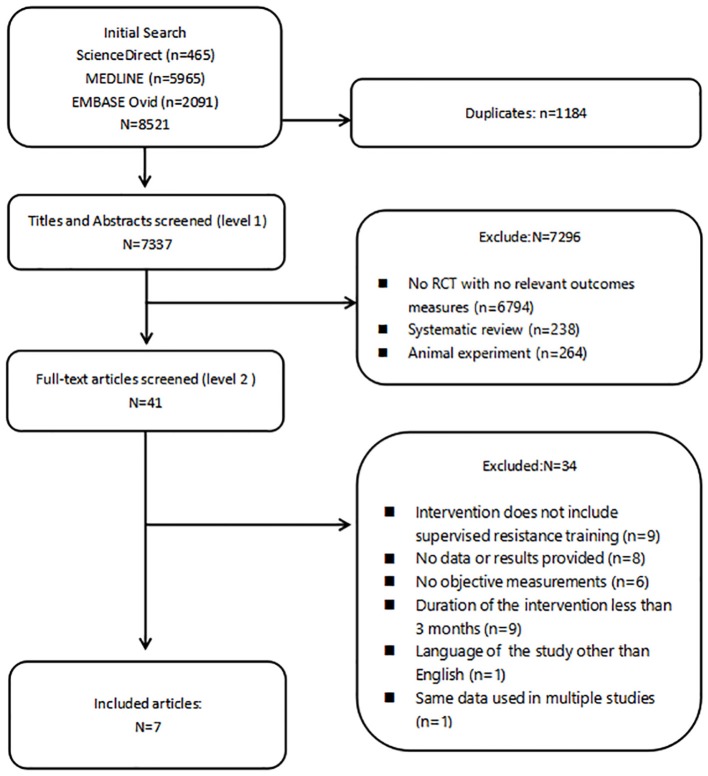
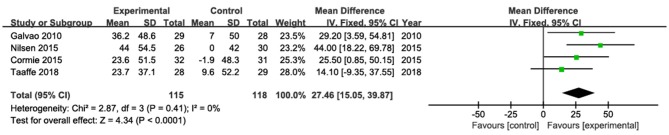
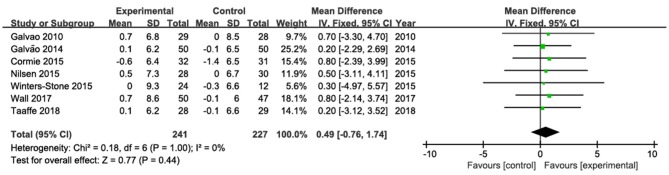
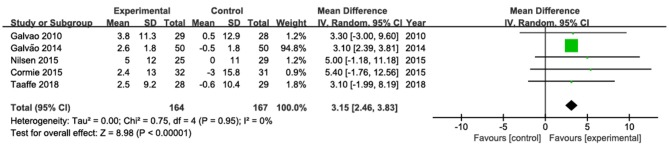
Androgen deprivation therapy (ADT) is considered the basic treatment for advanced prostate cancer, but it is highly associated with detrimental changes in muscle mass and muscle strength. The aim of this meta-analysis was to investigate the effects of supervised physical training on lean mass and muscle strength in prostate cancer patients undergoing ADT. A systematic literature search was performed using MEDLINE, Embase, and ScienceDirect until October 2018. Only studies that examined both muscle mass and strength in prostate cancer patients undergoing ADT were included. Outcomes of interest were changes in lean body mass (surrogate for muscle mass) as well as upper and lower body muscle strength. The meta-analysis was performed with fixed-effects models to calculate mean differences between intervention and no-training control groups. We identified 8,521 publications through the search of the following key words: prostate cancer, prostate tumor, prostate carcinoma, prostate neoplasm, exercise, and training. Out of these studies, seven randomized controlled trials met the inclusion criteria and where included in the analysis. No significant mean differences for changes in lean mass were observed between the intervention and control groups (0.49 kg, 95% CI: -0.76, 1.74; = 0.44). In contrast, the mean difference for muscle strength was significant both in chest (3.15 kg, 95% CI: 2.46, 3.83; < 0.001) and in leg press (27.46 kg, 95% CI: 15.05, 39.87; < 0.001). This meta-analysis provides evidence that low- to moderate-intensity resistance and aerobic training is effective for increasing muscle strength but may not be sufficient to affect muscle mass in prostate cancer patients undergoing ADT. The underlying mechanisms for this maladaptation may in part be explained by an insufficient stimulus induced by the training regimens as well as a delayed initiation of training in relation to the start of ADT. When interpreting the present findings, one should bear in mind that the overall number of studies included in this review was rather low, emphasizing the need for further studies in this field.
雄激素剥夺疗法(ADT)被认为是晚期前列腺癌的基本治疗方法,但它与肌肉质量和肌肉力量的有害变化高度相关。本荟萃分析的目的是研究有监督的体育锻炼对接受ADT的前列腺癌患者瘦体重和肌肉力量的影响。使用MEDLINE、Embase和ScienceDirect进行了系统的文献检索,直至2018年10月。仅纳入了研究接受ADT的前列腺癌患者肌肉质量和力量的研究。感兴趣的结果是瘦体重(肌肉质量的替代指标)以及上、下肢肌肉力量的变化。采用固定效应模型进行荟萃分析,以计算干预组和无训练对照组之间的平均差异。通过搜索以下关键词,我们共识别出8521篇出版物:前列腺癌、前列腺肿瘤、前列腺癌、前列腺肿瘤、运动和训练。在这些研究中,有7项随机对照试验符合纳入标准并纳入分析。干预组和对照组之间在瘦体重变化方面未观察到显著的平均差异(0.49千克,95%CI:-0.76,1.74;P = 0.44)。相比之下,胸部肌肉力量的平均差异显著(3.15千克,95%CI:2.46,3.83;P < 0.001),腿举力量的平均差异也显著(27.46千克,95%CI:15.05,39.87;P < 0.001)。 本荟萃分析提供了证据,表明低至中等强度的抗阻训练和有氧运动对增加接受ADT的前列腺癌患者的肌肉力量有效,但可能不足以影响其肌肉质量。这种适应不良的潜在机制部分可能是由于训练方案引起的刺激不足以及与ADT开始时间相关的训练启动延迟。在解释本研究结果时,应牢记本综述纳入的研究总数相当少,这突出了该领域进一步研究的必要性。