Kalsoom Khan Faheema, Kluting Kerri, Tångrot Jeanette, Urbina Hector, Ammunet Tea, Eshghi Sahraei Shadi, Rydén Martin, Ryberg Martin, Rosling Anna
Department of Ecology and Genetics, Evolutionary Biology, Uppsala University, Norbyvägen 18D, 752 36, Uppsala, Sweden.
Department of Organismal Biology, Systematic Biology, Uppsala University, Norbyvägen 18D, 752 36, Uppsala, Sweden.
IMA Fungus. 2020 Nov 3;11(1):23. doi: 10.1186/s43008-020-00045-9.
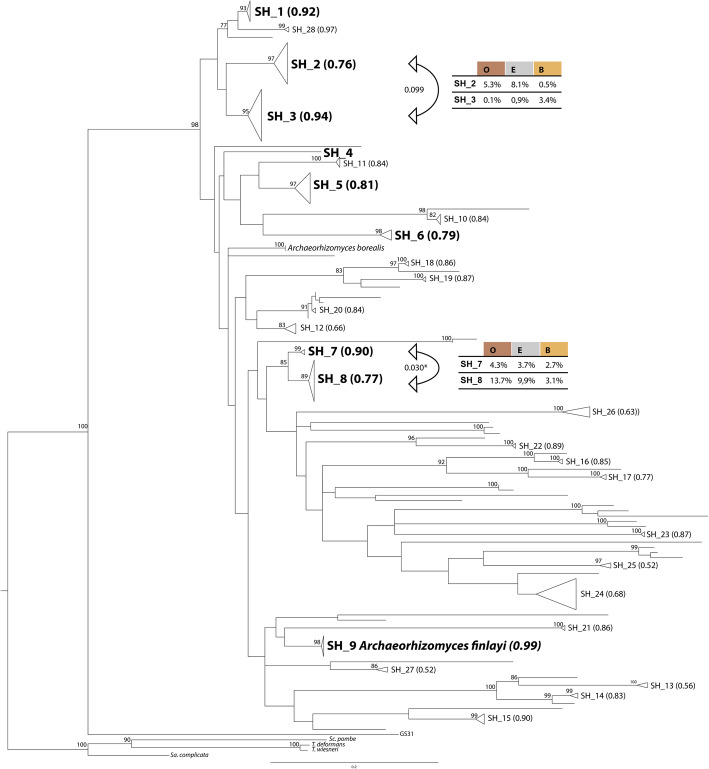
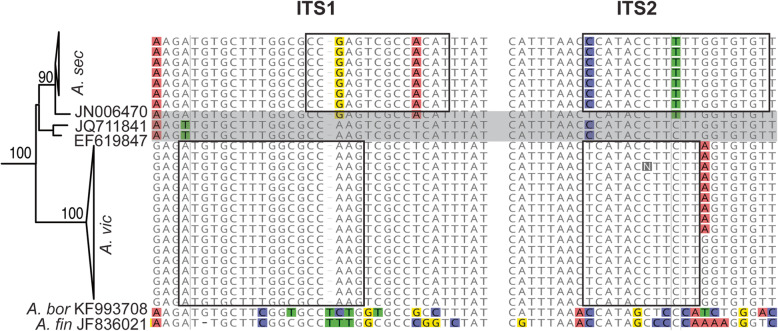
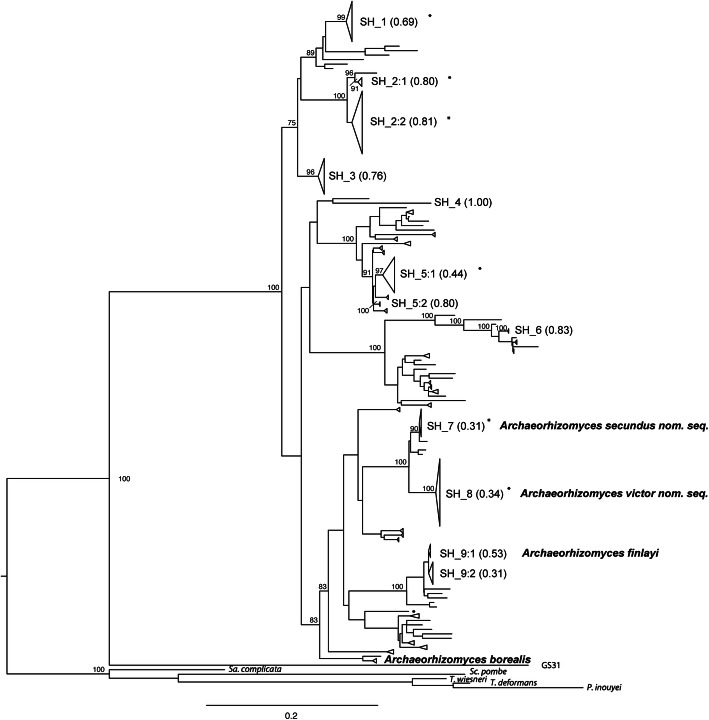
Due to their submerged and cryptic lifestyle, the vast majority of fungal species are difficult to observe and describe morphologically, and many remain known to science only from sequences detected in environmental samples. The lack of practices to delimit and name most fungal species is a staggering limitation to communication and interpretation of ecology and evolution in kingdom Fungi. Here, we use environmental sequence data as taxonomical evidence and combine phylogenetic and ecological data to generate and test species hypotheses in the class Archaeorhizomycetes (Taphrinomycotina, Ascomycota). Based on environmental amplicon sequencing from a well-studied Swedish pine forest podzol soil, we generate 68 distinct species hypotheses of Archaeorhizomycetes, of which two correspond to the only described species in the class. Nine of the species hypotheses represent 78% of the sequenced Archaeorhizomycetes community, and are supported by long read data that form the backbone for delimiting species hypothesis based on phylogenetic branch lengths.Soil fungal communities are shaped by environmental filtering and competitive exclusion so that closely related species are less likely to co-occur in a niche if adaptive traits are evolutionarily conserved. In soil profiles, distinct vertical horizons represent a testable niche dimension, and we found significantly differential distribution across samples for a well-supported pair of sister species hypotheses. Based on the combination of phylogenetic and ecological evidence, we identify two novel species for which we provide molecular diagnostics and propose names. While environmental sequences cannot be automatically translated to species, they can be used to generate phylogenetically distinct species hypotheses that can be further tested using sequences as ecological evidence. We conclude that in the case of abundantly and frequently observed species, environmental sequences can support species recognition in the absences of physical specimens, while rare taxa remain uncaptured at our sampling and sequencing intensity.
由于其水生和隐匿的生活方式,绝大多数真菌物种很难从形态上进行观察和描述,许多真菌仅从环境样本中检测到的序列才为科学界所知。缺乏界定和命名大多数真菌物种的方法,这对真菌界生态学和进化的交流与解释来说是一个惊人的限制。在这里,我们将环境序列数据用作分类学证据,并结合系统发育和生态数据,以生成和检验古根菌纲(子囊菌门,茶渍菌亚纲)中的物种假说。基于对一片经过充分研究的瑞典松树林灰化土的环境扩增子测序,我们生成了68个不同的古根菌纲物种假说,其中两个与该纲中唯一已描述的物种相对应。九个物种假说代表了测序的古根菌纲群落的78%,并得到了长读长数据的支持,这些数据构成了基于系统发育分支长度来界定物种假说的主干。土壤真菌群落受环境过滤和竞争排斥的影响,因此,如果适应性状在进化上是保守的,亲缘关系密切的物种在一个生态位中同时出现的可能性较小。在土壤剖面中,不同的垂直层代表了一个可检验的生态位维度,我们发现一对得到充分支持的姊妹物种假说在样本中的分布存在显著差异。基于系统发育和生态证据的结合,我们鉴定出两个新物种,并为其提供了分子诊断方法并提出了名称。虽然环境序列不能自动转化为物种,但它们可用于生成系统发育上不同的物种假说,这些假说可以使用序列作为生态证据进行进一步检验。我们得出结论,对于大量且频繁观察到的物种,环境序列可以在没有实体标本的情况下支持物种识别,而罕见分类群在我们目前的采样和测序强度下仍然未被捕获。