• 文献检索
  • 文档翻译
  • 深度研究
  • 学术资讯
  • Suppr Zotero 插件Zotero 插件
  • 邀请有礼
  • 套餐&价格
  • 历史记录
应用&插件
Suppr Zotero 插件Zotero 插件浏览器插件Mac 客户端Windows 客户端微信小程序
定价
高级版会员购买积分包购买API积分包
服务
文献检索文档翻译深度研究API 文档MCP 服务
关于我们
关于 Suppr公司介绍联系我们用户协议隐私条款
关注我们

Suppr 超能文献

核心技术专利:CN118964589B侵权必究
粤ICP备2023148730 号-1Suppr @ 2026

文献检索

告别复杂PubMed语法,用中文像聊天一样搜索,搜遍4000万医学文献。AI智能推荐,让科研检索更轻松。

立即免费搜索

文件翻译

保留排版,准确专业,支持PDF/Word/PPT等文件格式,支持 12+语言互译。

免费翻译文档

深度研究

AI帮你快速写综述,25分钟生成高质量综述,智能提取关键信息,辅助科研写作。

立即免费体验

用于 COVID-19 传播短期预测的经验模型。

Empirical model for short-time prediction of COVID-19 spreading.

机构信息

Comparative Medicine and Bioimage Centre of Catalonia (CMCiB), Fundació Institut d'Investigació en Ciències de la Salut Germans Trias i Pujol, Badalona, Catalonia, Spain.

Department of Physics, Universitat Politècnica de Catalunya (UPC-BarcelonaTech), Barcelona, Catalonia, Spain.

出版信息

PLoS Comput Biol. 2020 Dec 9;16(12):e1008431. doi: 10.1371/journal.pcbi.1008431. eCollection 2020 Dec.

DOI:10.1371/journal.pcbi.1008431
PMID:33296373
原文链接:https://pmc.ncbi.nlm.nih.gov/articles/PMC7725384/
Abstract

The appearance and fast spreading of Covid-19 took the international community by surprise. Collaboration between researchers, public health workers, and politicians has been established to deal with the epidemic. One important contribution from researchers in epidemiology is the analysis of trends so that both the current state and short-term future trends can be carefully evaluated. Gompertz model has been shown to correctly describe the dynamics of cumulative confirmed cases, since it is characterized by a decrease in growth rate showing the effect of control measures. Thus, it provides a way to systematically quantify the Covid-19 spreading velocity and it allows short-term predictions and longer-term estimations. This model has been employed to fit the cumulative cases of Covid-19 from several European countries. Results show that there are systematic differences in spreading velocity among countries. The model predictions provide a reliable picture of the short-term evolution in countries that are in the initial stages of the Covid-19 outbreak, and may permit researchers to uncover some characteristics of the long-term evolution. These predictions can also be generalized to calculate short-term hospital and intensive care units (ICU) requirements.

摘要

新冠疫情的出现和迅速传播令国际社会猝不及防。研究人员、公共卫生工作者和政治家之间已经建立了合作关系,以应对这一流行病。传染病学研究人员的一个重要贡献是对趋势进行分析,以便仔细评估当前状况和短期未来趋势。戈珀特兹模型已被证明能够正确描述累积确诊病例的动态,因为它的特征是增长率下降,显示出控制措施的效果。因此,它提供了一种系统地量化新冠病毒传播速度的方法,并允许进行短期预测和长期估计。该模型已被用于拟合来自几个欧洲国家的累积新冠病例。结果表明,各国之间的传播速度存在系统性差异。该模型的预测为处于新冠疫情初始阶段的国家的短期演变提供了可靠的图景,并可能使研究人员发现长期演变的一些特征。这些预测还可以推广到计算短期医院和重症监护病房(ICU)的需求。
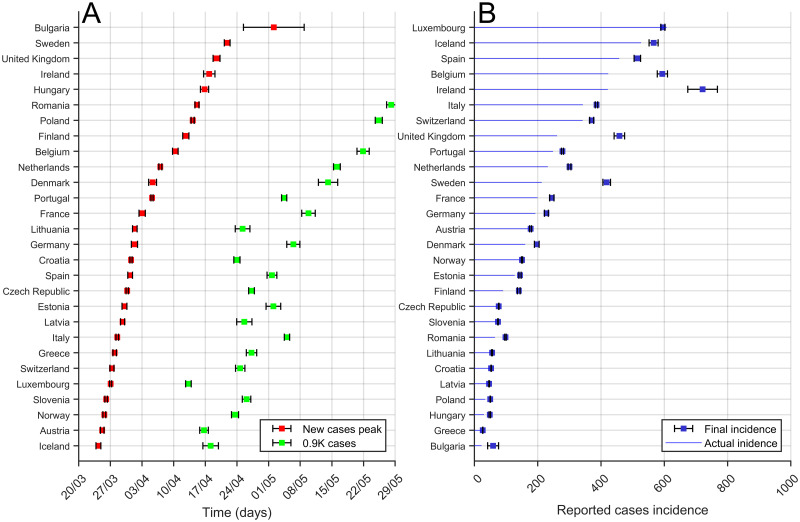
https://cdn.ncbi.nlm.nih.gov/pmc/blobs/e177/7725384/e1af31d36787/pcbi.1008431.g009.jpg
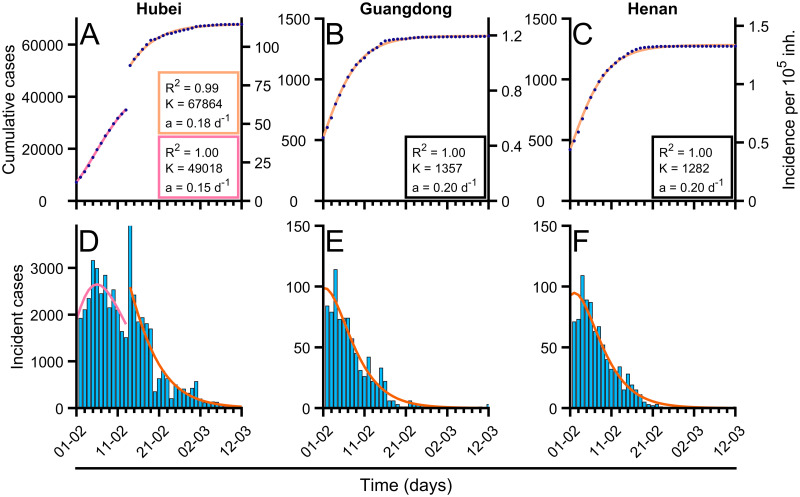
https://cdn.ncbi.nlm.nih.gov/pmc/blobs/e177/7725384/fd8513cb25ec/pcbi.1008431.g001.jpg
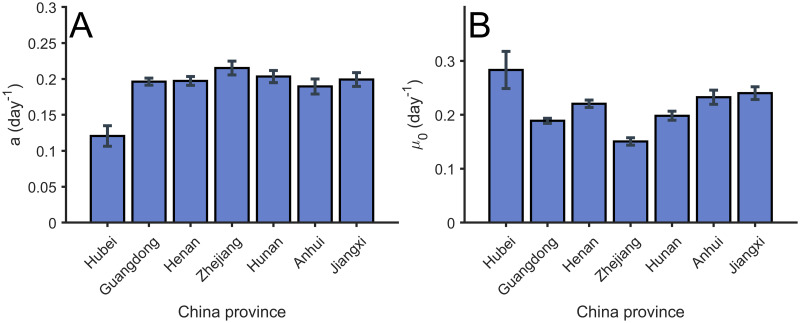
https://cdn.ncbi.nlm.nih.gov/pmc/blobs/e177/7725384/c15430002855/pcbi.1008431.g002.jpg
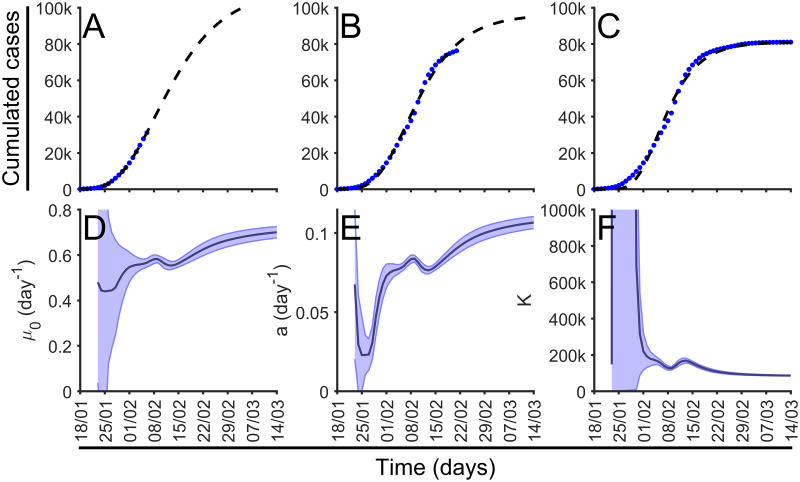
https://cdn.ncbi.nlm.nih.gov/pmc/blobs/e177/7725384/4498d0f341af/pcbi.1008431.g003.jpg
https://cdn.ncbi.nlm.nih.gov/pmc/blobs/e177/7725384/2252da8bf9d1/pcbi.1008431.g004.jpg
https://cdn.ncbi.nlm.nih.gov/pmc/blobs/e177/7725384/02e859098f1e/pcbi.1008431.g005.jpg
https://cdn.ncbi.nlm.nih.gov/pmc/blobs/e177/7725384/877b81ec1a32/pcbi.1008431.g006.jpg
https://cdn.ncbi.nlm.nih.gov/pmc/blobs/e177/7725384/8a11e01cbf28/pcbi.1008431.g007.jpg
https://cdn.ncbi.nlm.nih.gov/pmc/blobs/e177/7725384/e69f69558528/pcbi.1008431.g008.jpg
https://cdn.ncbi.nlm.nih.gov/pmc/blobs/e177/7725384/e1af31d36787/pcbi.1008431.g009.jpg
https://cdn.ncbi.nlm.nih.gov/pmc/blobs/e177/7725384/fd8513cb25ec/pcbi.1008431.g001.jpg
https://cdn.ncbi.nlm.nih.gov/pmc/blobs/e177/7725384/c15430002855/pcbi.1008431.g002.jpg
https://cdn.ncbi.nlm.nih.gov/pmc/blobs/e177/7725384/4498d0f341af/pcbi.1008431.g003.jpg
https://cdn.ncbi.nlm.nih.gov/pmc/blobs/e177/7725384/2252da8bf9d1/pcbi.1008431.g004.jpg
https://cdn.ncbi.nlm.nih.gov/pmc/blobs/e177/7725384/02e859098f1e/pcbi.1008431.g005.jpg
https://cdn.ncbi.nlm.nih.gov/pmc/blobs/e177/7725384/877b81ec1a32/pcbi.1008431.g006.jpg
https://cdn.ncbi.nlm.nih.gov/pmc/blobs/e177/7725384/8a11e01cbf28/pcbi.1008431.g007.jpg
https://cdn.ncbi.nlm.nih.gov/pmc/blobs/e177/7725384/e69f69558528/pcbi.1008431.g008.jpg
https://cdn.ncbi.nlm.nih.gov/pmc/blobs/e177/7725384/e1af31d36787/pcbi.1008431.g009.jpg

相似文献

1
Empirical model for short-time prediction of COVID-19 spreading.用于 COVID-19 传播短期预测的经验模型。
PLoS Comput Biol. 2020 Dec 9;16(12):e1008431. doi: 10.1371/journal.pcbi.1008431. eCollection 2020 Dec.
2
Predictive Mathematical Models of the Short-Term and Long-Term Growth of the COVID-19 Pandemic.预测 COVID-19 大流行短期和长期增长的数学模型。
Comput Math Methods Med. 2021 Aug 11;2021:5556433. doi: 10.1155/2021/5556433. eCollection 2021.
3
Predictions of COVID-19 dynamics in the UK: Short-term forecasting and analysis of potential exit strategies.预测英国的 COVID-19 动态:短期预测和潜在退出策略分析。
PLoS Comput Biol. 2021 Jan 22;17(1):e1008619. doi: 10.1371/journal.pcbi.1008619. eCollection 2021 Jan.
4
Development of the reproduction number from coronavirus SARS-CoV-2 case data in Germany and implications for political measures.德国冠状病毒 SARS-CoV-2 病例数据中繁殖数的发展及其对政治措施的影响。
BMC Med. 2021 Jan 28;19(1):32. doi: 10.1186/s12916-020-01884-4.
5
How New Mexico Leveraged a COVID-19 Case Forecasting Model to Preemptively Address the Health Care Needs of the State: Quantitative Analysis.新墨西哥州如何利用新冠疫情预测模型来预先满足该州的医疗保健需求:定量分析
JMIR Public Health Surveill. 2021 Jun 9;7(6):e27888. doi: 10.2196/27888.
6
New statistical RI index allow to better track the dynamics of COVID-19 outbreak in Italy.新的统计 RI 指数可更好地追踪意大利 COVID-19 疫情动态。
Sci Rep. 2020 Dec 22;10(1):22365. doi: 10.1038/s41598-020-79039-x.
7
Short-term real-time prediction of total number of reported COVID-19 cases and deaths in South Africa: a data driven approach.南非报告的 COVID-19 病例和死亡总数的短期实时预测:一种数据驱动的方法。
BMC Med Res Methodol. 2021 Jan 11;21(1):15. doi: 10.1186/s12874-020-01165-x.
8
Phenomenological Modelling of COVID-19 Epidemics in Sri Lanka, Italy, the United States, and Hebei Province of China.斯里兰卡、意大利、美国和中国河北省 COVID-19 疫情的现象学建模。
Comput Math Methods Med. 2020 Oct 18;2020:6397063. doi: 10.1155/2020/6397063. eCollection 2020.
9
Approaches to Daily Monitoring of the SARS-CoV-2 Outbreak in Northern Italy.意大利北部地区针对 2019 年冠状病毒病疫情的日常监测方法。
Front Public Health. 2020 May 22;8:222. doi: 10.3389/fpubh.2020.00222. eCollection 2020.
10
Social contacts, epidemic spreading and health system. Mathematical modeling and applications to COVID-19 infection.社会联系、传染病传播和卫生系统。数学建模及其在 COVID-19 感染中的应用。
Math Biosci Eng. 2021 Apr 15;18(4):3384-3403. doi: 10.3934/mbe.2021169.

引用本文的文献

1
Country-report pattern corrections of new cases allow accurate 2-week predictions of COVID-19 evolution with the Gompertz model.国家报告模式修正新病例,使基于戈珀兹模型的 COVID-19 演变的准确两周预测成为可能。
Sci Rep. 2024 May 11;14(1):10775. doi: 10.1038/s41598-024-61233-w.
2
A semi-empirical risk panel to monitor epidemics: multi-faceted tool to assist healthcare and public health professionals.用于监测传染病的半经验风险面板:协助医疗保健和公共卫生专业人员的多方面工具。
Front Public Health. 2024 Jan 8;11:1307425. doi: 10.3389/fpubh.2023.1307425. eCollection 2023.
3
Learning from the past: A short term forecast method for the COVID-19 incidence curve.

本文引用的文献

1
Robust estimation of diagnostic rate and real incidence of COVID-19 for European policymakers.为欧洲政策制定者稳健估计 COVID-19 的诊断率和实际发病率。
PLoS One. 2021 Jan 7;16(1):e0243701. doi: 10.1371/journal.pone.0243701. eCollection 2021.
2
Modeling and prediction of COVID-19 in Mexico applying mathematical and computational models.运用数学和计算模型对墨西哥的新冠疫情进行建模与预测。
Chaos Solitons Fractals. 2020 Sep;138:109946. doi: 10.1016/j.chaos.2020.109946. Epub 2020 May 29.
3
Forecasting the novel coronavirus COVID-19.
从过去中学习:COVID-19 发病率曲线的短期预测方法。
PLoS Comput Biol. 2023 Jun 21;19(6):e1010790. doi: 10.1371/journal.pcbi.1010790. eCollection 2023 Jun.
4
Exploring epidemic voluntary vaccinating behavior based on information-driven decisions and benefit-cost analysis.基于信息驱动决策和效益成本分析探索流行性疾病自愿接种行为。
Appl Math Comput. 2023 Jun 15;447:127905. doi: 10.1016/j.amc.2023.127905. Epub 2023 Feb 12.
5
Virus spread on a scale-free network reproduces the Gompertz growth observed in isolated COVID-19 outbreaks.无标度网络上的病毒传播再现了孤立的 COVID-19 爆发中观察到的 Gompertz 增长。
Adv Biol Regul. 2022 Dec;86:100915. doi: 10.1016/j.jbior.2022.100915. Epub 2022 Sep 30.
6
An ensemble n-sub-epidemic modeling framework for short-term forecasting epidemic trajectories: Application to the COVID-19 pandemic in the USA.一种用于短期预测传染病轨迹的集成 n 亚流行模型框架:在美国 COVID-19 大流行中的应用。
PLoS Comput Biol. 2022 Oct 6;18(10):e1010602. doi: 10.1371/journal.pcbi.1010602. eCollection 2022 Oct.
7
An ensemble -sub-epidemic modeling framework for short-term forecasting epidemic trajectories: Application to the COVID-19 pandemic in the USA.一种用于短期预测疫情轨迹的集成子疫情建模框架:在美国新冠肺炎疫情中的应用。
medRxiv. 2022 Jun 21:2022.06.19.22276608. doi: 10.1101/2022.06.19.22276608.
8
A Short-Term Prediction Model at the Early Stage of the COVID-19 Pandemic Based on Multisource Urban Data.基于多源城市数据的新冠疫情早期短期预测模型
IEEE Trans Comput Soc Syst. 2021 Mar 5;8(4):938-945. doi: 10.1109/TCSS.2021.3060952. eCollection 2021 Aug.
9
VSHR: A Mathematical Model for the Prediction of Second-Wave COVID-19 Epidemics in Malaysia.VSHR:马来西亚第二波 COVID-19 疫情预测的数学模型。
Comput Math Methods Med. 2022 Jan 18;2022:4168619. doi: 10.1155/2022/4168619. eCollection 2022.
10
Modeling the COVID-19 Epidemic With Multi-Population and Control Strategies in the United States.用美国多人群和控制策略对 COVID-19 疫情进行建模。
Front Public Health. 2022 Jan 3;9:751940. doi: 10.3389/fpubh.2021.751940. eCollection 2021.
预测新型冠状病毒(COVID-19)。
PLoS One. 2020 Mar 31;15(3):e0231236. doi: 10.1371/journal.pone.0231236. eCollection 2020.
4
Data-based analysis, modelling and forecasting of the COVID-19 outbreak.基于数据的 COVID-19 疫情分析、建模和预测。
PLoS One. 2020 Mar 31;15(3):e0230405. doi: 10.1371/journal.pone.0230405. eCollection 2020.
5
Real-time forecasts of the COVID-19 epidemic in China from February 5th to February 24th, 2020.2020年2月5日至2月24日中国新冠肺炎疫情的实时预测
Infect Dis Model. 2020 Feb 14;5:256-263. doi: 10.1016/j.idm.2020.02.002. eCollection 2020.
6
Short-term Forecasts of the COVID-19 Epidemic in Guangdong and Zhejiang, China: February 13-23, 2020.中国广东和浙江地区2019冠状病毒病疫情的短期预测:2020年2月13日至23日
J Clin Med. 2020 Feb 22;9(2):596. doi: 10.3390/jcm9020596.
7
Clinical features of patients infected with 2019 novel coronavirus in Wuhan, China.中国武汉地区 2019 年新型冠状病毒感染患者的临床特征。
Lancet. 2020 Feb 15;395(10223):497-506. doi: 10.1016/S0140-6736(20)30183-5. Epub 2020 Jan 24.
8
Comparative analysis of phenomenological growth models applied to epidemic outbreaks.应用于疫情爆发的现象学增长模型的比较分析。
Math Biosci Eng. 2019 May 16;16(5):4250-4273. doi: 10.3934/mbe.2019212.
9
Assessing the Use of Influenza Forecasts and Epidemiological Modeling in Public Health Decision Making in the United States.评估流感预测和流行病学模型在美国公共卫生决策中的应用。
Sci Rep. 2018 Aug 17;8(1):12406. doi: 10.1038/s41598-018-30378-w.
10
Fitting dynamic models to epidemic outbreaks with quantified uncertainty: A Primer for parameter uncertainty, identifiability, and forecasts.用量化不确定性将动态模型拟合到疫情爆发:参数不确定性、可识别性和预测入门
Infect Dis Model. 2017 Aug;2(3):379-398. doi: 10.1016/j.idm.2017.08.001. Epub 2017 Aug 12.