Department of Biological Sciences, Wellesley College, Wellesley, Massachusetts, United States of America.
School of Environmental Sciences, University of Guelph, Guelph, Ontario, Canada.
PLoS One. 2020 Dec 9;15(12):e0242668. doi: 10.1371/journal.pone.0242668. eCollection 2020.
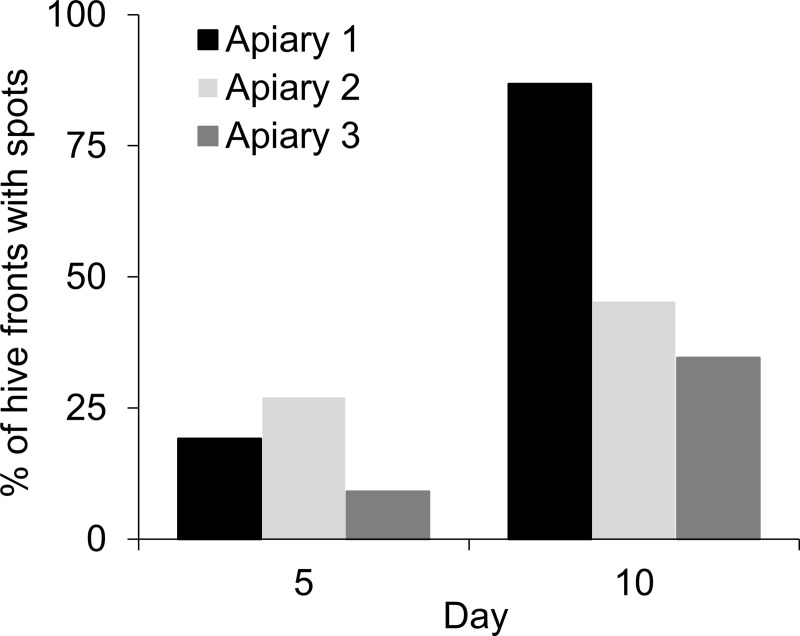
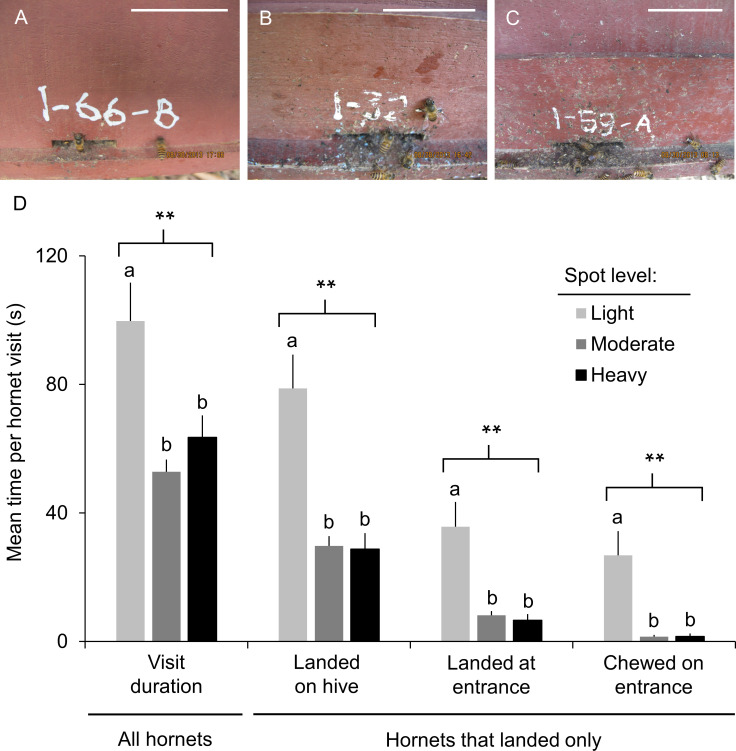
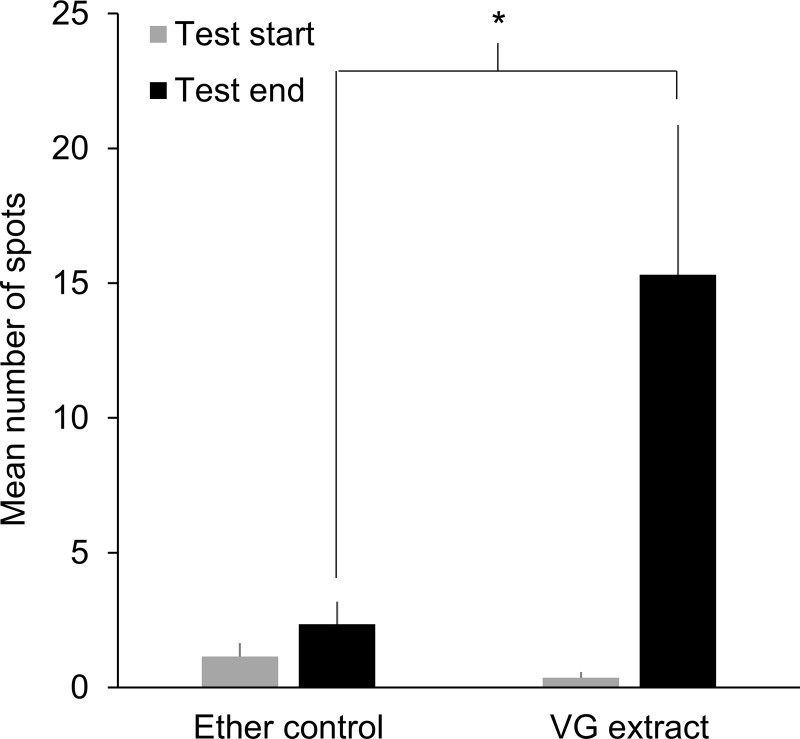
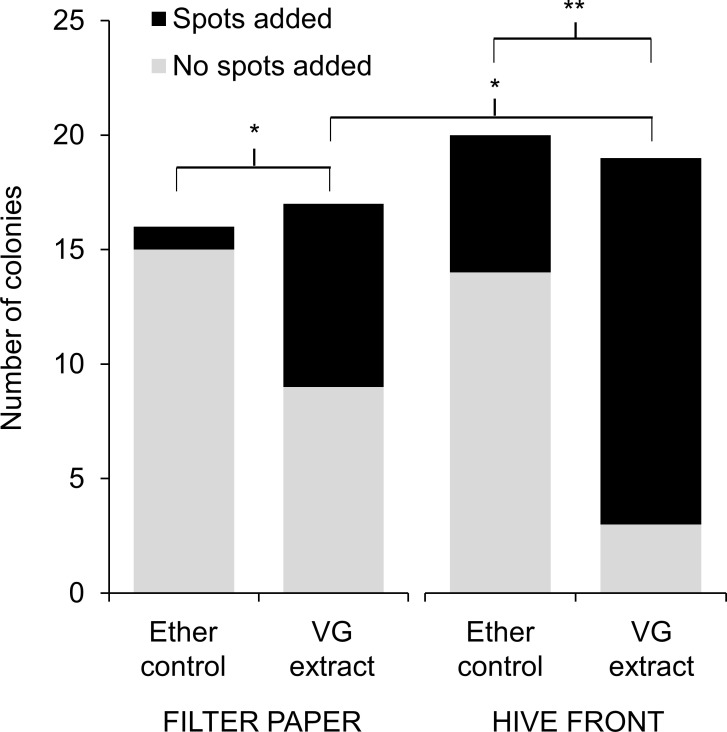
Honey bees (genus Apis) are well known for the impressive suite of nest defenses they have evolved to protect their abundant stockpiles of food and the large colonies they sustain. In Asia, honey bees have evolved under tremendous predatory pressure from social wasps in the genus Vespa, the most formidable of which are the giant hornets that attack colonies in groups, kill adult defenders, and prey on brood. We document for the first time an extraordinary collective defense used by Apis cerana against the giant hornet Vespa soror. In response to attack by V. soror, A. cerana workers foraged for and applied spots of animal feces around their nest entrances. Fecal spotting increased after colonies were exposed either to naturally occurring attacks or to chemicals that scout hornets use to target colonies for mass attack. Spotting continued for days after attacks ceased and occurred in response to V. soror, which frequently landed at and chewed on entrances to breach nests, but not Vespa velutina, a smaller hornet that rarely landed at entrances. Moderate to heavy fecal spotting suppressed attempts by V. soror to penetrate nests by lowering the incidence of multiple-hornet attacks and substantially reducing the likelihood of them approaching and chewing on entrances. We argue that A. cerana forages for animal feces because it has properties that repel this deadly predator from nest entrances, providing the first report of tool use by honey bees and the first evidence that they forage for solids that are not derived from plants. Our study describes a remarkable weapon in the already sophisticated portfolio of defenses that honey bees have evolved in response to the predatory threats they face. It also highlights the strong selective pressure honey bees will encounter if giant hornets, recently detected in western North America, become established.
蜜蜂(属 Apis)以其令人印象深刻的一系列巢穴防御措施而闻名,这些防御措施是为了保护它们丰富的食物储备和维持的大型群体而进化的。在亚洲,蜜蜂在来自胡蜂属(Vespa)的社会性黄蜂的巨大捕食压力下进化,其中最强大的是成群攻击蜂巢的大黄蜂,它们会杀死成年防御者,并捕食幼虫。我们首次记录了中华蜜蜂(Apis cerana)针对大黄蜂(Vespa soror)所使用的非凡集体防御行为。当中华蜜蜂巢穴受到大黄蜂 Vespa soror 的攻击时,工蜂会在巢穴入口处寻找并涂抹动物粪便。当蜂巢受到自然攻击或侦察蜂用来定位和大规模攻击蜂巢的化学物质的暴露时,粪便涂抹的情况会增加。在攻击停止后的几天内,这种行为仍会继续发生,而且还会对大黄蜂 Vespa soror 做出反应,因为后者经常降落在入口处并啃咬以试图破坏巢穴,但不会对 Vespa velutina 做出反应,后者是一种很少降落在入口处的小型胡蜂。适度到大量的粪便涂抹会降低多只大黄蜂攻击的发生率,并大大降低它们接近和啃咬入口的可能性,从而抑制大黄蜂 Vespa soror 试图穿透巢穴的行为。我们认为,中华蜜蜂会寻找动物粪便,是因为它具有将这种致命捕食者从巢穴入口处驱赶出去的特性,这是首次报道蜜蜂使用工具,也是首次证明它们会寻找不是来自植物的固体来觅食。我们的研究描述了蜜蜂已经进化出的复杂防御策略中的一种非凡武器,以应对它们所面临的捕食威胁。它还强调了如果最近在北美西部发现的大黄蜂得以建立种群,蜜蜂将面临的强烈选择性压力。