Wilson Telissa, Looney Chris, Tembrock Luke R, Dickerson Sapphitah, Orr Jessica, Gilligan Todd M, Wildung Mark
Washington State Department of Agriculture, Olympia, WA, United States.
Department of Agricultural Biology, Colorado State University, Fort Collins, CO, United States.
Front Insect Sci. 2023 Feb 17;3:1134781. doi: 10.3389/finsc.2023.1134781. eCollection 2023.
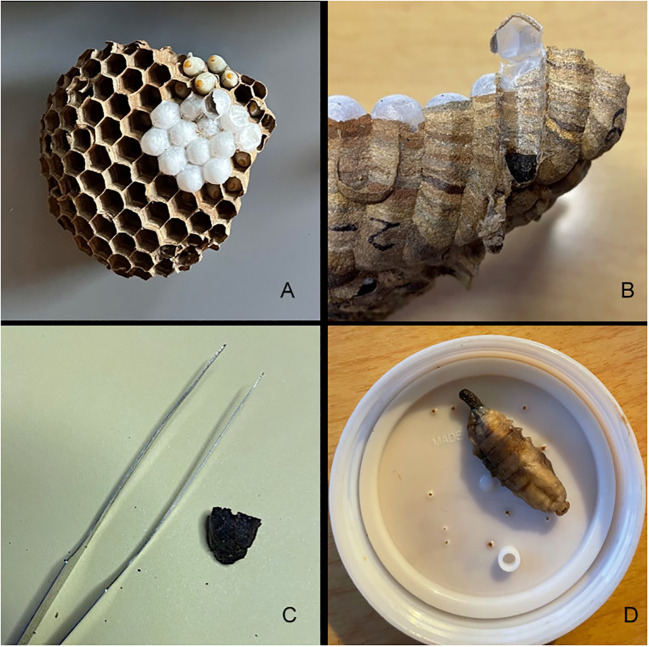
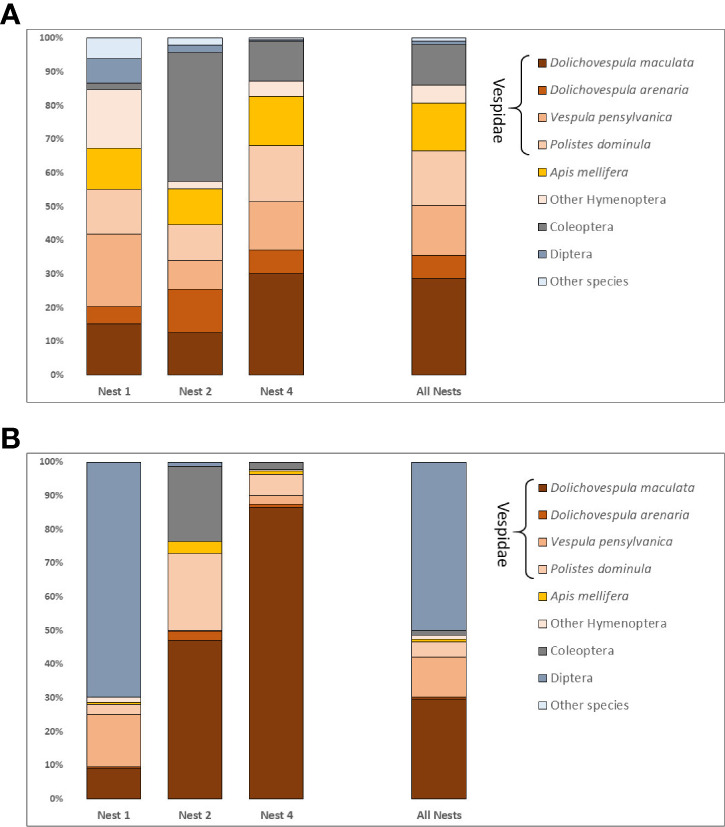
The northern giant hornet, (Hymenoptera: Vespidae), was detected for the first time in North America in 2019. Four nests have since been located and removed in northwestern Washington State as part of an extensive survey and eradication program. This recent introduction into North America has prompted new research on the biology and ecology of to help inform management strategies. In its native range, is known to prey on a variety of insects including the economically important honey bee species and . Although has developed defense mechanisms against attack by , have no such defenses and an entire hive can be quickly destroyed by only a few hornets. In North America the hornet has been observed foraging on paper wasps () and honey bees, but little else is known about prey use in its novel range. To address this knowledge gap, we employed a DNA metabarcoding approach to characterize species detected in larval feces collected from 3 of the 4 Washington nests found to date. Sequences were recovered for 56 species across fourteen orders, of which 36 species were likely prey items and 20 were suspected inquilines. The most frequently detected species were other social Hymenoptera, with , , and present in most samples. All of the species detected, except for , represent new prey records for , with eight families of insects newly associated with giant hornets. These results suggest that in Washington preys on an assortment of insects similar to those documented in its native range, and that this new invader has readily incorporated novel species into its foraging and diet.
北方大黄蜂(膜翅目:胡蜂科)于2019年在北美首次被发现。自那以后,在华盛顿州西北部已定位并移除了四个蜂巢,这是一项广泛的调查和根除计划的一部分。最近这种黄蜂被引入北美,促使人们对其生物学和生态学展开新的研究,以帮助制定管理策略。在其原生范围内,已知它会捕食各种昆虫,包括具有重要经济价值的蜜蜂物种西方蜜蜂和东方蜜蜂。虽然西方蜜蜂已经进化出抵御北方大黄蜂攻击的防御机制,但东方蜜蜂没有这种防御能力,几只北方大黄蜂就能迅速摧毁整个蜂巢。在北美,人们观察到这种黄蜂会捕食造纸胡蜂和蜜蜂,但对于它在新分布范围内的猎物利用情况知之甚少。为了填补这一知识空白,我们采用了DNA宏条形码方法来鉴定从华盛顿州迄今发现的4个蜂巢中的3个蜂巢所采集的幼虫粪便中检测到的物种。在14个目中共鉴定出56个物种的序列,其中36个物种可能是猎物,20个被怀疑是共栖者。最常检测到的物种是其他社会性膜翅目昆虫,大多数样本中都有黄脚胡蜂、金环胡蜂和德国黄胡蜂。除了西方蜜蜂外,所有检测到的物种都是北方大黄蜂的新猎物记录,有8个昆虫科首次与北方大黄蜂相关联。这些结果表明,华盛顿州的北方大黄蜂捕食的昆虫种类与在其原生范围内记录的类似,并且这种新的入侵物种已经很容易地将新物种纳入其觅食和饮食中。