Durmuş Hasan, Gökler Mehmet Enes, Metintaş Selma
Dörtyol District Health Directorate, Hatay, Turkey.
Department of Public Health, Ankara Yildirim Beyazit University, Ankara, Turkey.
J Prev Med Public Health. 2020 Nov;53(6):397-404. doi: 10.3961/jpmph.20.381. Epub 2020 Nov 2.
The objective of this study was to demonstrate the effects of community-based social distancing interventions after the first coronavirus disease 2019 (COVID-19) case in Turkey on the course of the pandemic and to determine the number of prevented cases.
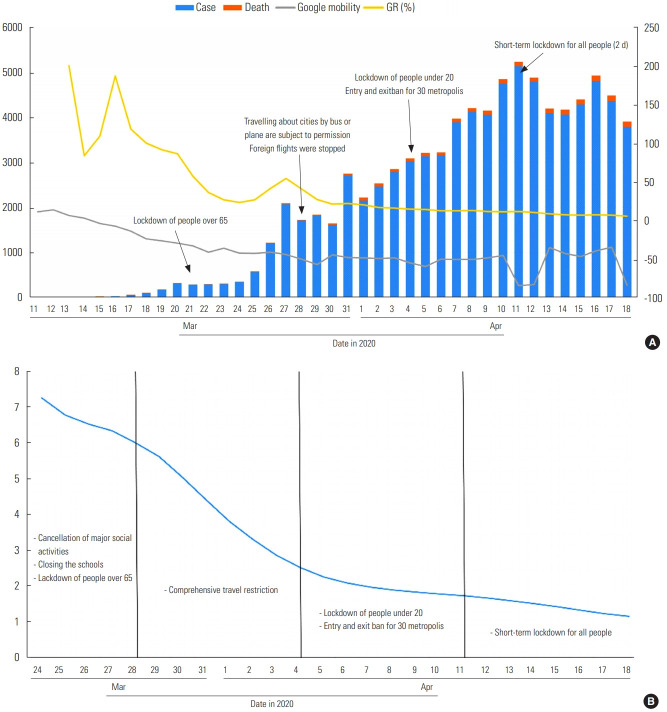
In this ecological study, the interventions implemented in response to the first COVID-19 cases in Turkey were evaluated and the effect of the interventions was demonstrated by calculating the effective reproduction number (Rt) of severe acute respiratory syndrome coro navirus 2 (SARS-CoV-2) when people complied with community-based social distancing rules.
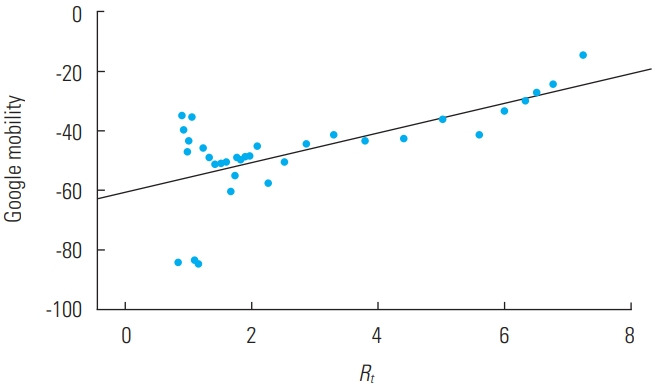
Google mobility scores decreased by an average of 36.33±22.41 points (range, 2.60 to 84.80) and a median of 43.80 points (interquartile range [IQR], 24.90 to 50.25). The interventions caused the calculated Rt to decrease to 1.88 (95% confidence interval, 1.87 to 1.89). The median growth rate was 19.90% (IQR, 10.90 to 53.90). A positive correlation was found between Google mobility data and Rt (r=0.783; p<0.001). The expected number of cases if the growth rate had not changed was predicted according to Google mobility categories, and it was estimated to be 1 381 922 in total. Thus, community-based interventions were estimated to have prevented 1 299 593 people from being infected.
Community-based social distancing interventions significantly decreased the Rt of COVID-19 by reducing human mobility, and thereby prevented many people from becoming infected. Another important result of this study is that it shows health policy-makers that data on human mobility in the community obtained via mobile phones can be a guide for measures to be taken.
本研究的目的是证明土耳其出现首例2019冠状病毒病(COVID-19)病例后基于社区的社交距离干预措施对疫情发展过程的影响,并确定预防病例的数量。
在这项生态学研究中,对土耳其针对首例COVID-19病例实施的干预措施进行了评估,并通过计算当人们遵守基于社区的社交距离规则时严重急性呼吸综合征冠状病毒2(SARS-CoV-2)的有效繁殖数(Rt)来证明干预措施的效果。
谷歌移动性得分平均下降了36.33±22.41分(范围为2.60至84.80),中位数下降了43.80分(四分位间距[IQR]为24.90至50.25)。这些干预措施使计算出的Rt降至1.88(95%置信区间为1.87至1.89)。中位数增长率为19.90%(IQR为10.90至53.90)。发现谷歌移动性数据与Rt之间存在正相关(r = 0.783;p<0.001)。根据谷歌移动性类别预测了如果增长率没有变化时的预期病例数,估计总数为1381922例。因此,估计基于社区的干预措施预防了1299593人感染。
基于社区的社交距离干预措施通过减少人员流动显著降低了COVID-19的Rt,从而防止了许多人被感染。本研究的另一个重要结果是,它向卫生政策制定者表明,通过手机获得的社区人员流动数据可以作为采取措施的指导。