Public Health Department, Istanbul Medical Faculty, Istanbul University, Istanbul, Turkey.
Center for Primary Care and Public Health, Queen Mary University of London, London, United Kingdom.
Front Public Health. 2021 Jan 20;8:575145. doi: 10.3389/fpubh.2020.575145. eCollection 2020.
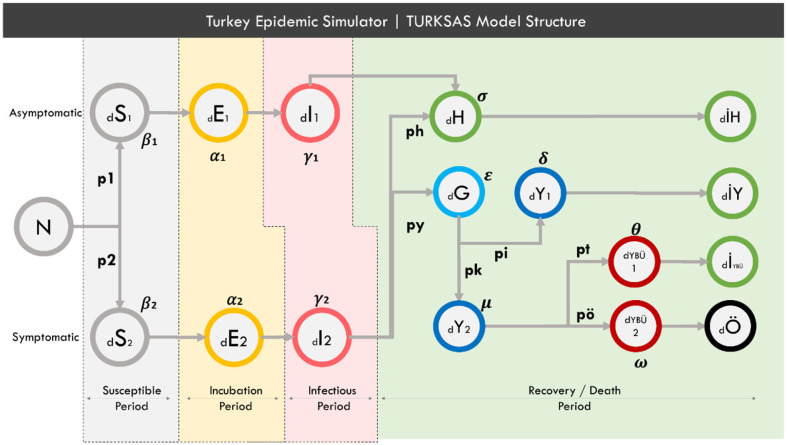
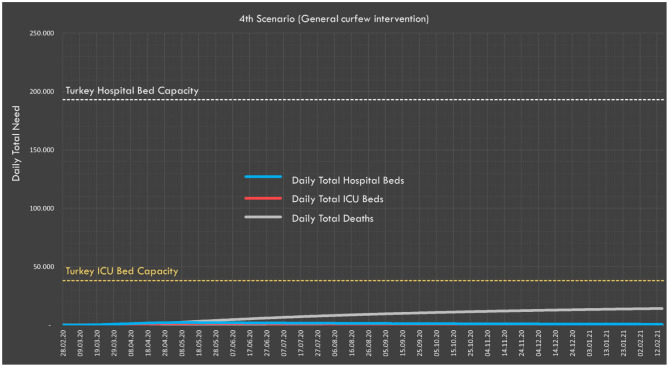
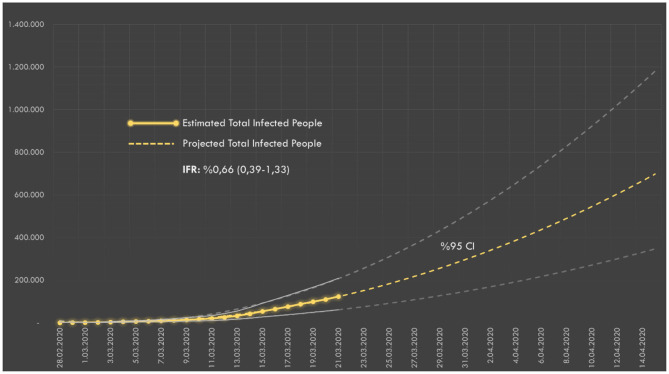
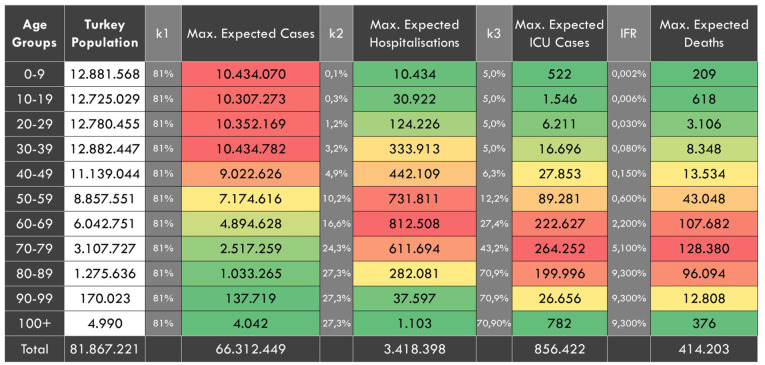
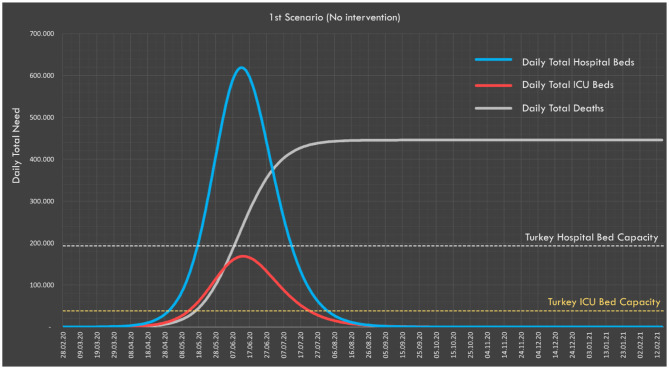
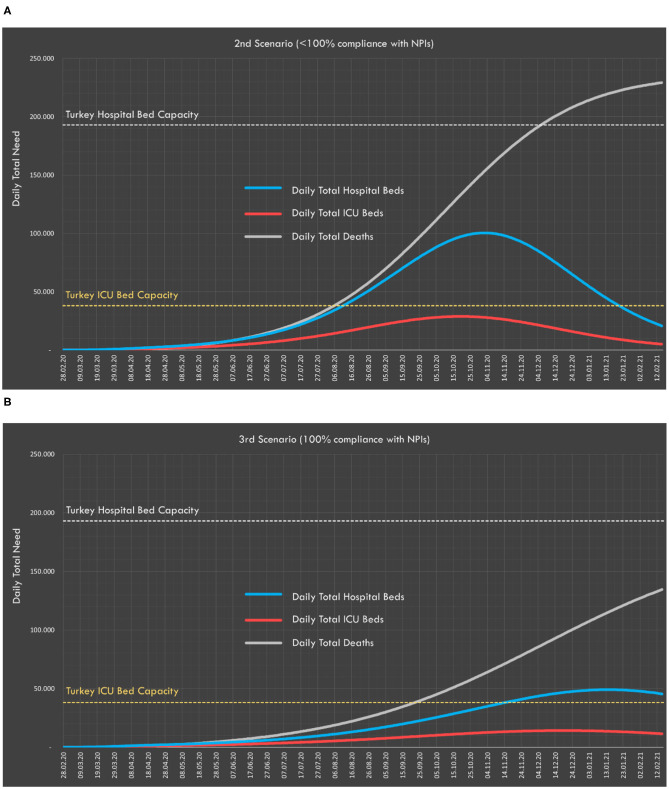
This study aims to estimate the total number of infected people, evaluate the effects of NPIs on the healthcare system, and predict the expected number of cases, deaths, hospitalizations due to COVID-19 in Turkey. This study was carried out according to three dimensions. In the first, the actual number of infected people was estimated. In the second, the expected total numbers of infected people, deaths, hospitalizations have been predicted in the case of no intervention. In the third, the distribution of the expected number of infected people and deaths, and ICU and non-ICU bed needs over time has been predicted a SEIR-based simulator (TURKSAS) in four scenarios. According to the number of deaths, the estimated number of infected people in Turkey on March 21 was 123,030. In the case of no intervention the expected number of infected people is 72,091,595 and deaths is 445,956, the attack rate is 88.1%, and the mortality ratio is 0.54%. The ICU bed capacity in Turkey is expected to be exceeded by 4.4-fold and non-ICU bed capacity by 3.21-fold. In the second and third scenarios compliance with NPIs makes a difference of 94,303 expected deaths. In both scenarios, the predicted peak value of occupied ICU and non-ICU beds remains below Turkey's capacity. Predictions show that around 16 million people can be prevented from being infected and 94,000 deaths can be prevented by full compliance with the measures taken. Modeling epidemics and establishing decision support systems is an important requirement.
本研究旨在估计受感染人数,评估 NPIs 对医疗保健系统的影响,并预测土耳其 COVID-19 的病例、死亡和住院人数。本研究从三个维度进行。在第一个维度,估算实际受感染人数。在第二个维度,在没有干预的情况下,预测预期的总感染人数、死亡人数和住院人数。在第三个维度,基于 SEIR 的模拟器(TURKSAS)预测了在四个场景下受感染人数和死亡人数以及 ICU 和非 ICU 床位需求的分布随时间的变化。根据死亡人数,土耳其在 3 月 21 日的估计受感染人数为 123030 人。在没有干预的情况下,预期感染人数为 72091595 人,死亡人数为 445956 人,发病率为 88.1%,死亡率为 0.54%。土耳其的 ICU 床位容量预计将增加 4.4 倍,非 ICU 床位容量将增加 3.21 倍。在第二和第三个场景中,遵守 NPIs 可以减少 94303 例预期死亡。在这两种情况下,预测的 ICU 和非 ICU 占用床位的峰值仍低于土耳其的容量。预测表明,通过全面遵守所采取的措施,可以预防约 1600 万人感染,预防 94000 人死亡。建立流行病模型和决策支持系统是一个重要要求。