Taylor Stephanie Parks, Short Robert T, Asher Anthony M, Taylor Brice, Beidas Rinad S
Department of Internal Medicine, Atrium Health's Carolinas Medical Center, 1000 Blythe Blvd. MEB 5th Floor, Charlotte, NC, 28203, USA.
University of North Carolina School of Medicine, Chapel Hill, USA.
Implement Sci Commun. 2020 Dec 9;1(1):110. doi: 10.1186/s43058-020-00098-2.
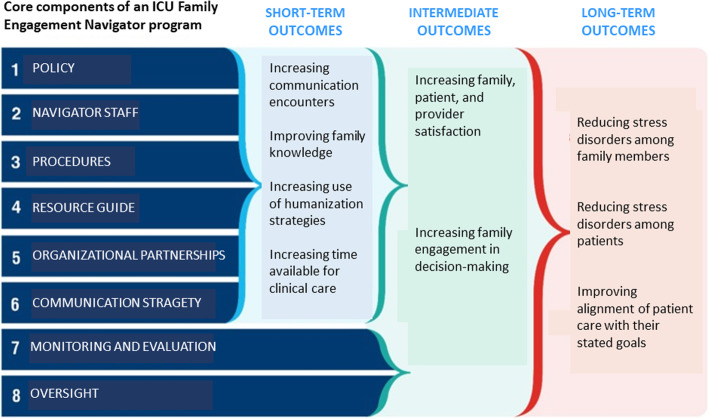
Innovative models of family engagement and support are needed in the intensive care unit (ICU) during times of restricted visitation such as the COVID-19 pandemic. Limited understanding of the factors affecting the uptake and outcomes of different family support models hinders the implementation of best practices. We aimed to conduct a rapid pre-implementation evaluation of stakeholder-perceived facilitators and barriers to design implementation strategies to support a novel program using medical students to facilitate family-centered care in the ICU.
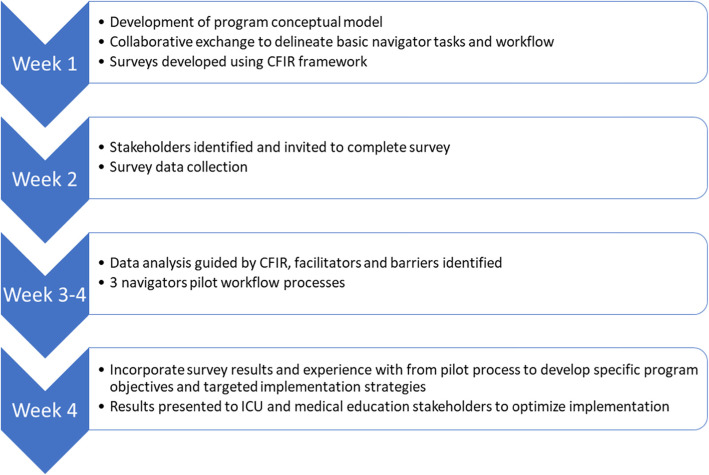
We conducted a 2-step process. In step 1, we gathered contextual data via interview-style open-ended questions sent to clinicians and navigator stakeholders via email. We used electronic data collection due to the physical distancing requirements, the need to prioritize brief data collection for respondent burden, and the need for rapid knowledge gain. A codebook based on the Consolidated Framework for Implementation Research (CFIR), an integrated framework from the field of implementation science, was used to analyze the findings. In step 2, a pilot of the intervention was implemented with 3 navigators over 2 weeks. Implementation strategies were developed to target barriers identified by the pre-implementation evaluation.
Fourteen (70%) of the identified stakeholders responded to the survey. Ten constructs encompassing all five CFIR domains were present in responses as implementation influencers, with the Intervention domain most frequently represented. Through these results and operational feedback from navigators during the pilot period, stakeholders selected multiple implementation strategies: audit and provide feedback, develop educational materials, conduct ongoing training, promote adaptability, assess and redesign workflow, identify and prepare champions, and engage community resources.
We demonstrated how a conceptually based pre-implementation program evaluation can be used to rapidly inform optimal implementation strategies. We report key factors to inform design and implementation strategies for a novel ICU family engagement navigator program that may be useful to others wishing to adopt similar programs.
在诸如新冠疫情等探视受限时期,重症监护病房(ICU)需要创新的家庭参与和支持模式。对影响不同家庭支持模式采用情况及结果的因素了解有限,阻碍了最佳实践的实施。我们旨在对利益相关者所感知的促进因素和障碍进行快速的实施前评估,以设计实施策略,支持一项利用医学生在ICU中促进以家庭为中心护理的新项目。
我们分两步进行。第一步,通过电子邮件向临床医生和导航员利益相关者发送访谈式开放式问题,收集背景数据。由于需要保持社交距离、需优先进行简短的数据收集以减轻受访者负担以及需要快速获取知识,我们采用了电子数据收集方式。基于实施研究综合框架(CFIR)(实施科学领域的一个综合框架)的编码手册用于分析研究结果。第二步,在两周内对3名导航员实施了干预试点。针对实施前评估确定的障碍制定了实施策略。
14名(70%)已识别的利益相关者回复了调查。回复中作为实施影响因素出现了涵盖CFIR所有五个领域的10个构建模块,其中干预领域出现的频率最高。通过这些结果以及试点期间导航员的操作反馈,利益相关者选择了多种实施策略:审核并提供反馈、开发教育材料、进行持续培训、促进适应性、评估并重新设计工作流程、识别并培养支持者以及利用社区资源。
我们展示了基于概念的实施前项目评估如何能够快速为最佳实施策略提供信息。我们报告了关键因素,以为一项新的ICU家庭参与导航员项目的设计和实施策略提供信息,这可能对其他希望采用类似项目的人有用。