Department of Psychosomatic Medicine and Psychotherapy, University of Göttingen Medical Center, Von-Siebold-Str. 5, 37075, Göttingen, Germany.
German Center for Cardiovascular Research (DZHK), Partner Site Göttingen, Göttingen, Germany.
BMC Cardiovasc Disord. 2020 Dec 10;20(1):520. doi: 10.1186/s12872-020-01810-9.
Coronary heart disease (CHD) is the leading cause of death and years of life lost worldwide. While effective treatments are available for both acute and chronic disease stages there are unmet needs for effective interventions to support patients in health behaviors required for secondary prevention. Psychosocial distress is a common comorbidity in patients with CHD and associated with substantially reduced health-related quality of life (HRQoL), poor health behavior, and low treatment adherence.
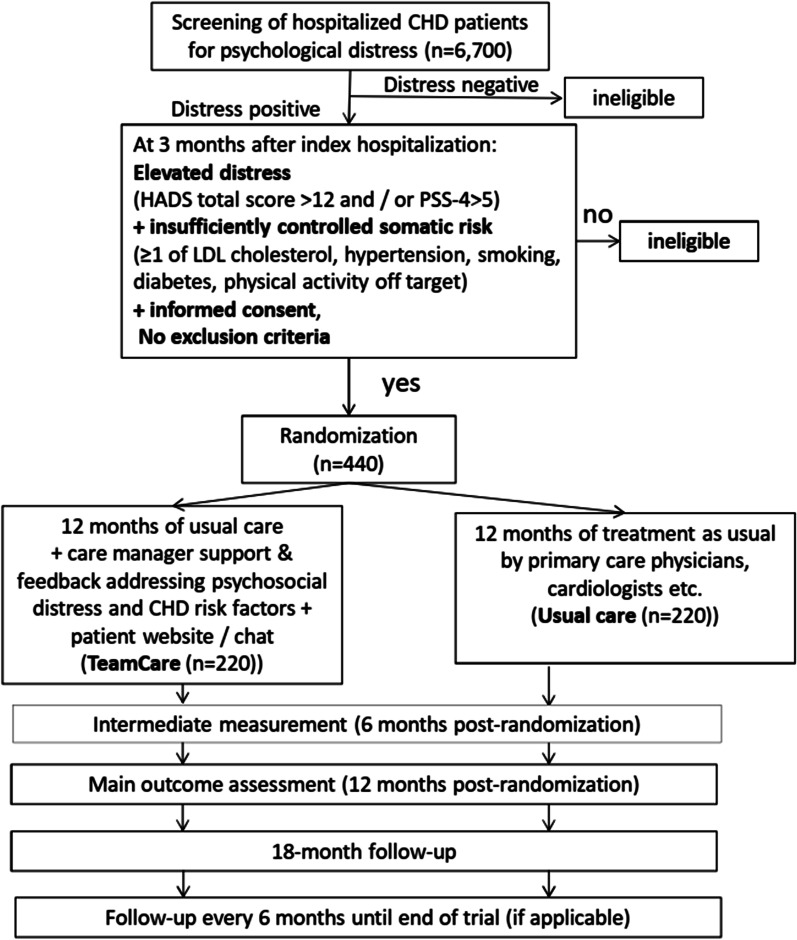
In a confirmatory, randomized, controlled, two-arm parallel group, multicenter behavioral intervention trial we will randomize 440 distressed CHD patients with at least one insufficiently controlled cardiac risk factor to either their physicians' usual care (UC) or UC plus 12-months of blended collaborative care (TeamCare = TC). Trained nurse care managers (NCM) will proactively support patients to identify individual sources of distress and risk behaviors, establish a stepwise treatment plan to improve self-help and healthy behavior, and actively monitor adherence and progress. Additional e-health resources are available to patients and their families. Intervention fidelity is ensured by a treatment manual, an electronic patient registry, and a specialist team regularly supervising NCM via videoconferences and recommending protocol and guideline-compliant treatment adjustments as indicated. Recommendations will be shared with patients and their physicians who remain in charge of patients' care. Since HRQoL is a recommended outcome by both, several guidelines and patient preference we chose a ≥ 50% improvement over baseline on the HeartQoL questionnaire at 12 months as primary outcome. Our primary hypothesis is that significantly more patients receiving TC will meet the primary outcome criterion compared to the UC group. Secondary hypotheses will evaluate improvements in risk factors, psychosocial variables, health care utilization, and durability of intervention effects over 18-30 months of follow-up.
TEACH is the first study of a blended collaborative care intervention simultaneously addressing distress and medical CHD risk factors conducted in cardiac patients in a European health care setting. If proven effective, its results can improve long-term chronic care of this vulnerable patient group and may be adapted for patients with other chronic conditions.
German Clinical Trials Register, DRKS00020824, registered on 4 June, 2020; https://www.drks.de/drks_web/navigate.do?navigationId=trial.HTML&TRIAL_ID=DRKS00020824.
冠心病(CHD)是全球范围内导致死亡和生命损失的主要原因。虽然有有效的治疗方法可用于急性和慢性疾病阶段,但仍需要有效的干预措施来支持患者采取二级预防所需的健康行为。心理社会困扰是冠心病患者的常见合并症,与健康相关生活质量(HRQoL)显著降低、不良健康行为和低治疗依从性有关。
在一项确认性、随机、对照、双臂平行分组、多中心行为干预试验中,我们将随机分配 440 名患有至少一种心脏风险因素控制不充分的有心理压力的 CHD 患者,分为他们的医生的常规护理(UC)或 UC 加 12 个月的混合协作护理(TeamCare=TC)。经过培训的护士护理经理(NCM)将积极支持患者识别个人压力源和风险行为,制定逐步改善自助和健康行为的治疗计划,并积极监测依从性和进展。患者及其家属可获得额外的电子健康资源。通过治疗手册、电子患者登记册以及专家团队定期通过视频会议监督 NCM 并根据需要建议符合方案和指南的治疗调整,从而确保干预的一致性。建议将与患者及其医生共享,患者及其医生仍负责患者的护理。由于 HRQoL 是两个指南和患者偏好的推荐的结果,我们选择了在 12 个月时使用 HeartQoL 问卷测量,将基线提高≥50%作为主要结局。我们的主要假设是,与 UC 组相比,接受 TC 的患者将有更多的患者达到主要结局标准。次要假设将评估 18-30 个月随访期间危险因素、心理社会变量、医疗保健利用和干预效果的持久性的改善。
TEACH 是在欧洲医疗环境中针对心脏患者进行的同时解决心理困扰和医疗 CHD 风险因素的混合协作护理干预的第一项研究。如果证明有效,其结果可以改善这一脆弱患者群体的长期慢性护理,并可能适用于其他慢性疾病患者。
德国临床试验注册处,DRKS00020824,于 2020 年 6 月 4 日注册;https://www.drks.de/drks_web/navigate.do?navigationId=trial.HTML&TRIAL_ID=DRKS00020824。