Satriano Alessandro, Afzal Yarmaghan, Sarim Afzal Muhammad, Fatehi Hassanabad Ali, Wu Cody, Dykstra Steven, Flewitt Jacqueline, Feuchter Patricia, Sandonato Rosa, Heydari Bobak, Merchant Naeem, Howarth Andrew G, Lydell Carmen P, Khan Aneal, Fine Nowell M, Greiner Russell, White James A
Stephenson Cardiac Imaging Center, Calgary, AB, Canada.
Division of Cardiology, School of Medicine, University of Calgary, Calgary, AB, Canada.
Front Cardiovasc Med. 2020 Nov 11;7:584727. doi: 10.3389/fcvm.2020.584727. eCollection 2020.
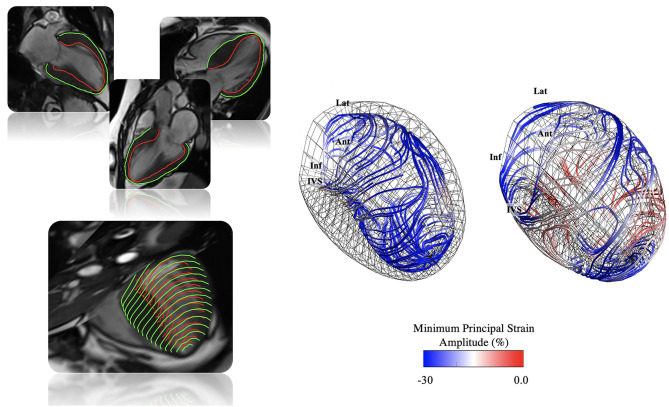
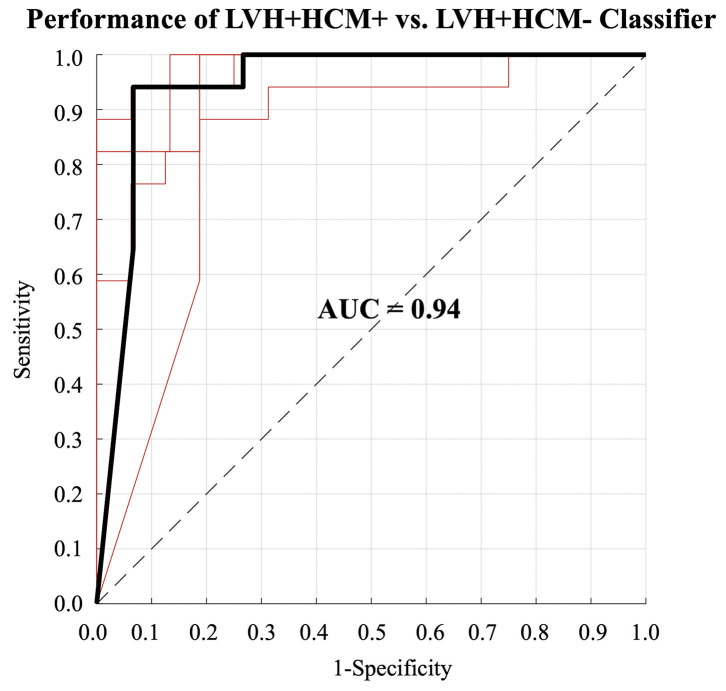
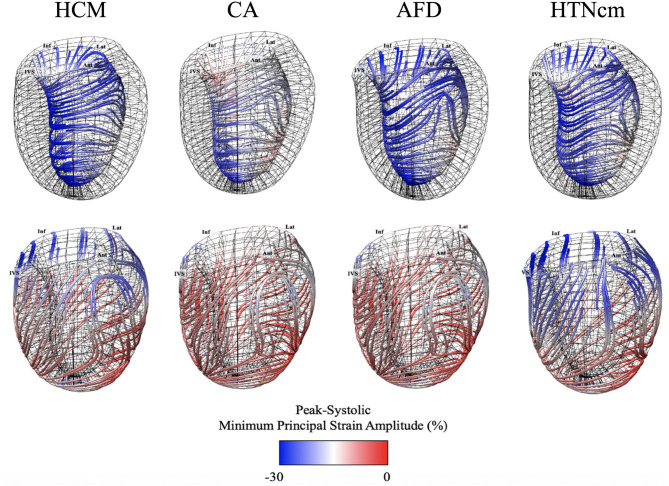
The diagnosis of cardiomyopathy states may benefit from machine-learning (ML) based approaches, particularly to distinguish those states with similar phenotypic characteristics. Three-dimensional myocardial deformation analysis (3D-MDA) has been validated to provide standardized descriptors of myocardial architecture and deformation, and may therefore offer appropriate features for the training of ML-based diagnostic tools. We aimed to assess the feasibility of automated disease diagnosis using a neural network trained using 3D-MDA to discriminate hypertrophic cardiomyopathy (HCM) from its mimic states: cardiac amyloidosis (CA), Anderson-Fabry disease (AFD), and hypertensive cardiomyopathy (HTNcm). 3D-MDA data from 163 patients (mean age 53.1 ± 14.8 years; 68 females) with left ventricular hypertrophy (LVH) of known etiology was provided. Source imaging data was from cardiac magnetic resonance (CMR). Clinical diagnoses were as follows: 85 HCM, 30 HTNcm, 30 AFD, and 18 CA. A fully-connected-layer feed-forward neural was trained to distinguish HCM vs. other mimic states. Diagnostic performance was compared to threshold-based assessments of volumetric and strain-based CMR markers, in addition to baseline clinical patient characteristics. Threshold-based measures provided modest performance, the greatest area under the curve (AUC) being 0.70. Global strain parameters exhibited reduced performance, with AUC under 0.64. A neural network trained exclusively from 3D-MDA data achieved an AUC of 0.94 (sensitivity 0.92, specificity 0.90) when performing the same task. This study demonstrates that ML-based diagnosis of cardiomyopathy states performed exclusively from 3D-MDA is feasible and can distinguish HCM from mimic disease states. These findings suggest strong potential for computer-assisted diagnosis in clinical practice.
心肌病状态的诊断可能受益于基于机器学习(ML)的方法,特别是用于区分那些具有相似表型特征的状态。三维心肌变形分析(3D-MDA)已被验证可提供心肌结构和变形的标准化描述符,因此可能为基于ML的诊断工具的训练提供合适的特征。我们旨在评估使用基于3D-MDA训练的神经网络自动诊断疾病的可行性,以区分肥厚型心肌病(HCM)与其模仿状态:心脏淀粉样变性(CA)、安德森-法布里病(AFD)和高血压性心肌病(HTNcm)。提供了163例已知病因的左心室肥厚(LVH)患者(平均年龄53.1±14.8岁;68名女性)的3D-MDA数据。源成像数据来自心脏磁共振成像(CMR)。临床诊断如下:85例HCM、30例HTNcm、30例AFD和18例CA。训练了一个全连接层前馈神经网络以区分HCM与其他模仿状态。除了基线临床患者特征外,还将诊断性能与基于阈值的容积和应变CMR标记评估进行了比较。基于阈值的测量表现一般,曲线下最大面积(AUC)为0.70。整体应变参数表现较差,AUC低于0.64。当执行相同任务时,仅从3D-MDA数据训练的神经网络的AUC为0.94(敏感性0.92,特异性0.90)。这项研究表明,仅从3D-MDA进行基于ML的心肌病状态诊断是可行的,并且可以区分HCM与模仿疾病状态。这些发现表明计算机辅助诊断在临床实践中有很大潜力。