Bello Ghalib A, Dawes Timothy J W, Duan Jinming, Biffi Carlo, de Marvao Antonio, Howard Luke S G E, Gibbs J Simon R, Wilkins Martin R, Cook Stuart A, Rueckert Daniel, O'Regan Declan P
MRC London Institute of Medical Sciences, Imperial College London,UK.
National Heart and Lung Institute, Imperial College London, UK.
Nat Mach Intell. 2019 Feb 11;1:95-104. doi: 10.1038/s42256-019-0019-2.
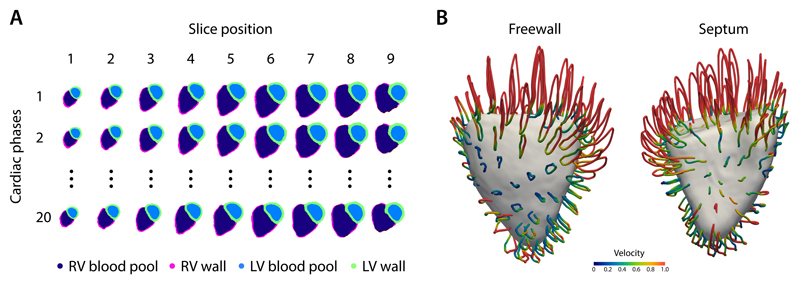
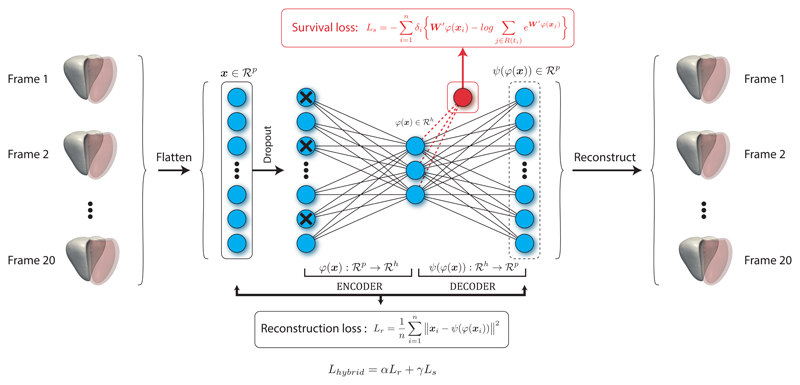
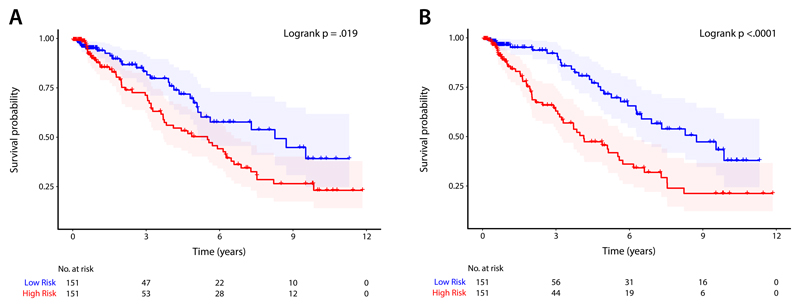
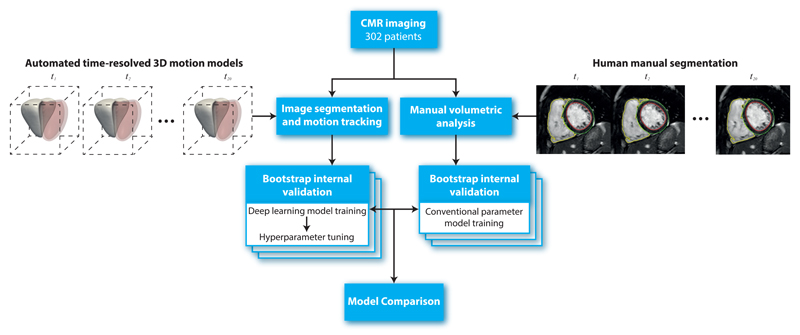
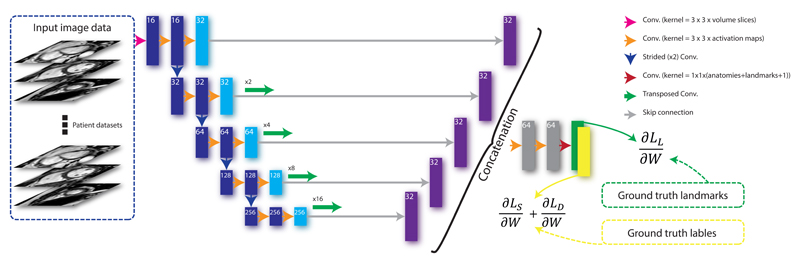
Motion analysis is used in computer vision to understand the behaviour of moving objects in sequences of images. Optimising the interpretation of dynamic biological systems requires accurate and precise motion tracking as well as efficient representations of high-dimensional motion trajectories so that these can be used for prediction tasks. Here we use image sequences of the heart, acquired using cardiac magnetic resonance imaging, to create time-resolved three-dimensional segmentations using a fully convolutional network trained on anatomical shape priors. This dense motion model formed the input to a supervised denoising autoencoder (4D), which is a hybrid network consisting of an autoencoder that learns a task-specific latent code representation trained on observed outcome data, yielding a latent representation optimised for survival prediction. To handle right-censored survival outcomes, our network used a Cox partial likelihood loss function. In a study of 302 patients the predictive accuracy (quantified by Harrell's C-index) was significantly higher (p = .0012) for our model C=0.75 (95% CI: 0.70 - 0.79) than the human benchmark of C=0.59 (95% CI: 0.53 - 0.65). This work demonstrates how a complex computer vision task using high-dimensional medical image data can efficiently predict human survival.
运动分析在计算机视觉中用于理解图像序列中移动物体的行为。优化动态生物系统的解释需要精确且准确的运动跟踪以及高维运动轨迹的有效表示,以便将其用于预测任务。在这里,我们使用通过心脏磁共振成像获取的心脏图像序列,利用基于解剖形状先验训练的全卷积网络创建时间分辨的三维分割。这种密集运动模型构成了一个有监督去噪自编码器(4D)的输入,该自编码器是一个混合网络,由一个自编码器组成,它学习基于观察到的结果数据训练的特定任务潜在代码表示,产生针对生存预测优化的潜在表示。为了处理右删失生存结果,我们的网络使用了Cox偏似然损失函数。在对302名患者的研究中,我们的模型C = 0.75(95%置信区间:0.70 - 图0.79)的预测准确性(通过Harrell氏C指数量化)显著高于人类基准C = 0.59(95%置信区间:0.53 - 0.65)(p = 0.0012)。这项工作展示了使用高维医学图像数据的复杂计算机视觉任务如何能够有效地预测人类生存。