Akcay Melek, Etiz Durmus, Celik Ozer
Department of Radiation Oncology, Medical Faculty of Osmangazi University, Eskişehir, Turkey.
Department of Mathematics-Computer, Eskisehir Osmangazi University, Eskişehir, Turkey.
Adv Radiat Oncol. 2020 Jul 29;5(6):1179-1187. doi: 10.1016/j.adro.2020.07.007. eCollection 2020 Nov-Dec.
Radical surgery is the most important treatment modality in gastric cancer. Preoperative or postoperative radiation therapy (RT) and perioperative chemotherapy are the treatment options that should be added to surgery. This study aimed to evaluate the overall survival (OS) and recurrence patterns by machine learning in gastric cancer cases undergoing RT.
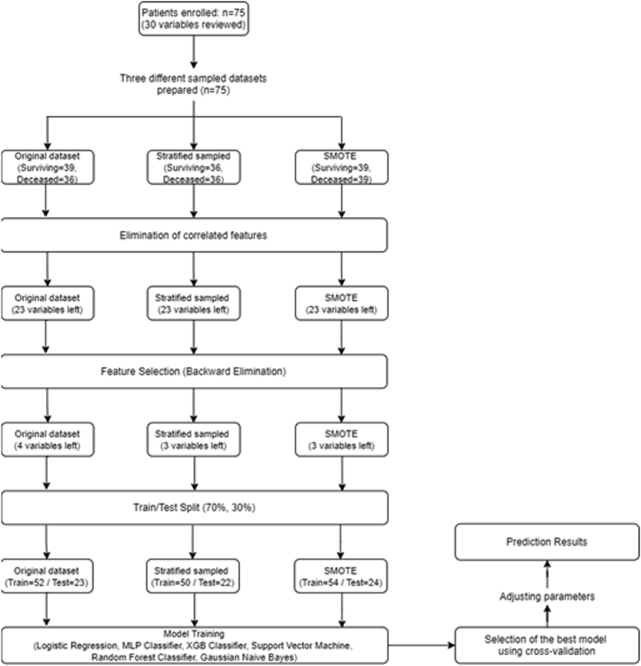
Between 2012 and 2019, the OS and recurrence patterns of 75 gastric cancer cases receiving RT ± chemotherapy at the Department of Radiation Oncology were evaluated by machine learning. Logistic regression, multilayer perceptron, XGBoost, support vector classification, random forest, and Gaussian Naive Bayes (GNB) algorithms were used to predict OS, hematogenous distant metastases, and peritoneal metastases. After the correlation analysis, the backward feature selection was performed as the variable selection method, and the variables with values less than .005 were selected.
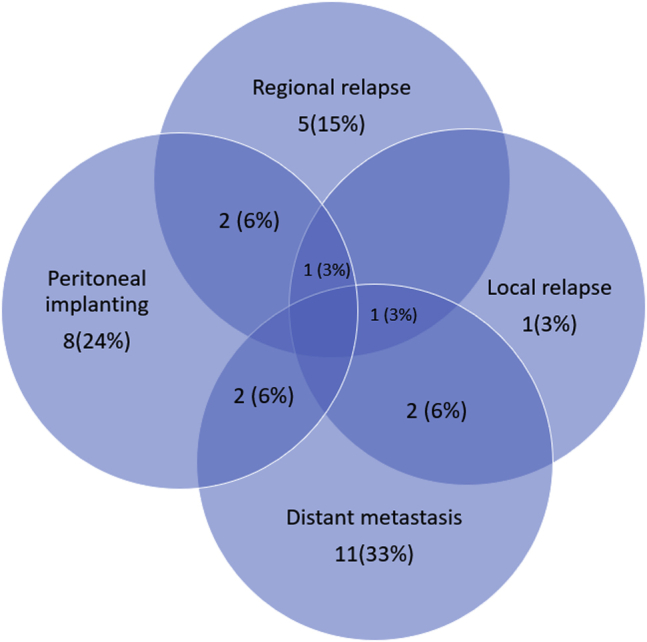
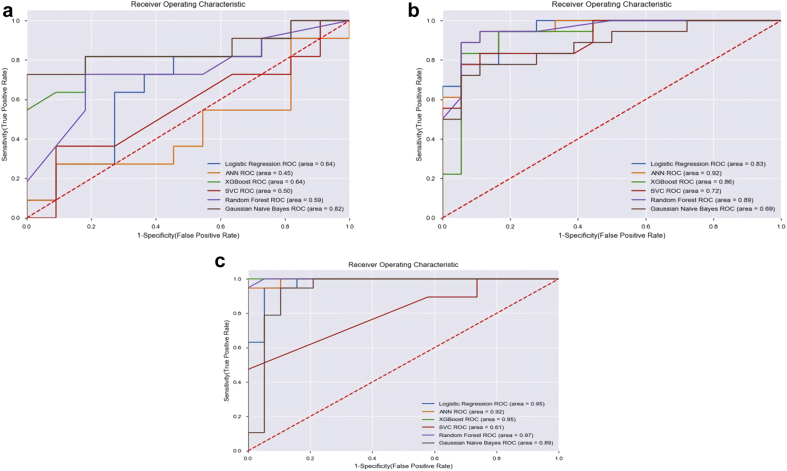
Over the median 23-month follow-up, recurrence was seen in 33 cases, and 36 patients died. The median OS was 23 (min: 7; max: 82) months, and the disease-free survival was 18 (min: 5, max: 80) months. The most common recurrence pattern was hematogenous distant metastasis, followed by peritoneal metastasis. In this study, the most successful algorithms in the prediction of OS, distant metastases, and peritoneal metastases were found to be GNB with an accuracy of 81% (95% confidence interval [CI], 0.65-0.97, area under the curve [AUC]: 0.89), XGBoost with 86% accuracy (95% CI, 0.74-0.97, AUC: 0.86), and random forest with 97% accuracy (95% CI, 0.92-1.00, AUC: 0.97), respectively.
In gastric cancer, GNB, XGBoost, and random forest algorithms were determined to be the most successful algorithms for predicting OS, distant metastases, and peritoneal metastases, respectively. To determine the most accurate algorithm and perhaps make personalized treatments applicable, more precise machine learning studies are needed with an increased number of cases in the coming years.
根治性手术是胃癌最重要的治疗方式。术前或术后放射治疗(RT)以及围手术期化疗是应添加到手术中的治疗选择。本研究旨在通过机器学习评估接受RT的胃癌病例的总生存期(OS)和复发模式。
2012年至2019年间,对放射肿瘤学部门75例接受RT±化疗的胃癌病例的OS和复发模式进行机器学习评估。采用逻辑回归、多层感知器、XGBoost、支持向量分类、随机森林和高斯朴素贝叶斯(GNB)算法预测OS、血行远处转移和腹膜转移。相关性分析后,采用向后特征选择作为变量选择方法,选择值小于0.005的变量。
在中位23个月的随访期内,33例出现复发,36例患者死亡。中位OS为23(最小值:7;最大值:82)个月,无病生存期为18(最小值:5,最大值:80)个月。最常见的复发模式是血行远处转移,其次是腹膜转移。在本研究中,预测OS、远处转移和腹膜转移最成功的算法分别是GNB,准确率为81%(95%置信区间[CI],0.65 - 0.97,曲线下面积[AUC]:0.89);XGBoost,准确率为86%(95%CI,0.74 - 0.97,AUC:0.86);随机森林,准确率为97%(95%CI,0.92 - 1.00,AUC:0.97)。
在胃癌中,GNB、XGBoost和随机森林算法分别被确定为预测OS、远处转移和腹膜转移最成功的算法。为了确定最准确的算法并使个性化治疗可能得以应用,未来几年需要进行更多病例的更精确的机器学习研究。